US Data Center Power Demand Projected to More Than Double by 2027
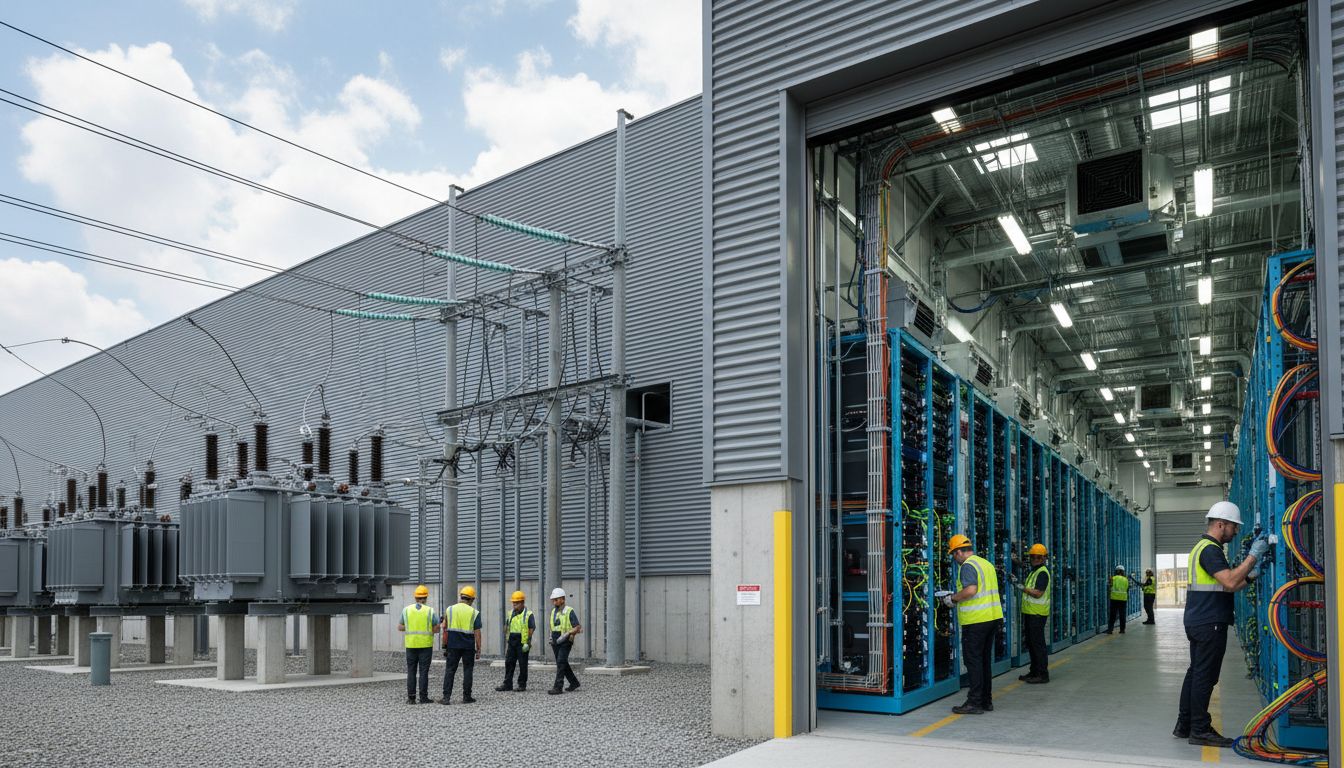
US data center power demand is on track to more than double within just two years, according to Goldman Sachs Research. The firm forecasts demand climbing from roughly 31 gigawatts (GW) in 2025 to 41 GW in 2026 and 66 GW by 2027. The primary driver behind this surge is the ongoing buildout of AI infrastructure across the country.
Alongside this rise, data centers' share of US peak summer electricity demand is projected to climb from about 4.1% to 8.5% over the same period. Many observers note that a shift of this scale, if it materializes as forecast, would represent one of the more significant changes to the US electricity demand picture in recent memory.
How the Forecast Accounts for Delays and Cancellations
Goldman Sachs builds a degree of caution directly into its model. Historically, only about 72% of data centers scheduled for activation within a given four-quarter window have actually gone online on time. To reflect this, the forecast discounts scheduled capacity additions, applying roughly a 60% completion assumption for next-year capacity and about 50% for capacity scheduled two years out.
This matters because scheduled additions are accelerating sharply. Goldman Sachs points to 13.6 GW of capacity scheduled for 2026 and 36.3 GW for 2027, compared with just 6.4 GW and 8.5 GW actually realized in 2024 and 2025, respectively. The firm frames this as carrying meaningful uncertainty in both directions, meaning actual outcomes could land notably higher or lower than the headline projection.
Independent Data Points to the Same Trend
The Goldman Sachs projection does not stand alone. The US Energy Information Administration's Short-Term Energy Outlook separately projects record US electricity demand in both 2026 and 2027. The EIA forecasts commercial electricity sales of approximately 1,528 billion kilowatt-hours and industrial sales of roughly 1,065 billion kilowatt-hours in 2026 alone.
A recurring observation among analysts is that when independent forecasting methodologies converge on a similar directional trend, it strengthens the case that the underlying demand growth is structural rather than speculative noise.
Grid Reliability Risk Varies Sharply by Region
Not all regions face the same exposure. Forecasts flag the Mid-Atlantic, Mid-Continent, and Northwest markets as carrying elevated reliability risk relative to the national picture. A recurring consumer and industry concern is that a national aggregate figure may mask much more acute localized strain.
Texas offers a concrete example of this dynamic. The state paused approvals for energizing large-load and crypto-mining facilities pending an audit by the Electric Reliability Council of Texas, after data centers reportedly comprised roughly 90% of a 474 gigawatt interconnection request queue in the state. ERCOT's review is expected to shape how the state handles similar requests going forward.
Grid Operators Are Already Responding
Regulatory and market responses suggest grid operators are treating this as an active concern rather than a distant hypothetical. PJM Interconnection has proposed rules that would require large new power users to contract for new generation capacity or face curtailment during periods of stress.
Separately, the North American Electric Reliability Corporation has reported multiple incidents in 2025 involving more than 1,000 megawatts of data center load unexpectedly disconnecting during transmission faults. Many observers view these episodes, tracked by NERC, as an early signal of the operational challenges that rapid, concentrated load growth can introduce.
Separating Real Demand From 'Ghost Demand'
A recurring theme among analysts is the difficulty of distinguishing genuine data center demand from speculative or duplicate interconnection requests, sometimes referred to informally as "ghost demand." This distinction is not merely academic: overstated headline capacity figures could complicate planning for utilities, regulators, and infrastructure investors alike.
It remains an open question how much of the reported interconnection queue reflects projects that will ultimately be built versus requests that may be withdrawn, delayed, or duplicated across multiple sites.
What This Means Going Forward
If the buildout proceeds broadly as forecast, some analysts suggest there could be implications for electricity prices and grid stability, particularly in regions where generation capacity additions struggle to keep pace with demand growth. However, uncertainty is described as a defining feature of this forecast rather than a flaw awaiting resolution.
Continued monitoring of actions by regional grid operators, including ERCOT, PJM, and NERC, is likely to offer some of the clearest early indicators of how this trend actually unfolds over the next two to three years.