The Technology Powering Hypersonic Flight
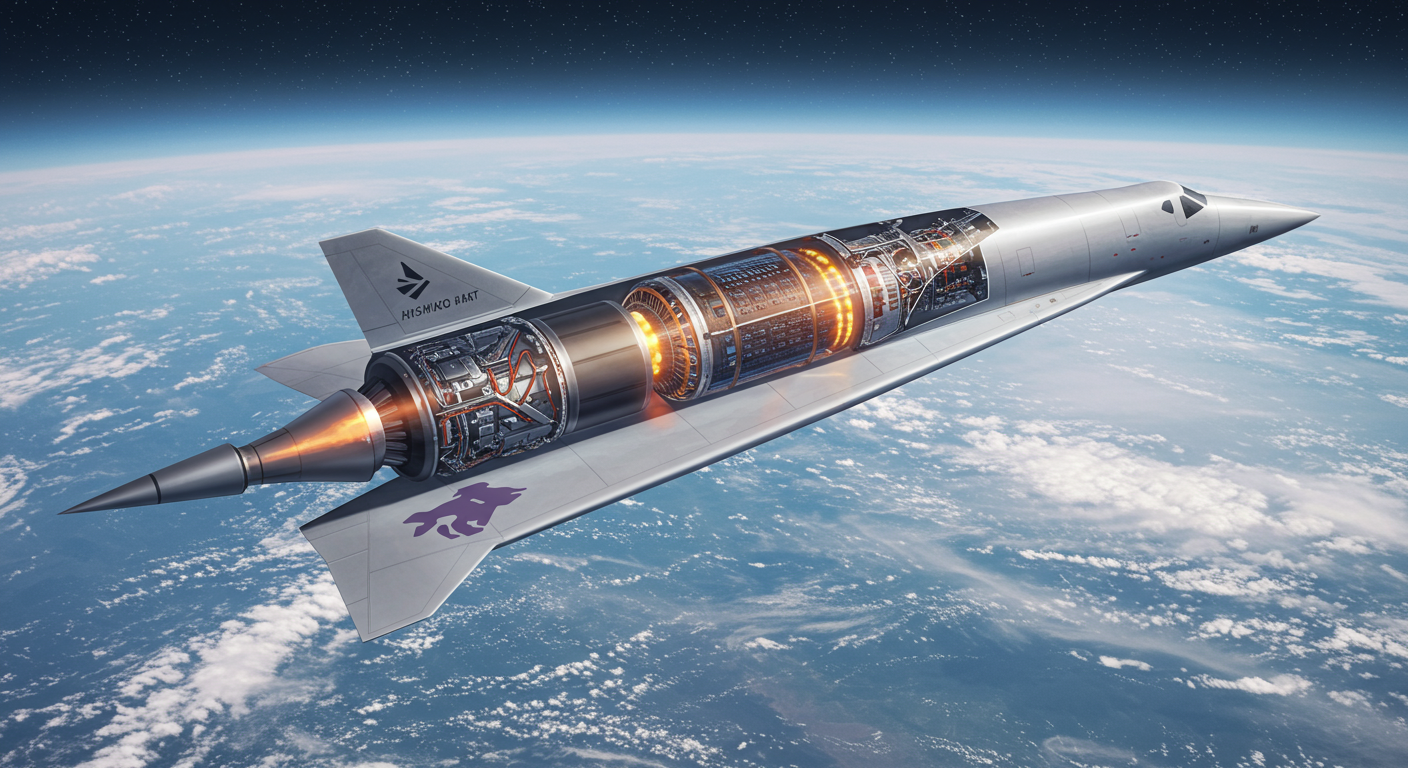
Hypersonic flight usually refers to sustained travel at Mach 5 or faster, but the real story is not just speed. At that point, the air around a vehicle behaves differently enough that engineers must treat propulsion, heating, aerodynamics, and control as a single, connected problem. A craft that can briefly accelerate to hypersonic velocity is not necessarily one that can survive, steer, and operate effectively in that regime.
That is what makes hypersonic technology so demanding. The challenge is not only to go fast, but to do so while managing intense heat, powerful shock waves, changing pressure loads, and very small margins for error.
What Counts as Hypersonic Flight
The common benchmark for hypersonic flight is Mach 5 or higher. Below that range, aircraft and missiles may still face major aerodynamic and thermal stresses, but above it the physics become more extreme. Shock waves strengthen, temperatures rise sharply from air compression, and even the chemistry of the airflow can begin to matter.
That is why hypersonic flight is usually treated as a distinct flight regime rather than simply a faster version of supersonic travel. The vehicle must keep its structure intact, remain aerodynamically stable, and preserve control authority while moving through an environment that grows increasingly hostile as speed rises.
Why Hypersonic Speed Is So Hard to Achieve
One of the biggest obstacles is aerodynamic heating. As a vehicle moves through the atmosphere at extreme speed, the air in front of it is compressed so intensely that temperatures around the surface can climb high enough to damage structural components, sensors, and control surfaces. This is often described casually as friction, but compression heating is a major part of the problem.
Shock waves also become more consequential. They affect drag, lift, pressure distribution, and stability, and they can interact with the shape of the vehicle in ways that make design choices highly sensitive. A change intended to improve performance in one area may create new heating or control problems somewhere else.
Because of that, hypersonic design is fundamentally a systems challenge. Propulsion influences vehicle shape. Shape influences heating. Heating affects materials. Materials affect mass, and mass affects controllability and range. No major subsystem can be designed in isolation.
The Two Main Hypersonic Vehicle Approaches
Most hypersonic concepts fall into two broad categories: boost-glide vehicles and hypersonic cruise vehicles. Both can reach hypersonic speed, but they rely on different technology stacks.
Boost-glide systems use rocket propulsion to accelerate a vehicle to very high speed and altitude. After that boost phase, the vehicle glides unpowered or semi-unpowered through the atmosphere at hypersonic velocity. In this approach, the rocket does the work of reaching the regime, while the vehicle’s aerodynamic design and control systems determine how effectively it can maneuver and survive afterward.
Hypersonic cruise systems aim to sustain high-speed atmospheric flight using air-breathing propulsion, most notably scramjets. Instead of carrying all of their oxidizer like a rocket, they rely on oxygen from the atmosphere. That can improve efficiency in some flight profiles, but it also creates a much more complex engine environment.
Propulsion: Engines That Work Above Mach 5
Rockets are the most established path to hypersonic speed. They generate thrust by carrying both fuel and oxidizer, allowing them to operate independently of the atmosphere. That makes them highly effective for boost phases and for reaching extreme velocity quickly. The tradeoff is that rockets are generally less efficient than air-breathing systems for sustained atmospheric cruise because they must carry all reaction mass onboard.
Scramjets, or supersonic-combustion ramjets, are one of the signature technologies associated with hypersonic cruise. Unlike a conventional jet engine, a scramjet has no rotating compressor. Instead, it uses the vehicle’s forward speed to compress incoming air. Unlike a ramjet, it allows the airflow to remain supersonic through the combustor.
That sounds elegant in principle, but it is exceptionally hard in practice. Fuel must mix with rapidly moving air, ignite, and release useful energy in milliseconds. The engine has to produce enough thrust to overcome drag while operating within a narrow and punishing envelope of pressure, temperature, and airflow conditions.
This is why many hypersonic concepts use rockets for initial acceleration even when their long-range goal involves air-breathing propulsion. Scramjets are not a simple replacement for rockets. They are a different solution with different tradeoffs in range, complexity, efficiency, and operational profile.
Aerodynamic Design and Vehicle Shape
At hypersonic speed, shape is not just about reducing drag. Vehicle geometry affects how shock waves form, where heat builds up, how lift is generated, and whether the craft remains stable. Even relatively subtle changes to contours or leading edges can significantly alter performance.
Some designs use very sharp leading edges to reduce drag and better manage airflow, but those same sharp surfaces can experience especially severe heating. Other concepts use blended shapes to distribute loads and improve stability. Waverider-style designs, discussed by NASA and other aerospace researchers, illustrate how tightly aerodynamics and shock behavior are linked in this regime.
The central compromise is that the most aerodynamically efficient shape may not be the most survivable one. Designers have to balance speed and lift against material limits and thermal stress.
Thermal Protection and High-Temperature Materials
No hypersonic vehicle works without serious thermal protection. Surface temperatures can become extreme enough to weaken load-bearing structures, degrade electronics, or impair sensors. The heat problem is not limited to the outer skin; it can propagate into the vehicle and affect systems throughout the airframe.
To cope with this, engineers use combinations of high-temperature ceramics, carbon-carbon materials, advanced composites, specialized alloys, and protective coatings. Some materials are selected because they can carry structural loads under heat. Others are used mainly as thermal barriers that protect the structure beneath them.
This distinction matters. A structural material must preserve strength and stiffness while exposed to high temperatures and dynamic forces. A protective layer may be designed primarily to insulate, ablate, or shield. In many hypersonic systems, performance depends on how well those layers and structures work together rather than on any single miracle material.
Guidance, Navigation, and Control at Extreme Speed
Even if propulsion and materials problems are solved, a hypersonic vehicle still has to know where it is going and remain controllable while getting there. That is difficult because aerodynamic forces can change quickly, thermal conditions can stress sensors and actuators, and the vehicle has very little time to correct for disturbances.
At these speeds, small errors can quickly become large deviations. Guidance and navigation systems must process data fast enough to keep up with the flight environment, while onboard computers and control surfaces have to function reliably under severe thermal and pressure loads.
This makes precision especially important. Maintaining a stable trajectory is not simply a matter of steering harder. It requires a vehicle architecture in which sensing, computation, actuation, and aerodynamic response are all closely matched.
Why Hypersonic Systems Are Built as Integrated Platforms
Hypersonic vehicles are often discussed in terms of standout technologies such as scramjets or heat-resistant materials, but successful flight depends on integration. A change in engine placement can alter airflow over the body. A material substitution can shift weight, which affects stability. A modified control surface can change both maneuverability and local heating.
That is why hypersonic development is often described as a whole-vehicle optimization problem. Engineers are not simply selecting best-in-class parts. They are trying to create a configuration in which propulsion, aerodynamics, structures, thermal protection, and control systems reinforce one another instead of creating new failure points.
In practice, that systems-level integration is one reason progress can be slow. A vehicle may perform well in one test objective but still fall short once all subsystems have to operate together across a full mission profile.
Where the Technology Stands Today
NASA and DARPA both present hypersonics as an active area of research and testing rather than a mature, solved field. The underlying science is well established, but reliable operation at scale remains technically demanding. Reaching the right speed is only part of the challenge; sustaining flight, preserving control, managing heat, and producing repeatable performance are equally important.
That helps explain why hypersonic development tends to advance through incremental experiments, focused demonstrations, and subsystem validation. As coverage from IEEE Spectrum and reference overviews from Britannica and ScienceDirect also suggest, the significance of the field lies not merely in crossing a speed threshold, but in mastering one of the harshest flight environments engineers attempt to use.
In other words, the technology powering hypersonic flight is not one engine or one material. It is the combination of propulsion, vehicle shaping, thermal protection, and control working together well enough to survive and function in an extreme regime of atmospheric flight.