The Science Behind Artificial Atmospheres in Space Habitats
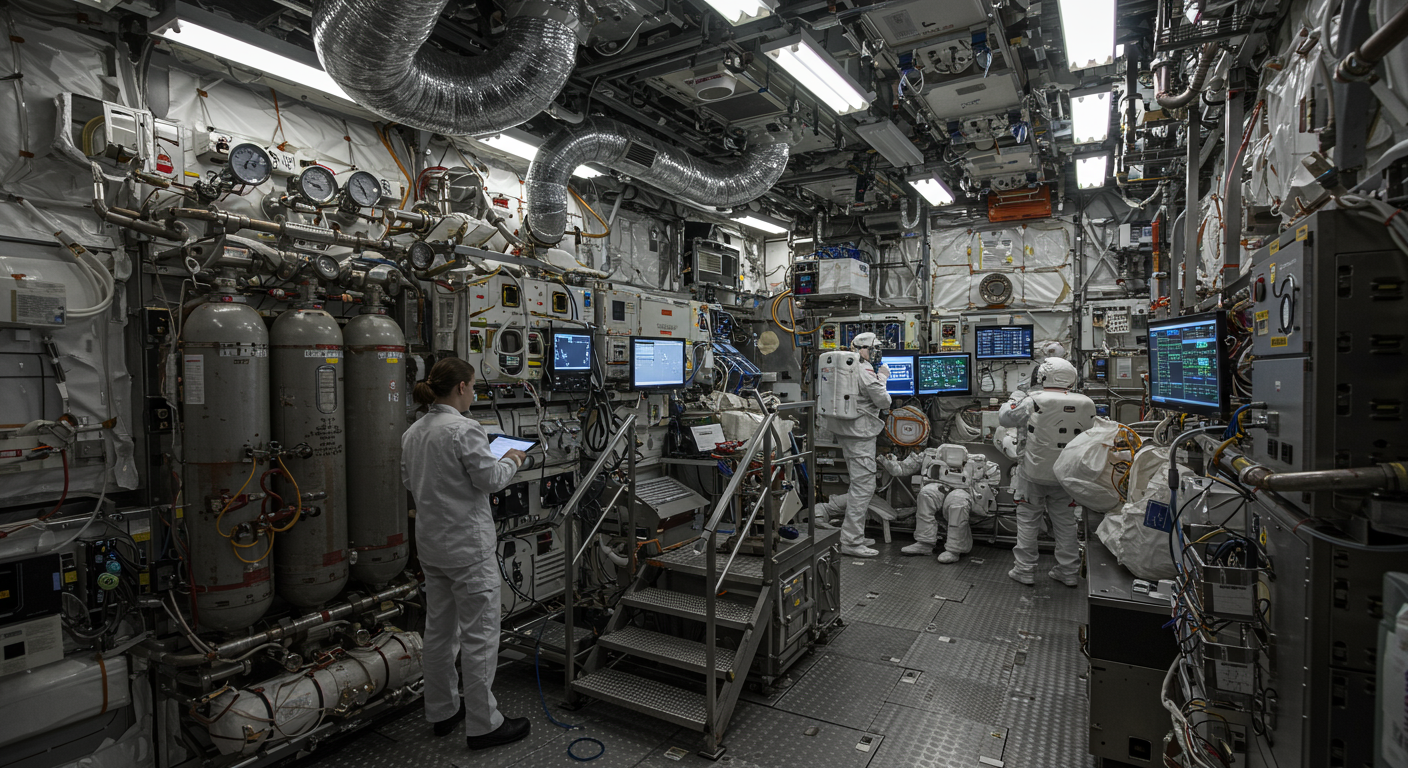
An artificial atmosphere in space is not just a sealed room filled with air. In spacecraft, orbiting stations, and future lunar or Martian habitats, the atmosphere is an actively managed life-support system. It must remain breathable, chemically stable, and safe inside a closed environment where every leak, contaminant, and equipment failure matters.
That makes atmosphere design one of the core scientific and engineering challenges of human spaceflight. A working habitat has to regulate oxygen, carbon dioxide, pressure, humidity, airborne particles, trace chemicals, and airflow. The goal is not to reproduce Earth perfectly, but to maintain an environment that keeps people alive, functional, and protected for long periods with limited resources.
Why an artificial atmosphere is more than “air in a box”
On Earth, the atmosphere is vast and self-buffering on human timescales. In a space habitat, it is finite, enclosed, and completely dependent on hardware. Every breath changes the balance. Crew members consume oxygen, release carbon dioxide and moisture, shed particles, and introduce microbes and chemical byproducts into the air. Equipment also affects air quality through heat, off-gassing, and mechanical wear.
As a result, the cabin atmosphere has to be treated as a dynamic system rather than a static mix of gases. Fans move air so gases do not collect in stagnant zones. Sensors track pressure and chemistry. Filters and scrubbers remove unwanted compounds. Water recovery and thermal control systems help shape humidity. All of these elements interact.
In practical terms, an artificial atmosphere is a controlled environmental envelope. Its success depends on keeping several variables within safe ranges at the same time, often with very little room for error.
The real metric: partial pressure, not just gas percentage
One of the most important ideas in habitat atmosphere science is that human survival depends on partial pressure, not just gas percentage. Oxygen may make up a certain fraction of the air, but whether that amount is enough depends on the cabin's total pressure. If total pressure drops, the oxygen actually available to the body can fall even when the percentage appears normal.
That is why engineers do not simply ask whether the atmosphere contains roughly Earth-like oxygen levels. They ask whether the oxygen partial pressure is high enough to support normal physiology and whether carbon dioxide partial pressure remains low enough to prevent harmful buildup. A habitat can therefore use different combinations of total pressure and gas composition while still remaining breathable.
Buffer gases such as nitrogen are also important. They provide total pressure without raising oxygen concentration to levels that increase fire risk. In other words, a safe cabin atmosphere is usually a balance of oxygen delivery, carbon dioxide control, and inert gas support rather than a perfect recreation of sea-level air.
Pressure design is a tradeoff between biology, engineering, and operations
Cabin pressure is not chosen for a single reason. It reflects a compromise between human biology, structural engineering, and mission operations. Higher pressures can feel more Earth-like, but they place more stress on habitat structures. Lower pressures can reduce structural mass, which is attractive for launch and construction, but they may require altered gas mixtures and stricter operating procedures.
One major issue is decompression sickness, especially when astronauts prepare for extravehicular activity. If suit pressure differs sharply from cabin pressure, crew members may need prebreathe protocols to reduce dissolved nitrogen in the body before a spacewalk. That means atmosphere design affects not only comfort inside the habitat, but also scheduling, workload, and mission efficiency.
Long-duration exposure adds another layer. A habitat atmosphere must support sleep, cognition, exercise, and general health over weeks or months, not just keep someone alive for a few hours. That makes pressure design a sustained physiological question as much as an engineering one.
Carbon dioxide removal is one of the hardest continuous jobs
In enclosed habitats, carbon dioxide is one of the fastest and most persistent problems. Humans exhale it constantly, and without active removal it builds up quickly. Even modest increases can affect comfort, concentration, and overall wellbeing, making carbon dioxide control critical for performance as well as safety.
Spacecraft and stations rely on scrubbers and related air-revitalization systems to capture and remove carbon dioxide from cabin air. These systems have to work continuously and reliably because, unlike many other consumables, carbon dioxide cannot simply be left for later. According to NASA, carbon dioxide removal remains one of the most important functions in environmental control systems for crewed habitats.
For missions lasting months or years, dependable carbon dioxide management may be one of the main factors that determines whether a habitat remains viable. It is not a secondary feature of life support. It is one of its central functions.
A safe atmosphere also requires humidity, contaminant, and microbe control
Breathable air is only part of the challenge. Humidity also has to be controlled. Too much moisture can produce condensation, which threatens electronics, promotes corrosion, and creates conditions that support unwanted microbial growth. Too little can reduce comfort and irritate the respiratory system and skin.
Trace contaminants are another concern. Materials inside a habitat can release small amounts of chemicals over time, a process often described as off-gassing. Cleaning products, experiments, manufacturing processes, and equipment operation can all add compounds to the air. In a sealed environment, these contaminants cannot simply disperse into the wider atmosphere as they would on Earth. They have to be detected and removed.
Microbes belong in the same conversation. A habitat atmosphere can carry bacterial or fungal particles, and microbial activity can affect both crew health and hardware surfaces. Monitoring the cabin environment therefore involves more than gas sensors and filters. It also requires a broader understanding of biological activity in closed systems.
Fire safety changes when oxygen and pressure change
A breathable atmosphere is not automatically a safe one. Flammability depends strongly on oxygen concentration and total pressure. Materials that behave one way under Earth-normal conditions may ignite more easily or burn differently in altered atmospheric environments. This means atmosphere design and fire safety have to be planned together.
If oxygen levels rise or pressure conditions change, combustion risks can increase. That affects everything from the selection of fabrics and wall materials to wiring insulation and onboard procedures. Research published in Science and other aerospace safety literature has shown that fire behavior cannot be judged only by assumptions drawn from everyday terrestrial conditions.
For habitat designers, this creates a clear rule: life-support chemistry, materials science, and hazard analysis are inseparable. The atmosphere must be survivable in a biological sense and safe in a combustion sense at the same time.
From open-loop supplies to closed-loop life support
Early and short-duration missions can rely more heavily on open-loop systems, meaning consumables such as oxygen and water are brought from Earth and used directly. But that model scales poorly for long missions and permanent outposts. The farther humans travel, the more important recycling becomes.
Closed-loop life-support systems aim to recover and reuse critical resources. In atmospheric terms, that means removing carbon dioxide, generating or recovering oxygen, integrating water recovery, and maintaining stable cabin chemistry over time. This is not just about efficiency. It is about making deep-space habitats feasible at all.
The challenge is that closed-loop systems are tightly coupled. A change in humidity can affect condensation and water recovery. A change in crew activity can alter carbon dioxide production. Equipment degradation can slowly shift system performance. As the European Space Agency has noted in its life-support research, maintaining an artificial atmosphere for months or years is as much a control problem as a supply problem.
Could plants help build a habitat atmosphere?
Plants and other biological systems are often proposed as part of bioregenerative life support. In principle, they offer attractive benefits. Plants can absorb carbon dioxide, release oxygen, contribute to food production, and provide psychological value in otherwise highly artificial settings.
But biological loops are not simple replacements for engineered systems. Plants respond to light, water, nutrients, temperature, and stress in ways that can be difficult to predict precisely. Their gas exchange also varies over time. That makes them potentially useful as part of a broader atmospheric strategy, but not automatically stable enough to carry the full burden of life support on their own.
For that reason, future habitats may use hybrid systems in which physicochemical hardware provides precise control while biological components add resilience, resource recovery, and multifunctional benefits. The appeal is strong, but the systems-integration challenge is substantial.
What NASA and ESA have already taught us
Human spaceflight programs have already shown that atmosphere management is an ongoing operational task, not a one-time design decision. NASA and the European Space Agency have shown through work on spacecraft and orbital habitats that continuous monitoring, redundant hardware, fault tolerance, and regular maintenance are essential. Atmosphere systems have to be designed for repair, verification, and long-term reliability.
These programs have also demonstrated that environmental control is deeply interconnected. Carbon dioxide removal, oxygen management, humidity control, filtration, thermal systems, and crew procedures all influence one another. NASA experience in station operations suggests that successful habitats depend not only on advanced equipment, but also on effective coordination between automation, sensors, and human oversight.
That matters for future lunar and Martian habitats. They may face different gravity levels, dust exposure, and mission timelines, but the core life-support principles are not entirely new. They are extensions of problems space agencies have been studying and solving for decades.
The future of artificial atmospheres in space habitats
The future of artificial atmospheres will likely be shaped by better recycling efficiency, more sensitive environmental monitoring, smarter control software, and tighter integration across life-support subsystems. Advances in sensors, materials, filtration, and autonomous fault detection could make habitat atmospheres more robust and less dependent on constant crew intervention.
At the same time, the basic scientific problem will remain the same. A space habitat must continuously provide enough oxygen, remove enough carbon dioxide, maintain safe pressure, control moisture, manage contaminants, and minimize fire and biological risks. That requires chemistry, physiology, mechanical engineering, and systems design to work together at all times.
In that sense, building an artificial atmosphere is less about reproducing Earth in miniature and more about engineering a stable, survivable environment under extreme constraints. The air inside a future space habitat will not be natural. Its success will depend on being carefully and continuously made.