The Rise of Space-Based Solar Power Stations
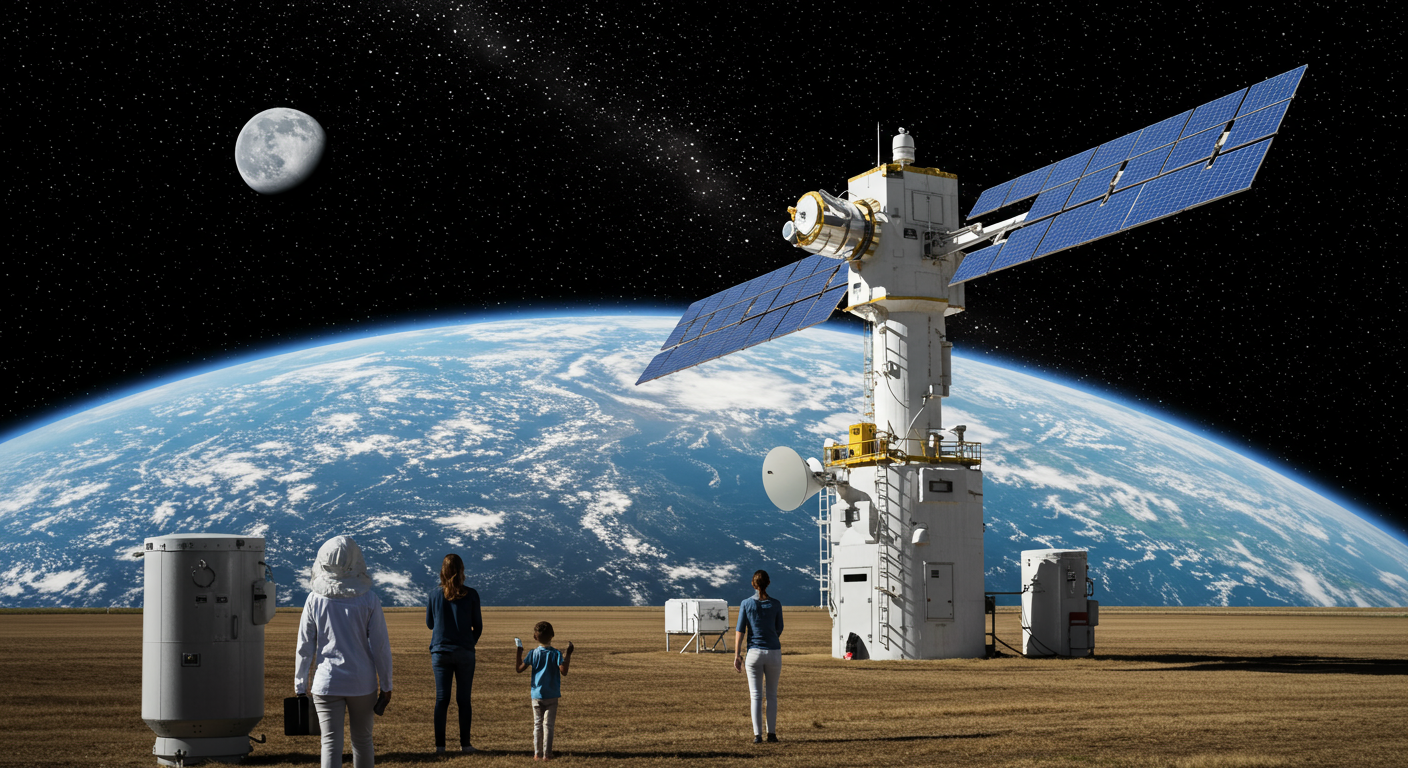
Space-based solar power, often shortened to SBSP, is one of those ideas that sounds futuristic until you realize how many serious institutions are now studying it. The concept is straightforward in principle: collect solar energy in orbit, convert it into a transmissible form, and beam that energy down to Earth for use on the grid or in remote applications.
What has changed is not the basic vision, which has been discussed for decades, but the surrounding technology. Lower launch costs, lighter materials, better photovoltaics, and renewed interest in wireless power transmission have pushed SBSP back into mainstream technical discussion. That does not mean orbital power plants are just around the corner. It does mean the idea has moved beyond pure speculation.
What Space-Based Solar Power Is
Unlike conventional solar farms, which generate electricity on the ground and must contend with clouds, nightfall, seasonal variation, and land-use constraints, SBSP places the collection system in space. Solar arrays in orbit would gather sunlight almost continuously, especially in high or geostationary orbits, where exposure is far more consistent than on Earth.
The electricity produced in orbit would then be converted into a form suitable for wireless transmission, usually microwaves or lasers. That energy would be directed to a receiving station on the ground, where it would be converted back into usable electricity. In other words, SBSP is not just solar generation in space. It is a full end-to-end system involving orbital generation, power conversion, long-distance beaming, and terrestrial reception.
That is what sets it apart from ordinary solar power. Ground-based renewables are now mature and increasingly cost-competitive, but they remain intermittent. SBSP aims to replace intermittency with continuity, though at the price of much greater technical complexity.
Why the Idea Is Attracting Renewed Interest
The appeal of SBSP starts with one major advantage: sunlight in space is much more reliable than sunlight on Earth. Orbital systems avoid weather, atmospheric losses during collection, and the daily cycle of darkness that limits terrestrial solar. That creates the possibility of much higher capacity factors than traditional solar farms typically achieve.
There is also strategic appeal. A space-based system could, in theory, direct power to different regions depending on demand, including isolated areas, disaster zones, island grids, or military operations where fuel logistics are expensive and vulnerable. For energy planners, that flexibility makes the concept interesting even before it becomes competitive for bulk power.
Timing is another reason the field is drawing attention again. As countries pursue decarbonization, grid resilience, and new clean-energy technologies, agencies and research groups are revisiting options that once seemed too expensive or too immature. Public-facing work from NASA, the European Space Agency, the U.S. Department of Energy, and major university programs suggests SBSP is being treated as a legitimate long-term research area rather than just a science-fiction curiosity.
How a Space Solar Power Station Would Work
A full SBSP system would involve four main elements. First, a very large solar array in orbit would collect sunlight and generate electricity. Second, onboard electronics would convert that electricity into a beamable form. Third, the system would transmit energy wirelessly toward Earth. Fourth, a ground installation, often called a rectenna in microwave-based designs, would receive the beam and convert it back into electricity for distribution.
The two leading transmission approaches are microwaves and lasers. Microwaves are often seen as more practical for large-scale energy transmission because they can travel through the atmosphere more reliably under many conditions and can be spread across a broad receiving area. Lasers offer tighter beams and potentially smaller receiving stations, but they are more sensitive to clouds, atmospheric interference, and pointing precision.
Either approach brings major engineering demands. A usable power station would likely need to be enormous, far larger than most spacecraft operating today. It would also need precise beam control, stable orbital positioning, thermal management, fault tolerance, and long-term maintenance strategies. Building one satellite is difficult. Building an orbital power plant is a different class of challenge entirely.
What Has Actually Been Demonstrated So Far
It is important to separate concept studies from real-world demonstrations. SBSP has a long history of theoretical analysis and systems modeling, but full commercial-scale power delivery from orbit has not been achieved. Today, the field is best understood as a mix of feasibility studies, laboratory testing, and early in-space validation of individual components.
That said, recent progress is meaningful. NASA and the European Space Agency have both supported research into system architectures, enabling technologies, and economic viability. The U.S. Department of Energy has also publicly discussed the concept and its potential relevance. These are not declarations that SBSP is market-ready, but they do show that the topic is being evaluated within serious institutional frameworks.
One of the most visible milestones came from Caltech, whose Space Solar Power Demonstrator was designed to test key elements of the concept in orbit. That kind of mission matters because it moves the discussion from paper studies to hardware validation. Even so, the current state of the art is incremental. Researchers are showing that pieces of the system can work, not that a utility-scale orbital power station is ready for deployment.
The Biggest Technical and Economic Barriers
The largest obstacle may be scale. To deliver meaningful power to Earth, an SBSP station would likely require vast structures in orbit, assembled with high precision and maintained over long periods in a harsh environment. Launching that much mass remains expensive, even with improvements in commercial spaceflight. If the system depends on repeated launches, robotic assembly, and regular servicing, costs can rise quickly.
Efficiency is another challenge. Every stage of the process introduces losses: solar collection, electrical conversion, transmission, atmospheric passage, and reconversion on the ground. Even if each step works well on its own, the combined system must still deliver enough usable electricity to justify the cost and complexity.
Then there is the market question. Ground-based solar keeps getting cheaper. Battery storage is improving. Transmission planning, demand management, and other grid tools are advancing as well. For SBSP to compete as a mainstream utility resource, it would need either a substantial performance advantage, a significant drop in space infrastructure costs, or a niche in which terrestrial alternatives remain weak. Without one of those conditions, the economics will be difficult to justify.
Safety, Regulation, and Public Acceptance
Even if engineers solve the hardware problems, SBSP would still face difficult regulatory and public-policy questions. Wireless power beaming raises obvious concerns about exposure limits, beam control, fail-safe systems, and coordination with aviation and satellite operations. Those concerns do not automatically make the technology unsafe, but they do mean the system would require careful standards, testing, and transparent oversight.
Microwave and laser systems would also intersect with spectrum regulation, international space law, orbital traffic management, and environmental review. Ground receiving stations would need land, infrastructure, and local political acceptance. As with many large energy projects, public trust could become a deciding factor.
That broader governance challenge is easy to overlook. SBSP is not just a matter of building advanced hardware. It is also a matter of creating international rules and domestic regulations for a technology that crosses the boundaries between energy, telecommunications, aerospace, and national security.
Is This a Future Energy Source or a Perpetual Science Project?
That is the central debate. Supporters argue that the physics are sound, the strategic value is real, and the enabling technologies are improving enough to justify sustained investment. Skeptics counter that a technically possible system is not the same as an economically sensible one, especially when Earth-based renewables are already scaling quickly.
The most realistic near-term outcome may be specialized use rather than mass-market electricity. Remote installations, disaster response, defense logistics, and isolated regions could provide test cases where the premium for reliable delivered power is higher. If SBSP proves itself in those settings, broader commercial ambitions may start to look more credible.
For now, the most accurate view is a measured one. Space-based solar power is no longer just a speculative dream, and recent demonstrations have strengthened its legitimacy as a research field. But it is still far from proven as a cost-effective source of utility-scale electricity. The rise of SBSP is real in the sense that the research is serious. Whether that rise leads to a new energy industry or remains an ambitious experimental effort is a question the next decade of engineering will begin to answer.