The Race to Build Faster-Than-Ever Space Propulsion Systems
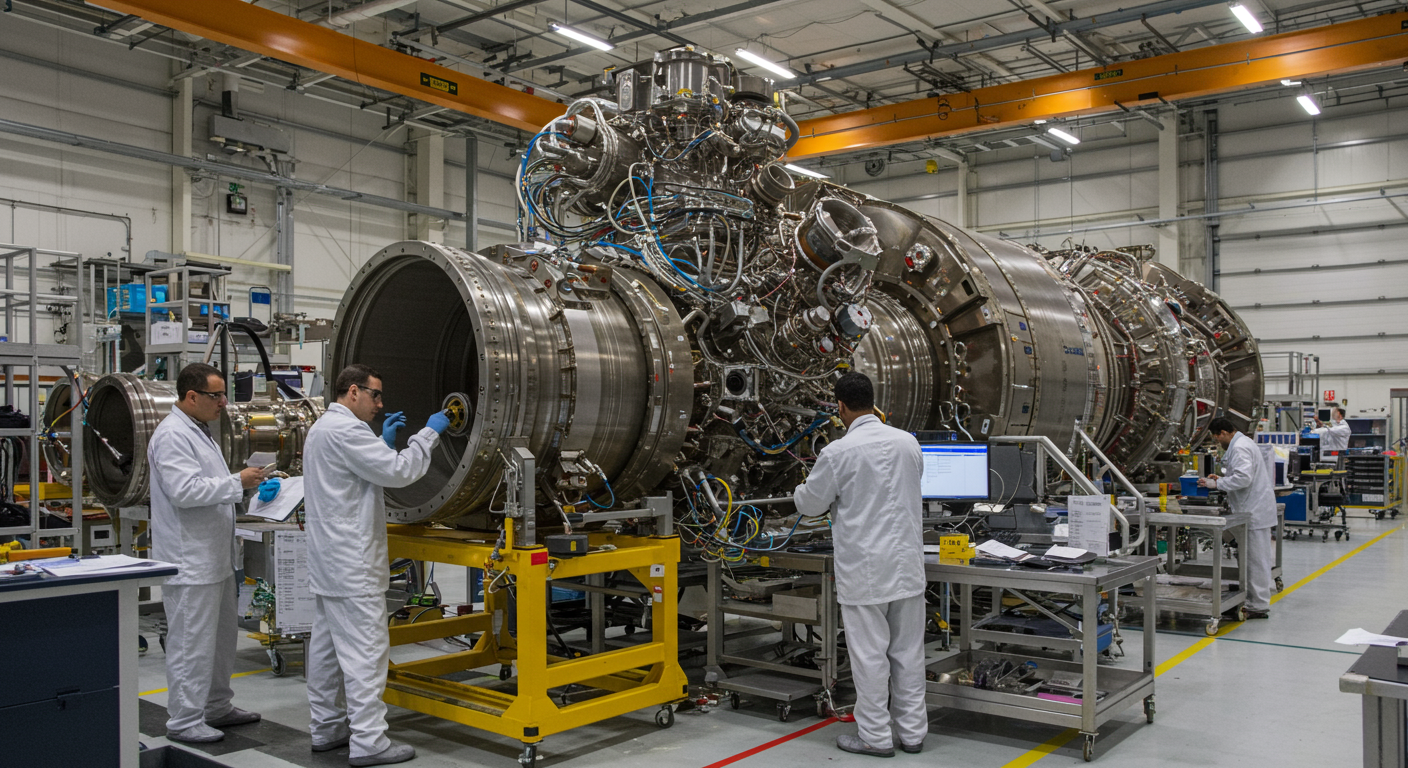
The Race to Build Faster-Than-Ever Space Propulsion Systems
The New Space Race Isn't About Getting There First—It's About Getting There Fast
Today's space race has evolved far beyond national prestige into a technical sprint toward revolutionary propulsion capabilities. While current chemical rockets are reliable workhorses, they impose fundamental constraints on humanity's cosmic ambitions—from the grueling months-long journeys to Mars to making nearby stars completely unreachable within human lifetimes.
Now, multiple breakthrough technologies are emerging simultaneously across public and private sectors, each promising to shatter these limitations. The stakes couldn't be higher: these advances could transform Mars missions from multi-year odysseys into routine business trips and make interstellar exploration feasible for the first time in human history.
Chemical Propulsion's Swan Song: SpaceX Raptor and the Final Frontier
SpaceX's Raptor engine represents the absolute pinnacle of chemical propulsion, squeezing maximum performance from methane and liquid oxygen through a full-flow staged combustion cycle. This sophisticated design achieves efficiency levels that brush against the theoretical limits of chemical reactions—a dramatic leap beyond traditional kerosene-powered rockets.
The Raptor's methane-oxygen combination offers compelling advantages: methane can be manufactured on Mars for return trips, burns far cleaner than kerosene, and delivers superior performance at extreme chamber pressures. Yet even these impressive achievements underscore how chemical propulsion is bumping against the laws of physics.
Other companies are pushing these same boundaries. Blue Origin's BE-4 engine and Relativity Space's Aeon engines each contribute innovations in manufacturing, fuel efficiency, and reusability. However, industry experts universally acknowledge that the next quantum leap in space transportation demands moving beyond chemical energy entirely.
Nuclear Goes Mainstream: From Laboratory Curiosity to Launch Reality
Nuclear propulsion, trapped in research labs for decades, is finally making its commercial debut through NASA partnerships and private ventures. Nuclear thermal systems deliver roughly twice the efficiency of chemical rockets, potentially slashing Mars transit times from nine months to four.
The National Aeronautics and Space Administration's Nuclear Thermal Propulsion program is collaborating with BWX Technologies and Ultra Safe Nuclear Technologies to demonstrate operational nuclear-powered spacecraft by the early 2030s. Instead of burning chemicals, these systems heat propellant using nuclear reactors, achieving dramatically higher exhaust velocities.
The regulatory maze presents unique challenges, requiring unprecedented coordination between NASA, the Department of Energy, and the Nuclear Regulatory Commission. Safety protocols include multiple containment systems, orbital assembly to avoid launching nuclear reactors from Earth's surface, and meticulous mission planning to prevent radioactive materials from reentering the atmosphere.
Beyond Mars missions, nuclear propulsion opens entirely new possibilities for deep space exploration, where solar panels become useless and chemical rockets lack the muscle for complex maneuvers around distant planets.
Fusion Propulsion: The Distant Dream Getting Dramatically Closer
Recent fusion energy breakthroughs are compressing fusion propulsion development timelines at breakneck speed. Unlike nuclear fission systems, fusion propulsion could achieve efficiency levels ten times greater than chemical rockets, enabling lightning-fast transit throughout the solar system.
The National Ignition Facility's historic achievement of fusion energy gain in 2022 proved that controlled fusion reactions can produce more energy than they consume. This milestone has supercharged fusion propulsion research, with organizations like Princeton Satellite Systems developing direct fusion drive concepts.
The technical hurdles remain mountainous: containing fusion reactions in spacecraft-sized reactors, managing brutal radiation and heat loads, and creating propulsion systems that operate flawlessly for years in the harsh space environment. However, recent advances in magnetic confinement and inertial fusion are providing fresh approaches to these challenges.
NASA's Glenn Research Center is investigating fusion-enabled missions to the outer planets, while private companies like TAE Technologies explore compact fusion reactor designs tailored for spacecraft. Current projections suggest demonstration missions could launch within two decades—a timeline that seemed impossible just years ago.
Reaching for the Stars: NASA's Interstellar Gambit
The National Aeronautics and Space Administration's participation in the Breakthrough Starshot initiative represents humanity's first serious attempt at interstellar propulsion. This audacious project aims to accelerate tiny spacecraft to 20% of light speed using massive laser arrays, potentially reaching Proxima Centauri within 20 years of launch.
Light-sail propulsion eliminates fuel entirely by harnessing photon pressure for acceleration. Ground-based laser arrays would focus tremendous energy on ultralight spacecraft, accelerating them to velocities impossible with any conventional propulsion. The engineering challenges are staggering: developing materials that survive intense laser heating and creating electronics that function at relativistic speeds.
Beyond Starshot, NASA is exploring other exotic propulsion concepts through its Innovative Advanced Concepts program. These include next-generation solar sails, ultra-efficient ion drives, and theoretical approaches like fusion ramjets that could sustain acceleration throughout interstellar journeys.
Global Competition Heats Up the Innovation Race
The European Space Agency has launched major strategic investments in future propulsion technologies, recognizing that advanced propulsion will determine which nations can access valuable space resources and conduct ambitious exploration missions. The European Space Agency's Future Launchers Preparatory Programme encompasses research into air-breathing engines, nuclear propulsion, and breakthrough chemical systems.
International competition is dramatically compressing development timelines. China's space program is reportedly investigating nuclear propulsion for Mars missions, while Russia continues developing nuclear-powered space tugs for satellite deployment. This creates fascinating dynamics between scientific collaboration and national security secrecy.
The challenge lies in balancing open research cooperation with protecting technologies that have potential military applications. Basic research often benefits from international collaboration, but nations increasingly guard propulsion advances that could provide strategic advantages.
The Portfolio Approach: Why No Single Technology Will Rule Them All
Industry experts predict that no single propulsion breakthrough will dominate every space application. Different mission profiles demand different propulsion solutions, creating a rich technological ecosystem where multiple approaches coexist.
Chemical propulsion will likely remain king for Earth-to-orbit transportation due to its high thrust and proven reliability. Nuclear thermal systems appear ideal for Mars cargo missions where efficiency trumps rapid acceleration. Fusion propulsion could unlock outer planet missions that are currently impossible with chemical or fission systems.
Cost, performance, and safety considerations will ultimately determine which technologies thrive in specific markets. Light-sail propulsion might revolutionize interstellar exploration while remaining completely unsuitable for human transportation. Ion drives excel at station-keeping and asteroid missions but lack the thrust needed for planetary launches.
The next decade will witness parallel development across multiple propulsion technologies, with market forces and mission requirements determining which approaches receive sustained investment and development resources. The race isn't just about speed—it's about building the diverse toolkit that will finally make humanity a true spacefaring species.