The Race to Build Faster-Than-Ever Space Propulsion Systems
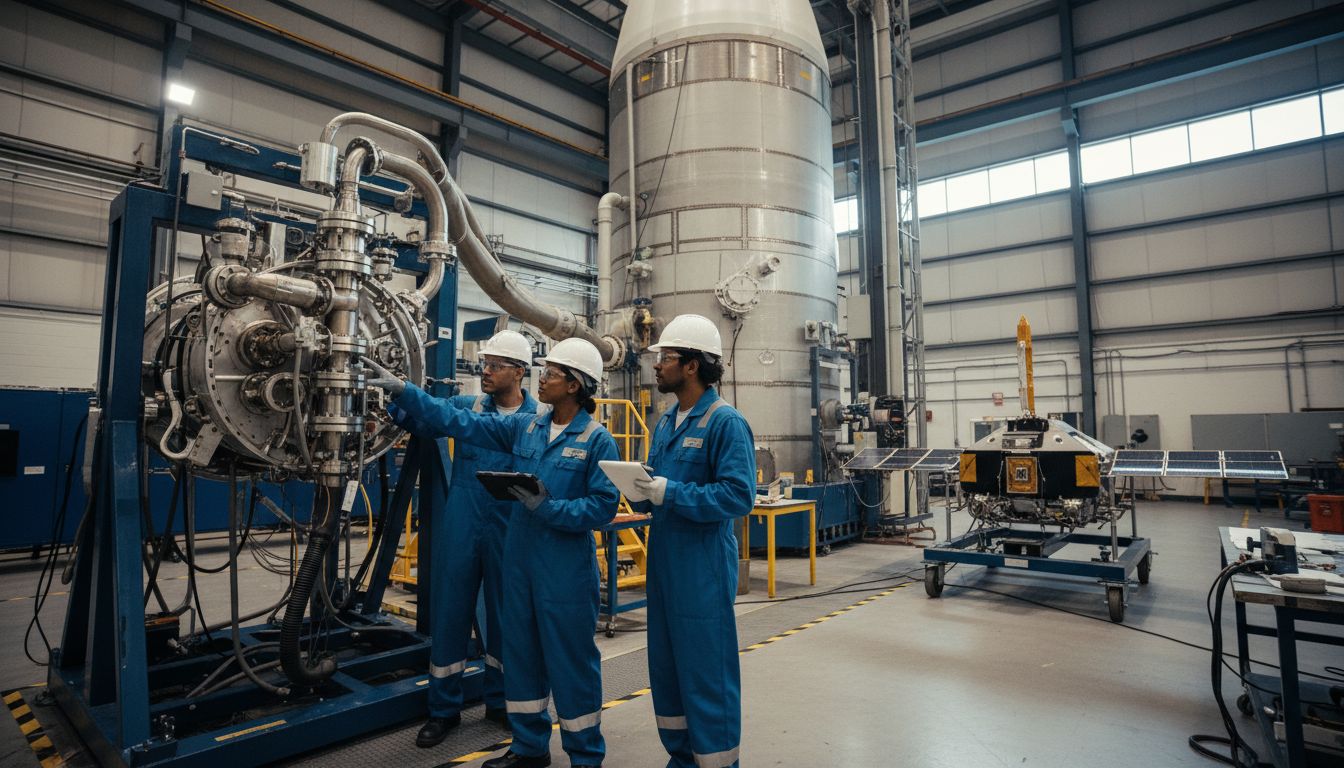
The push for faster space travel is real, but it is not a simple race with one obvious finish line. In practice, space agencies, defense programs, and private-sector engineers are pursuing several propulsion paths at once, each suited to a different kind of mission.
That distinction matters because “faster” does not always mean the same thing in spaceflight. It can mean higher thrust during launch, shorter travel time between orbits, better fuel efficiency over months or years, or more agile maneuvering in cislunar space. A propulsion system that excels in one of those categories may perform poorly in another.
As a result, the current competition is less about finding a single breakthrough that replaces every rocket engine and more about building a layered toolkit. Chemical propulsion, electric propulsion, and nuclear-related concepts are all advancing, but they serve different roles.
Why There Isn’t Just One Race to Build Faster Space Propulsion
Headlines often imply that the industry is chasing one next-generation engine that will make today’s systems obsolete. The reality is more complicated. Agencies such as the National Aeronautics and Space Administration and the European Space Agency typically frame propulsion choices around mission requirements, not one universal measure of performance.
A launch vehicle leaving Earth needs immense thrust immediately. A communications satellite may benefit more from an efficient engine that uses less propellant over years of station-keeping. A cargo vehicle heading deeper into space may tolerate slow acceleration if it can save mass and extend mission range.
That is why propulsion development increasingly looks like a portfolio strategy rather than a winner-take-all contest. Engineers are optimizing for launch, orbital transfers, lunar logistics, and deep-space exploration in parallel.
Chemical Propulsion Still Owns the High-Thrust Problem
For all the attention given to advanced propulsion, chemical rockets remain the backbone of practical spaceflight. They are still unmatched when a mission needs very high thrust in a short period, especially during launch from Earth or major impulsive maneuvers in space.
The reason is straightforward: chemical propulsion delivers powerful bursts of energy quickly. That makes it essential for lifting payloads out of Earth’s gravity well and for mission phases where gradual acceleration is not an option.
Just as important, chemical systems are mature. They are well understood, flight-proven, and deeply integrated into the world’s launch infrastructure. Even if they are not the most efficient option for long-duration travel, their raw performance and reliability keep them at the center of present-day operations.
In other words, any serious discussion about faster space transportation still starts with chemical propulsion because no other technology has displaced it in the high-thrust role.
Electric Propulsion Is Changing the Economics of In-Space Travel
If chemical propulsion dominates launch and fast burns, electric propulsion is reshaping what happens after a spacecraft reaches space. These systems generally produce far less thrust, but they can operate with much higher efficiency, allowing spacecraft to do more with less propellant.
This tradeoff is central to why electric propulsion has become so important. Low thrust means it usually cannot replace chemical rockets for liftoff. But high specific impulse makes it extremely attractive for station-keeping, orbit raising, cargo transport, and long-duration missions where steady, gradual acceleration is acceptable.
For satellites and deep-space missions, efficiency can matter more than immediate speed. Carrying less propellant can reduce launch mass, extend operational life, or free up weight for payloads. Over time, that can improve mission economics even if the spacecraft accelerates more slowly.
This is one reason electric propulsion has gained traction across commercial and government space programs. It does not solve every mobility problem, but it can make sustained in-space operations much more practical.
Nuclear Thermal and Nuclear Electric Systems Are Back in the Conversation
Some of the most closely watched propulsion concepts now involve nuclear power, though the term covers more than one approach. Nuclear thermal propulsion and nuclear electric propulsion are distinct systems with different engineering tradeoffs and performance goals.
Nuclear thermal propulsion uses a reactor to heat propellant and expel it for thrust, offering the prospect of stronger performance than conventional chemical systems in certain deep-space missions. Nuclear electric propulsion, by contrast, would use nuclear power generation to run electric thrusters over long durations, combining sustained power with efficient in-space propulsion.
Interest in these ideas has become more visible in recent years. The Defense Advanced Research Projects Agency’s DRACO program, short for Demonstration Rocket for Agile Cislunar Operations, is a notable example of renewed attention to propulsion systems that could improve mobility in cislunar space and eventually support faster missions beyond Earth orbit.
Still, it is important not to overstate readiness. These systems are promising, but they are not yet routine operational tools. Much of the current momentum is in demonstration, research, and strategic planning rather than widespread deployment.
What Agencies and Industry Are Actually Optimizing For
One of the clearest lessons from NASA and ESA materials is that propulsion is usually evaluated in context. There is no single metric that determines the best engine for every mission.
Agencies weigh transit time, payload mass, fuel efficiency, power availability, thermal limits, mission flexibility, and cost. A spacecraft designed for orbital servicing may prioritize precision and endurance. A lunar logistics vehicle may need a balance of maneuverability and efficiency. A Mars-class mission may place far more emphasis on reducing travel time while preserving enough mass for crew systems or scientific payloads.
This helps explain why multiple propulsion technologies continue to advance at the same time. The best system changes depending on whether the goal is launch, station-keeping, cislunar responsiveness, or deep-space exploration.
Industry follows the same logic. Companies and contractors may talk about speed, but they are usually solving for a mission architecture, not chasing an abstract title for the fastest engine on paper.
The Real Bottlenecks: Power, Heat, Safety, and Readiness
Propulsion progress is not limited by engine design alone. In many cases, the hardest problems lie elsewhere: generating enough power, managing extreme heat, building materials that survive harsh conditions, and meeting safety and regulatory requirements.
Electric propulsion depends heavily on power systems. More ambitious concepts often require better solar arrays, improved energy storage, or other supporting infrastructure. Nuclear-related systems introduce additional complexity around reactor design, shielding, testing, and mission approval.
Thermal management is another major constraint. High-performance systems can create intense heat loads that must be controlled without adding too much mass. Materials science therefore becomes part of the propulsion race, not just a supporting discipline.
Then there is technology readiness. Some concepts look transformative in studies or laboratory settings but remain years away from operational missions. Readers should distinguish carefully between theoretical performance, prototype demonstrations, and systems that are close to regular use.
That gap between promise and deployment is especially important in advanced propulsion, where the physics may be sound but the engineering path remains long.
So Who’s Ahead in the Push for Faster Space Travel?
The most accurate answer is that different technologies are ahead in different lanes. Chemical propulsion remains the leader for high-thrust practicality and launch. Electric propulsion leads in efficient in-space operations and is already changing how many satellites and long-duration missions are designed. Nuclear thermal and nuclear electric systems may become more important if agencies want meaningful gains in cislunar agility or deep-space transit speed.
That does not point to one final winner. Instead, it suggests that the next decade in space mobility will be shaped by a broader propulsion ecosystem, with each technology filling a role that matches its strengths.
So the race to build faster-than-ever propulsion systems is not really about one engine taking over spaceflight. It is about expanding the range of tools available for different journeys, from the violent force of launch to the long, efficient push into deeper space.