The Future of Space-Based Manufacturing and Zero-Gravity Factories
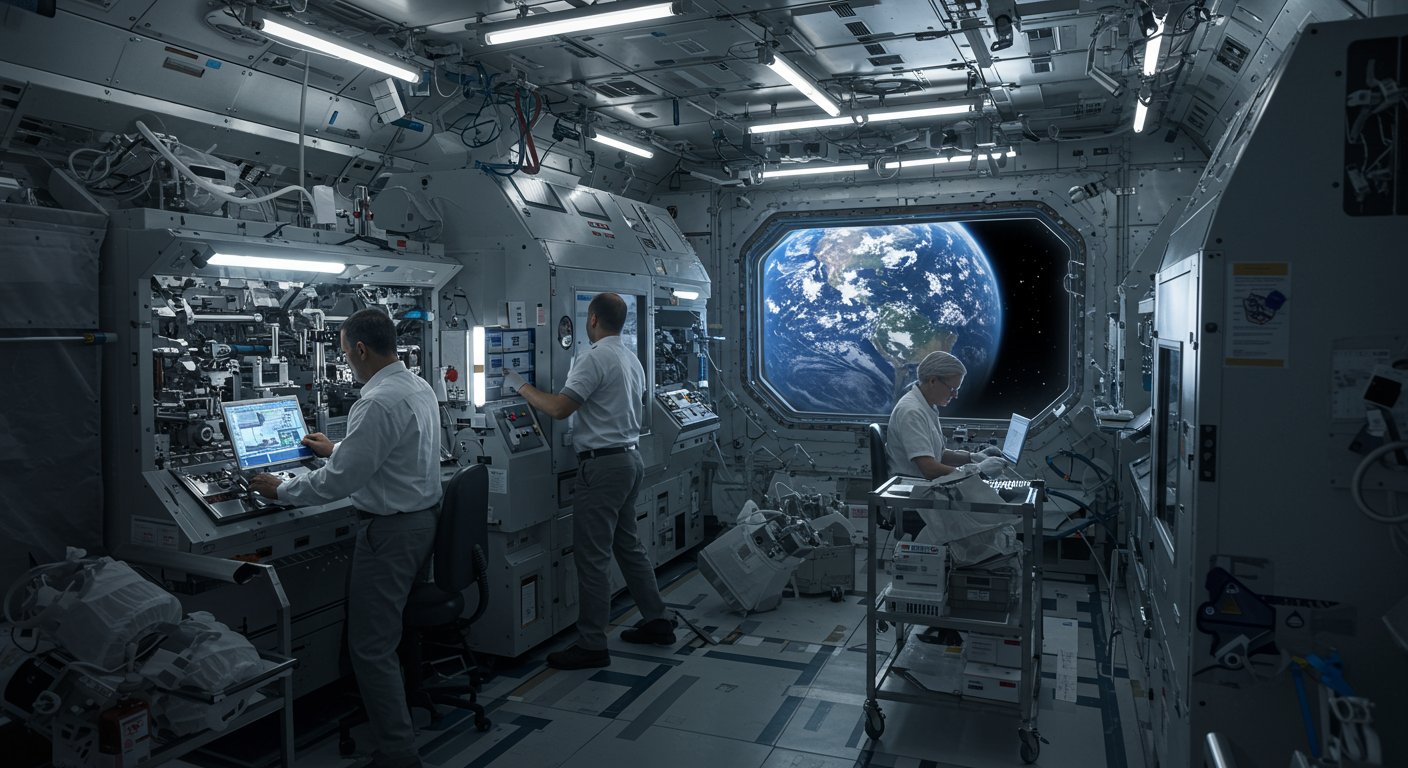
For decades, manufacturing in space sounded like a distant idea pulled from science fiction. Today, it is better understood as an early industrial experiment: real, technically promising, and still far from mass adoption.
The basic idea behind a zero-gravity factory is straightforward. Instead of making a product entirely on Earth, companies use orbital platforms to manufacture materials or components in microgravity, where the absence of strong gravity-driven effects can change how fluids move, how crystals form, and how materials solidify. The most credible opportunity is not bulk production, but small, high-value goods for which those differences can create a measurable performance advantage.
Why Manufacturing in Space Is Moving From Science Fiction to Industrial Experiment
Space-based manufacturing has advanced because the discussion has shifted from fantasy to selective use cases. Researchers and companies are no longer treating orbit as a place to build everything. Instead, they are asking a narrower question: are there products that become better, purer, or more uniform when made in microgravity?
That distinction matters. Most goods will remain far cheaper and easier to produce on Earth. But in fields where tiny structural defects have outsized consequences, microgravity may offer conditions that are difficult to reproduce in terrestrial factories. That is why the sector is drawing attention from space agencies, materials scientists, biotech researchers, and aerospace companies.
What Microgravity Changes in the Manufacturing Process
Microgravity affects the physical behavior of materials in ways that can change manufacturing results. On Earth, gravity drives sedimentation, buoyancy, and convection. Heavier particles settle, fluids circulate because of temperature differences, and growing crystals can develop imperfections as a result of those forces.
In orbit, those effects are reduced. Fluids can behave more uniformly, suspended particles may stay better distributed, and certain crystals or materials can form with fewer gravity-related distortions. Heat transfer also changes, which can influence solidification and structural formation. In some cases, this produces higher purity, better uniformity, or lower defect rates.
That does not mean microgravity automatically improves every industrial process. The benefit is highly application-specific. For many products, gravity is not a major problem, and the cost of orbital production would outweigh any quality gain. The strongest candidates are products for which even modest performance improvements can justify very high manufacturing costs.
How the ISS Became the First Testbed for Orbital Production
The International Space Station has served as the first major laboratory for testing whether orbital manufacturing concepts can work in practice. NASA-backed research on the station has allowed scientists and engineers to study how materials, biological systems, and manufacturing techniques behave in sustained microgravity.
These International Space Station experiments matter not because they created a mature factory system, but because they helped validate scientific feasibility. Researchers have used the station to examine crystal growth, fluid behavior, additive manufacturing, biological fabrication, and material processing under conditions that cannot be fully reproduced on Earth.
That work has clarified a key divide in the field. Laboratory-style demonstrations aboard the ISS show that certain processes are possible in orbit. Commercial manufacturing, however, requires far more: repeatable output, quality assurance, automation, stable power, contamination control, and dependable transport to and from space. The station has been a proving ground, not yet a true industrial platform.
The Most Promising Early Products for Zero-Gravity Factories
The most discussed products for space-based manufacturing share several traits. They are typically high value, relatively low mass, and highly sensitive to structural imperfections introduced by gravity-driven processes on Earth.
Fiber optics are one of the best-known examples. Certain specialty optical fibers have long been cited as candidates for orbital production because microgravity may support a more uniform internal structure. Pharmaceuticals are another area of interest, especially where protein crystal growth or other precise molecular arrangements matter for research or formulation.
Tissue engineering and bioprinting are also frequently mentioned because microgravity can change how biological materials assemble and interact. High-purity crystals, specialty semiconductors, and advanced alloys round out the list of leading candidates. In all of these categories, the commercial logic depends on one central condition: the product must gain enough value from microgravity to offset the extraordinary cost and complexity of making it in orbit.
That is why the near-term future is likely to center on niche products with clear technical advantages rather than broad industrial output. A successful orbital factory may look less like a giant off-world industrial complex and more like a highly specialized production lab for premium materials.
Who Is Building the Commercial Space Manufacturing Ecosystem
The ecosystem around orbital production is gradually expanding beyond government research. NASA and the European Space Agency have helped establish the scientific and operational foundations, but commercial firms are increasingly trying to turn those lessons into business models.
Companies such as Redwire Space have explored in-space manufacturing hardware and commercialization pathways tied to research, materials production, and orbital infrastructure. Around them, a larger support network is taking shape. Launch providers make access to orbit possible. Private station developers aim to create future laboratory and production space after the ISS era. Automation and robotics firms are relevant because any viable orbital factory will need to minimize dependence on crew labor. Return-logistics partners matter as well, since some products create value only if they can be brought back to Earth safely and intact.
This broader ecosystem is important because no single company can create a space manufacturing market on its own. Orbital production depends on a chain of services that includes transport, power, robotics, station access, process monitoring, and downmass capability.
Why Economics May Matter More Than Engineering
The engineering case for space manufacturing is compelling in selected niches. The economic case is much harder.
Every orbital production system has to overcome launch costs, limited facility access, tight power budgets, operational complexity, and the expense of returning finished goods. Human supervision in orbit is costly, which increases the value of automation but also raises technical demands. Even if a process works beautifully in microgravity, it still has to compete with Earth-based production that benefits from mature supply chains, abundant energy, easier maintenance, and far lower logistics costs.
That reality means only high-value, low-volume goods currently make sense. If reusable launch systems continue to improve and private orbital platforms become more frequent and reliable, the economics could change. But lower launch costs alone will not be enough. The industry also needs dependable infrastructure, regular access windows, and processes that can operate with minimal intervention.
The Hard Problems Zero-Gravity Factories Still Have to Solve
Several barriers stand between successful experiments and a functioning orbital manufacturing sector. Robotic reliability is one of the biggest. Space factories cannot depend on constant hands-on maintenance, so machines must perform precisely for long periods in a harsh environment.
Contamination control is another critical challenge, especially for pharmaceuticals, semiconductors, and high-purity materials. Quality assurance is equally important. Producing one impressive sample is not the same as delivering consistent commercial-grade output over time.
Power constraints and thermal management also shape what is possible in orbit. Manufacturing systems generate heat, and managing that heat in space is not trivial. Maintenance, spare parts, and process troubleshooting all become more complicated once equipment leaves Earth.
Then there is the issue of return. Some products justify orbital production only if their microgravity-derived properties survive reentry and transport back to customers. If the return process damages the goods or erodes the performance gains achieved in orbit, the business case weakens quickly.
What the Next Decade Will Likely Look Like
Over the next ten years, the most realistic path forward is a progression from experiments to pilot production and then, if economics allow, to limited commercial specialization. The industry is more likely to produce a handful of proven niche markets than a sweeping industrial revolution in orbit.
Private space stations could play a decisive role. If they provide more routine access, dedicated manufacturing volume, and better operational flexibility than current platforms, they could help move orbital production beyond demonstration projects. Transport infrastructure will matter just as much. Reliable launch and return services are prerequisites for turning scientific success into repeatable business.
What seems less likely in the near term is the emergence of large autonomous factories producing broad categories of consumer or industrial goods. That vision remains speculative. The nearer-term milestones are smaller and more concrete: validated processes, repeatable pilot runs, premium product categories, and customers willing to pay for measurable performance gains.
The Real Future of Space Manufacturing: Specialized, Not Universal
The strongest case for space-based manufacturing is not that factories will leave Earth on a massive scale. It is that orbit may become a valuable production environment for a narrow but important set of products that benefit uniquely from microgravity.
That makes the field both more credible and more constrained than popular imagination often suggests. There is already real science behind orbital manufacturing, and there are early commercial efforts trying to build on it. But the gap between promising experiments and a sustainable industry remains wide.
In the end, zero-gravity factories will succeed only where they can prove a repeatable economic advantage, not just technical novelty. If that happens, the future of space manufacturing will likely be specialized, premium, and strategically important rather than universal.