Tesla, Figure, and Apptronik Push Humanoid Robots Closer to Real Factory Work in 2026
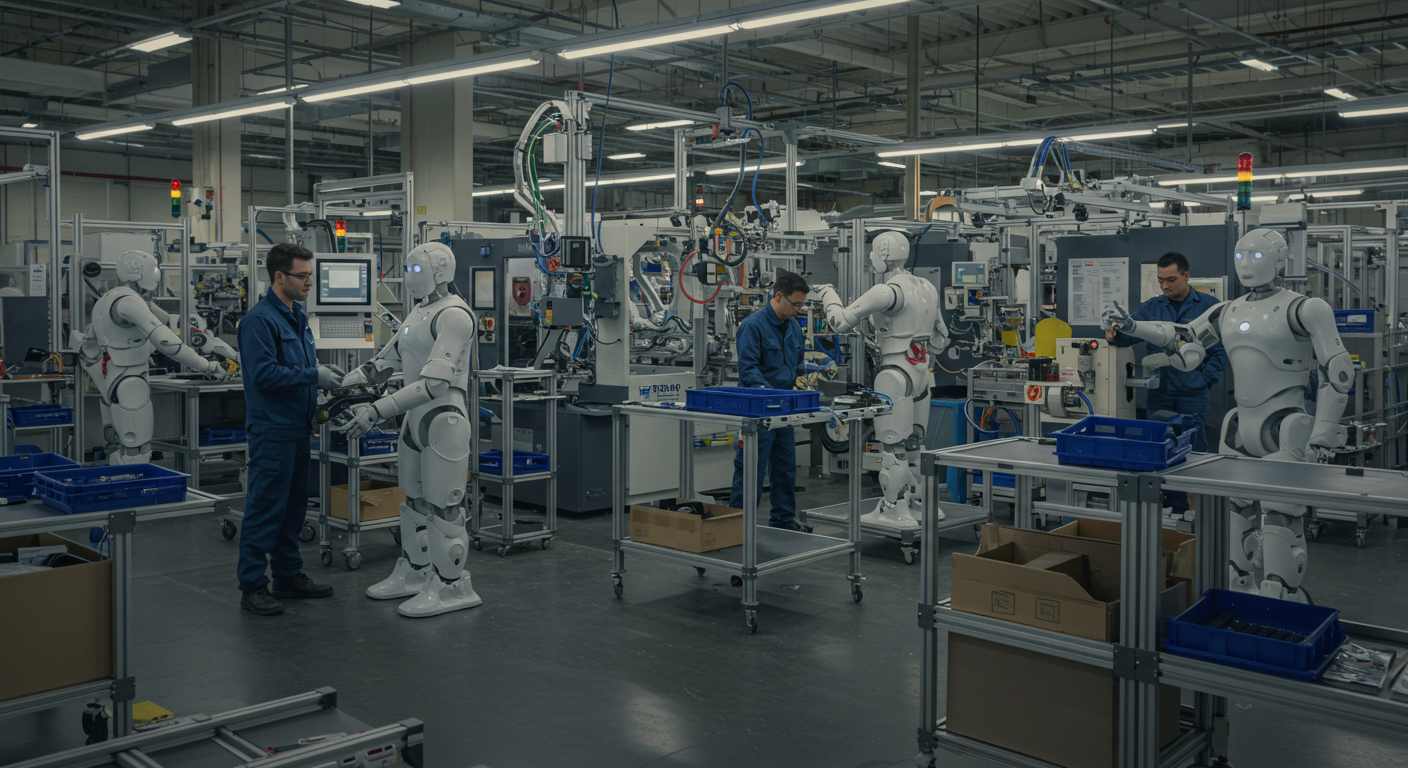
For years, humanoid robots have been easy to dismiss as attention-grabbing prototypes: impressive on video, uncertain in real work. What is changing now is not the existence of the machines, but the seriousness of the industrial push behind them. Tesla, Figure, and Apptronik are all positioning their humanoid systems for practical use in factories and other structured workplaces, and 2026 is shaping up to be an important test of whether that transition can hold up outside carefully managed demonstrations.
That does not mean a broad humanoid takeover of manufacturing is around the corner. The more realistic case is narrower. If 2026 becomes a milestone year, it will likely be because a small number of robots begin handling repeatable tasks in controlled production environments with measurable business value. That would be a meaningful step forward, even if it falls well short of mass deployment.
What counts as being on the factory floor
One reason coverage of humanoid robotics often becomes overheated is that very different stages get lumped together. A lab demo is not the same as a pilot. A pilot is not the same as regular operation in a warehouse or plant. And a robot working inside a company’s own facility is not necessarily equivalent to a commercial deployment across multiple customers.
The distinction matters. Investors and manufacturers want to know whether a system can perform useful tasks repeatedly, safely, and with enough uptime to justify its cost. Media coverage, by contrast, often rewards the most visually striking demonstration, even when the underlying evidence still points to early testing. For that reason, the most credible reading of the current market is that humanoids are approaching factory relevance, but in uneven and company-specific ways.
Tesla’s Optimus remains ambitious, but proof at scale is still limited
Tesla has arguably done more than any other company to make humanoid robots part of the mainstream industrial conversation. Through its Optimus project and broader AI messaging, the company has described a future in which humanoid robots handle repetitive and physically routine work, especially in environments already designed for human workers. Tesla’s own presentations and website frame Optimus as a machine intended for practical labor, not just research theater.
That framing makes sense. Factories contain many tasks that are repetitive, structured, and ergonomically taxing, which makes them attractive candidates for robotic assistance. A humanoid form factor could be useful in places where tools, stations, and pathways were built around people rather than custom automation.
Still, there is a difference between strategic ambition and independently confirmed deployment. Outside reporting, including Reuters and The Verge, has helped establish that Tesla is serious about factory applications and internal testing, but public evidence of broad, scaled factory use remains much thinner than the rhetoric surrounding the project. At this stage, the strongest conclusion is that Optimus has moved beyond a pure concept and into meaningful development for industrial work, while still needing far more proof on reliability, production volume, and sustained use in real manufacturing operations.
Figure has centered its story on commercial deployment
Figure has taken a somewhat different path, emphasizing partnerships and customer relevance as much as spectacle. The company’s messaging around its humanoid platform has focused on labor shortages, repetitive industrial tasks, and the economic argument for getting robots into actual workplaces. That commercial framing has made Figure one of the most closely watched players in the sector.
What makes Figure stand out is not just the technology pitch, but the effort to tie that pitch to real industrial relationships. Reporting and company announcements have pointed to collaborations intended to move the robot into practical enterprise settings rather than leave it as a perpetual demo product. That does not automatically mean large-scale production deployments are already here, but it does suggest Figure is trying to cross the commercialization gap in a more visible way than some rivals.
The key unknown is scale. Public information may show customer interest, pilot activity, or operational milestones, but it often leaves open the harder questions: how many units are actually working, how often they are running, which tasks they can do without intervention, and whether customers are placing repeat orders. Figure may appear closer than some competitors to customer-facing industrial use, but 2026 will be the year when that impression needs to be backed by more operational detail.
Apptronik’s Apollo is aimed at practical manufacturing and logistics work
Apptronik’s Apollo has been presented as a humanoid robot designed for jobs in manufacturing, logistics, and other repetitive workplace settings. Like its peers, Apptronik is targeting environments where the flexibility of a humanoid body might help bridge gaps that fixed automation does not handle easily. The appeal is straightforward: instead of redesigning an entire workflow around a specialized machine, companies may be able to insert a more general-purpose robot into tasks already shaped around human movement and reach.
Apptronik’s progress is best understood through its industrial positioning and partnership strategy. Official announcements and outside coverage indicate a commercialization push that is serious, but still developing. Apollo fits the broader industry pattern of moving from prototype demonstrations toward pilots and early customer evaluation.
For 2026, the most plausible scenario is not a sudden flood of Apollo units across global factories, but a deepening of real-world trials and the start of limited operational deployment. If Apptronik can show repeatable use in named industrial settings, that alone would be an important milestone for the category.
Why factories are the first real test
Manufacturing is a logical proving ground for humanoid robots. Factory environments are usually more structured than homes or public spaces. Tasks can be repetitive. Workflows are measurable. Safety protocols already exist. There is also a practical labor story behind the interest, especially in jobs that are difficult to staff, physically demanding, or not worth fully redesigning around custom automation.
That does not mean humanoids will replace traditional robots. In many cases, they are more likely to complement existing automation than displace it. Fixed systems still outperform general-purpose humanoids in many high-speed, tightly controlled tasks. The case for humanoids is strongest where flexibility matters: moving materials, tending workstations, handling simple repetitive actions, or covering tasks that change often enough to make custom automation less attractive.
In other words, success in factories will depend less on whether a robot can walk or wave and more on whether it can fit into a shift schedule, avoid costly errors, operate safely around people, and deliver a reasonable total cost of ownership.
The bottlenecks are still substantial
That is why 2026 should be viewed as a test year rather than a guaranteed breakout. Humanoid robots still face serious hardware and software constraints. Durability remains a concern in industrial settings where machines need to withstand repeated cycles, vibration, dust, and occasional impacts. Battery life can limit useful shift duration. Dexterity and perception are improving, but many factory tasks involve edge cases that are easy for humans and frustrating for robots.
Safety is another major hurdle. It is one thing for a robot to complete a choreographed task in a controlled demo. It is another to work reliably near people, carts, tools, forklifts, and changing floor conditions. Industrial buyers will also care about maintenance, service support, spare parts, training, and downtime response, not just raw capability.
Then there is the manufacturing challenge facing the robot makers themselves. Even if the technology works well enough for early customers, scaling production of the robots is its own difficult business. Cost per unit, quality control, deployment support, and software updates all become much harder when moving from pilot programs to sustained commercial rollout.
What to watch in 2026
The best way to separate hype from genuine progress is to focus on specific signals. Are companies naming customers? Are they disclosing how many units are deployed? Are they identifying concrete tasks instead of speaking in broad future-oriented language? Are robots operating for meaningful portions of a shift? Are there signs of safety validation, expanded contracts, or repeat orders?
Those indicators matter more than polished videos. A staged demonstration can show potential, but meaningful factory adoption means routine performance in production conditions. It means a robot is not just technically capable, but economically useful.
That is the lens readers should apply to Tesla, Figure, and Apptronik alike. Each company is helping move humanoid robotics closer to practical industry. Each also still has something important left to prove.
The bigger takeaway
The most balanced way to understand 2026 is as an inflection point, not an endpoint. Tesla, Figure, and Apptronik are contributing to a real shift from prototype-era storytelling toward early industrial adoption. That shift matters. It suggests humanoid robots are no longer just speculative products in search of a purpose.
But the stronger case is for selective deployment, not mass transformation. If these companies can show dependable use in factories, even at relatively small scale, that will be significant progress. The breakthrough to watch is not whether humanoids can impress on stage. It is whether they can quietly do useful work on the factory floor, day after day, well enough that customers want more.