Revolutionary Propulsion Technologies Could Launch First Interstellar Probes Within Decades
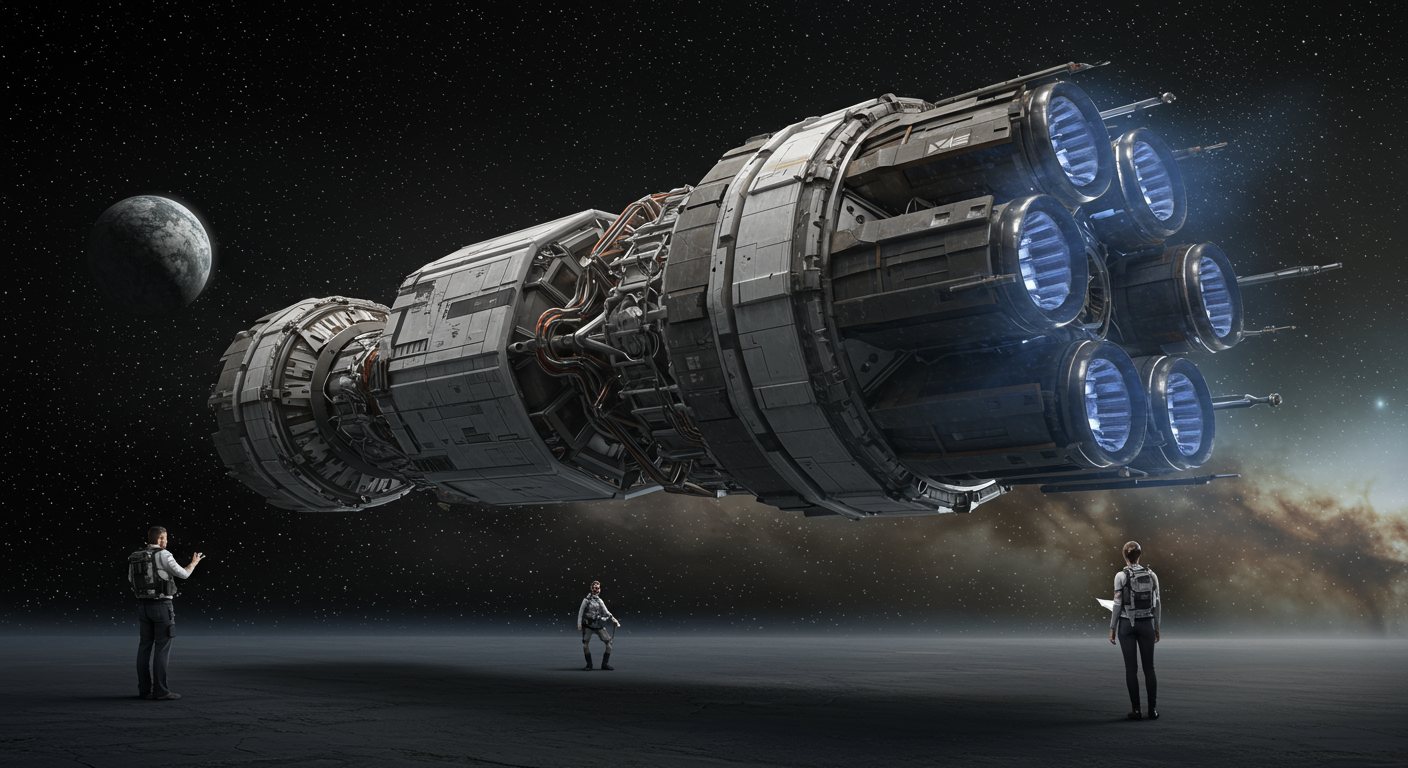
The dream of interstellar exploration is shifting from science fiction to engineering reality as revolutionary propulsion technologies emerge that could enable humanity's first probes to reach nearby star systems within decades rather than millennia.
The Interstellar Challenge: Why Current Propulsion Falls Short
Using today's chemical propulsion systems, a spacecraft would require more than 70,000 years to reach Proxima Centauri, our nearest stellar neighbor at 4.24 light-years away. The fundamental problem lies in mass-energy requirements: carrying enough fuel for interstellar distances creates an exponential mass penalty that makes such missions impractical with conventional rockets.
This reality has driven researchers to pursue revolutionary rather than evolutionary approaches to space propulsion, focusing on concepts that eliminate or dramatically reduce the need to carry fuel.
Light Sail Propulsion: Racing on Photons
The most advanced near-term concept is Breakthrough Starshot's ambitious laser-propelled nanoprobe initiative. This approach uses powerful ground-based laser arrays to accelerate ultra-lightweight spacecraft equipped with reflective light sails, potentially achieving 15-20% of light speed.
The concept involves gram-scale payloads carrying miniaturized scientific instruments that could reach Proxima Centauri in just 20-25 years, with data transmission requiring an additional four years to return to Earth. However, significant technical challenges remain, including maintaining precise beam focusing across interstellar distances, ensuring probe stability during acceleration, and establishing reliable communication systems for such tiny spacecraft.
Solar Sails: Harnessing Stellar Winds
Building on successful interplanetary solar sail missions, advanced materials are enabling larger acceleration ratios for deep space exploration. Modern concepts combine traditional solar pressure with hybrid approaches that incorporate laser propulsion elements for enhanced performance.
While solar sails alone cannot achieve the extreme velocities needed for rapid interstellar transit, they offer advantages for missions requiring larger scientific payloads and more gradual acceleration profiles. These systems excel in specific mission profiles where sustained, fuel-free propulsion provides strategic advantages over conventional approaches.
Fusion Ramjets: The Deep Space Highway
The Bussard ramjet concept, refined through modern computational modeling, proposes collecting interstellar hydrogen as fuel during flight. This approach could theoretically support much larger scientific payloads compared to light sail missions while maintaining impressive velocities.
Current fusion technology gaps present significant hurdles, requiring breakthroughs in magnetic field generation, plasma containment, and efficient fusion reactions at the densities available in interstellar space. Nevertheless, ongoing fusion research for terrestrial energy applications continues advancing the fundamental technologies needed for such propulsion systems.
Antimatter Engines: Ultimate Energy Density
Antimatter propulsion offers theoretical performance advantages that dwarf all other concepts, with matter-antimatter annihilation providing the highest energy density physically possible. Even tiny amounts of antimatter could propel substantial payloads to significant fractions of light speed.
However, current antimatter production capabilities and costs remain prohibitively high, with storage and containment presenting additional engineering challenges. Long-term research directions focus on more efficient production methods and advanced magnetic containment systems, though practical applications remain decades away.
The Miniaturization Revolution
The continued advancement of electronics miniaturization is enabling gram-scale scientific instruments capable of meaningful interstellar observations. Essential sensors, communication systems, and data processing capabilities can now fit into increasingly compact packages.
Power generation and storage at microscale remain critical challenges, with researchers exploring advanced photovoltaic systems, radioisotope power sources, and energy-efficient electronics. The fundamental trade-off between probe size and mission capability continues driving innovation in ultra-compact space systems.
Current Projects and Timelines
The National Aeronautics and Space Administration and the European Space Agency maintain active interstellar propulsion research programs, focusing on near-term technology demonstrations and proof-of-concept missions. Private sector initiatives, particularly the Breakthrough Starshot Initiative, are providing additional funding and development momentum for these ambitious concepts.
Realistic timelines suggest that technology demonstrations for laser-propelled light sails could begin within the next decade, with potential interstellar mission launches possible by the 2040s. More advanced concepts like fusion ramjets and antimatter propulsion remain further in the future, requiring fundamental breakthroughs in their respective technologies.
The convergence of advanced materials science, miniaturized electronics, and novel propulsion concepts is transforming interstellar exploration from distant speculation to engineering challenge, potentially enabling humanity's first steps toward becoming an interstellar species within this century.