NVIDIA’s Rubin Racks Signal a New Era of AI Data Center Power
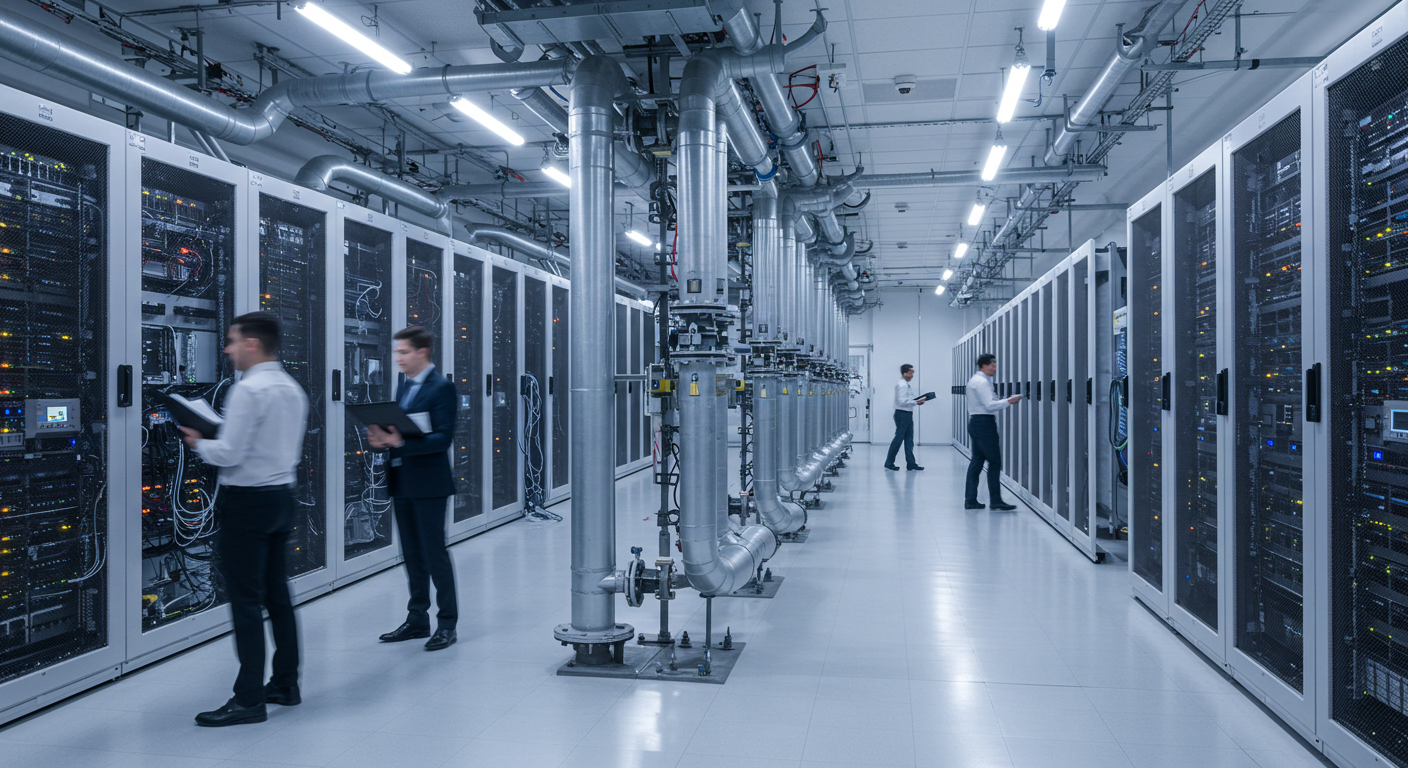
NVIDIA’s Rubin generation is shaping up to be about more than a faster successor to today’s AI hardware. The bigger signal is infrastructural: rack-scale systems on the company’s roadmap are moving toward roughly 300 kilowatts per rack, a level far beyond traditional server rack norms and one that forces data center operators to rethink how buildings are powered, cooled, and configured.
That matters because AI computing is no longer scaling through better chips alone. It is also scaling through denser systems that combine accelerators, high-bandwidth memory, networking, and tightly integrated rack designs into a single deployment unit. In that model, the rack itself becomes a strategic constraint. A new platform is measured not just by performance gains, but by whether a facility can actually supply the electricity and cooling it requires.
NVIDIA’s Rubin racks mark a new step change in AI infrastructure density
NVIDIA has used its data center materials and GTC roadmap updates to position Rubin as part of the next wave of accelerated computing platforms. While exact deployment details will vary by customer and system design, the broader takeaway is clear: AI infrastructure is becoming more concentrated, more integrated, and much more power-dense than conventional enterprise hardware.
That is why the reported roughly 300-kilowatt figure stands out. For years, many enterprise and cloud racks operated at a fraction of that level. AI clusters began changing the equation by increasing accelerator counts, then pushed further toward rack-scale architectures treated more like pre-integrated compute blocks than collections of general-purpose servers.
Rubin therefore represents more than a product milestone in NVIDIA’s lineup. It reflects a broader market shift toward AI systems designed around throughput per rack, networking efficiency, and physical density, even when that creates new pressure on buildings and utilities.
Why 300 kilowatts per rack is such a big deal
A 300-kilowatt rack is notable because it breaks with assumptions that shaped older data center design. Legacy enterprise racks often operated in much lower power ranges, and even modern cloud environments were not originally standardized for these kinds of sustained densities. At AI scale, however, operators are packing more compute into a smaller footprint because moving data quickly between accelerators matters almost as much as raw processor speed.
Several technical factors are driving the increase. Accelerated computing systems place high-performance GPUs in close proximity. High-bandwidth memory adds thermal and electrical complexity. Ultra-fast networking is essential to keep large model training and inference workloads supplied with data. And once vendors move toward rack-scale integration, the power profile of the entire system rises as a unit.
The result is that rack power is no longer a secondary specification buried in deployment documents. It is becoming a first-order design consideration for anyone planning AI capacity at scale.
The bottlenecks are no longer just chips—they are electricity, cooling, and facility design
As rack densities rise, data center constraints become more visible. The challenge is not simply securing access to the latest accelerators. Operators also need enough utility power, adequate internal distribution equipment, resilient backup systems, and buildings that can support the physical and thermal demands of AI hardware.
Cooling is especially important. At extreme densities, traditional air cooling becomes harder to scale efficiently. That is one reason liquid cooling is becoming central to the AI data center conversation. Higher-density deployments may require direct-to-chip liquid cooling or other advanced thermal management approaches that would have been unnecessary in many older facilities.
Independent industry coverage from Data Center Dynamics, Tom’s Hardware, and Reuters has increasingly connected AI chip roadmaps with practical construction and retrofit obstacles. Even when companies can afford the hardware, they may face long lead times for transformers, switchgear, substations, and other electrical infrastructure. In some regions, utility interconnection queues can limit how quickly new AI capacity comes online.
What the “million-watt” conversation actually means
Talk of million-watt AI infrastructure needs to be handled carefully. It does not automatically mean that a standard single rack today is drawing a full megawatt. More often, megawatt-scale planning refers to larger deployment units such as rows, pods, modules, or container-like clusters of integrated AI systems.
That distinction matters because it changes how the trend should be understood. The immediate benchmark is the rise of very high-power racks, including systems around the 300-kilowatt level. The broader shift is that once multiple dense racks are grouped together, operators quickly move into megawatt-class planning for a relatively compact footprint.
So the “race toward million-watt power demands” is best understood as a facility-scale and cluster-scale trajectory. It describes where AI buildouts are heading, not necessarily the draw of any single rack deployed today.
Why hyperscalers and colocation providers are redesigning around AI power density
For hyperscalers, model builders, and colocation providers, power density is becoming a competitive issue. It is no longer enough to have floor space available. Providers increasingly need campuses with enough electrical capacity, suitable cooling infrastructure, and upgrade paths for future rack generations.
That is helping drive larger capital plans across the industry. Reporting from Reuters and Data Center Dynamics has highlighted how AI demand is reshaping data center expansion strategies, with more attention on utility access, substation development, and the procurement of scarce electrical equipment. In many cases, the slowest part of an AI deployment is not software or silicon but the infrastructure needed to support it.
This is one reason NVIDIA’s roadmap matters beyond its own customer base. Every increase in rack density puts pressure on cloud providers and colocation operators to redesign around the needs of AI hardware. Those that adapt faster may gain an advantage in attracting the most demanding training and inference workloads.
Rubin’s significance goes beyond NVIDIA’s product lineup
The deeper story behind Rubin is the industry’s shift from server-centric data centers to what some executives increasingly describe as AI factories. In that model, facilities are designed less around generic compute flexibility and more around delivering massive amounts of power and cooling to concentrated clusters of accelerators.
Denser racks can improve compute concentration and potentially make deployments more efficient in terms of performance per square foot. But they can also narrow the pool of facilities capable of supporting the newest systems quickly. Not every existing site can be upgraded easily to handle these loads, which may favor operators with newer campuses or more aggressive retrofit budgets.
That makes Rubin a useful marker for where AI infrastructure economics are heading. The limiting resource in the next phase may not be demand for compute. It may be how quickly the physical world can be rebuilt around it.
What to watch next
The next important details will likely involve deployment specifics rather than headline chip names. Watch for clearer disclosures from NVIDIA around liquid cooling approaches, rack integration models, and how customers are expected to deploy Rubin-era systems in production environments.
It will also be worth tracking whether operators begin speaking more openly about megawatt-class AI pods, rows, or modules in earnings calls and infrastructure announcements. That kind of language would help clarify how quickly facility planning is converging with the power densities implied by next-generation AI platforms.
Finally, independent confirmation will matter. NVIDIA can define the roadmap, but the real test is how quickly cloud providers, hyperscalers, and colocation operators can adapt buildings and utility relationships to support these power levels at scale.