Nuclear Energy in Space: Powering Missions Beyond Mars
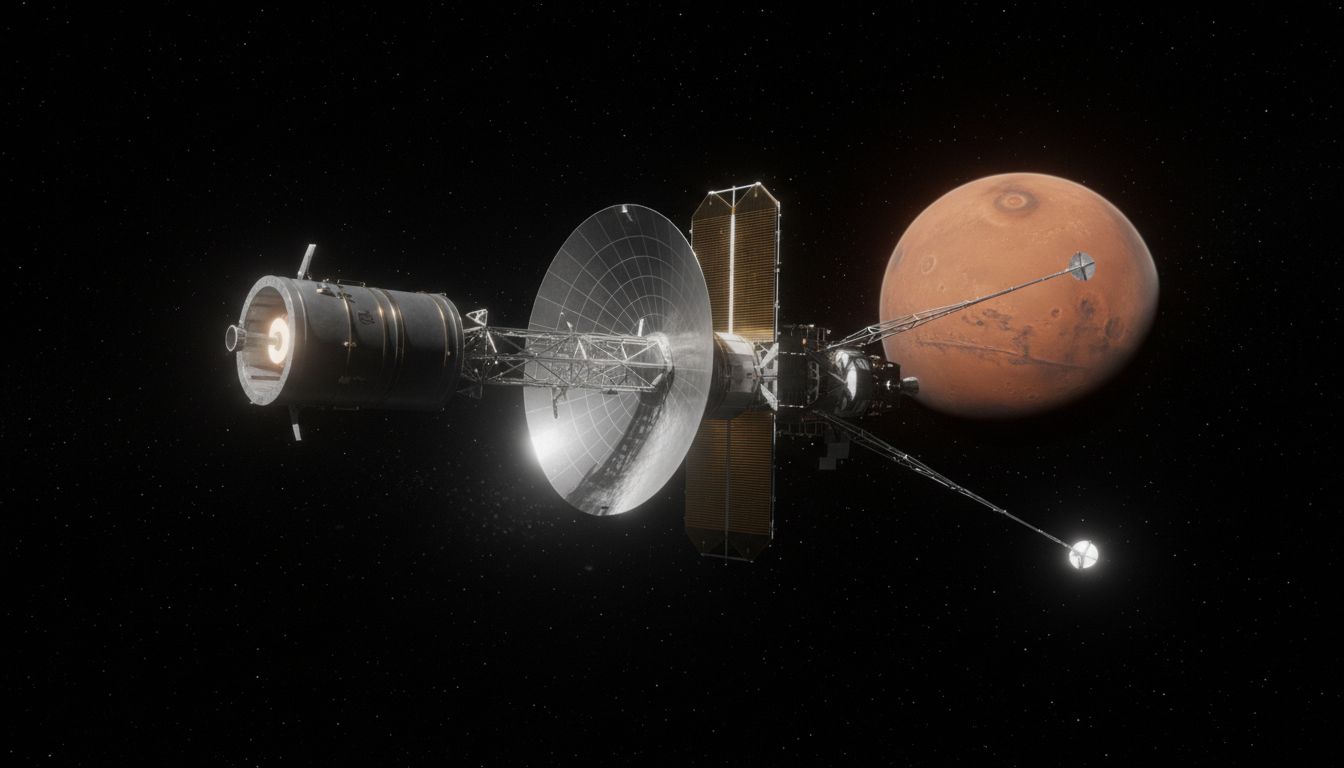
Nuclear Energy in Space: Powering Missions Beyond Mars
As humanity's ambitions push farther into the solar system, the question of how to power spacecraft becomes increasingly critical. Solar panels have served missions well within the inner solar system, but the regions beyond Mars present a fundamentally different challenge, one that is driving renewed investment in nuclear technologies for space applications.
Why Solar Power Runs Out of Road Beyond Mars
Sunlight intensity diminishes sharply with distance from the Sun, following the inverse-square law. A spacecraft operating near Jupiter receives only a fraction of the solar energy available near Earth, and the situation grows more extreme for missions targeting Saturn, Uranus, Neptune, or beyond.
To compensate for this drop-off, solar arrays would need to grow dramatically larger, adding mass, cost, and complexity to spacecraft design. For many outer planet and deep-space missions, this approach becomes impractical or even unworkable. Nuclear power offers a compact, reliable alternative that functions independently of a spacecraft's distance from the Sun, making it an essential tool for extending the reach of exploration.
A Proven Legacy: Radioisotope Power Systems (RPS)
Radioisotope Power Systems have quietly powered some of space exploration's most iconic missions for decades. These systems convert heat generated by the natural radioactive decay of plutonium-238 into electricity, providing a steady, long-lasting power source that requires no sunlight and has no moving parts to wear out.
RPS technology carries an impressive flight heritage. It powered the Voyager probes on their historic journeys through the outer planets and beyond, enabled the Cassini mission's thirteen-year exploration of Saturn, and supported New Horizons on its flyby of Pluto. Closer to home, RPS continues to power the Mars rovers Curiosity and Perseverance, allowing them to operate through dust storms and the cold Martian nights that would challenge solar-powered systems.
This decades-long track record, documented by NASA, underscores why RPS remains a trusted technology for missions in extreme environments, where reliability and longevity often matter more than raw power output.
The Next Frontier: Space Nuclear Propulsion
Beyond generating electricity, nuclear technology is now being explored as a means of propulsion itself. NASA and the Department of Energy have been collaborating on fission-based propulsion systems designed to move spacecraft faster and more efficiently than traditional chemical rockets.
The potential benefits are significant. Faster transit times could reduce the radiation exposure and physical strain associated with long-duration crewed missions to Mars, while also shortening the window of risk inherent in deep-space travel. For robotic missions, reduced transit times could mean more science return within a mission's operational lifetime.
Still, significant technical and engineering challenges remain. Scaling fission reactors for spaceflight requires solving problems related to safety, weight, heat management, and radiation shielding, all under the constraints of launch vehicle capacity. The Department of Energy notes that the strategic implications of this technology are substantial, as success could meaningfully shift the timelines under consideration for future human exploration missions.
JPL and the Engineering Behind Mission-Ready Nuclear Systems
The Jet Propulsion Laboratory has played a central role in translating RPS technology from concept into mission-ready hardware. JPL engineers integrate these power systems into spacecraft architecture, balancing competing demands: the power needs of scientific instruments, the mass constraints imposed by launch vehicles, and the multi-year or even multi-decade durations that many deep-space missions require.
Each mission builds on lessons learned from those that came before it. Insights gained from the operational performance of systems aboard Voyager, Cassini, and the Mars rovers continue to inform the design of future spacecraft, helping engineers anticipate challenges before they arise and refine power system architecture for the missions still to come.
Why This Matters: Competitiveness and the Future of Exploration
Nuclear power in space has drawn growing attention from industry and media outlets alike, a signal that many see as reflecting its strategic importance to the future of exploration. Coverage from Space.com and Reuters has tracked funding developments, program milestones, and policy discussions shaping this field.
As an enabling technology, nuclear power may prove essential for reaching the outer planets and their moons, destinations that hold significant scientific interest but remain largely inaccessible to solar-powered spacecraft. Policy momentum and funding trends will likely play a significant role in determining how quickly these capabilities mature and when they might be deployed on actual missions.
Ultimately, the broader implications extend beyond any single mission. The continued development of nuclear power and propulsion technologies could determine the pace and scope of deep-space exploration for decades to come, shaping humanity's ability to explore beyond Mars and into the farther reaches of the solar system.