Nuclear Energy in Space: Powering Missions Beyond Mars
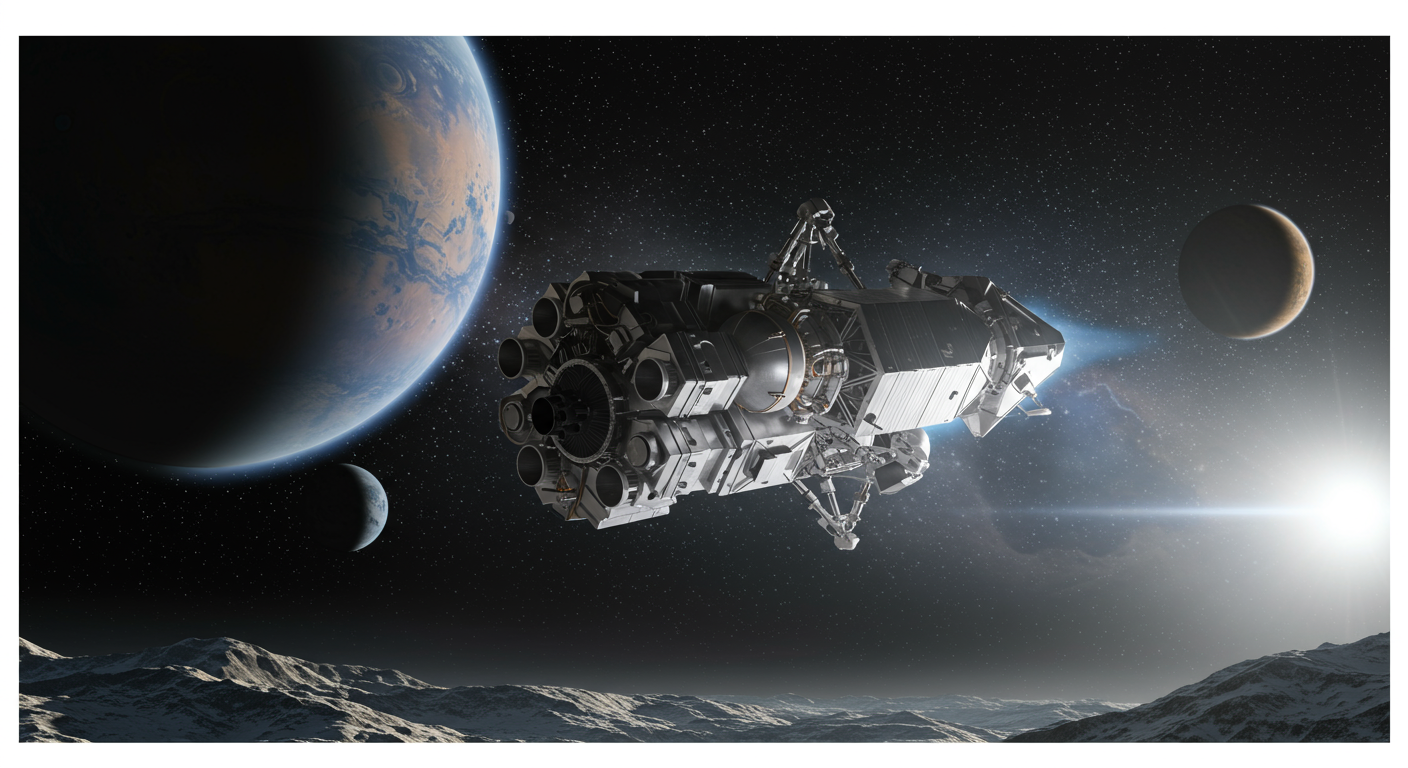
As humanity ventures deeper into the solar system, traditional power sources face fundamental limitations. Solar panels that work efficiently near Earth become nearly useless in the dim light beyond Mars, where sunlight is just a fraction of what reaches our planet. Nuclear energy has emerged as the critical solution, powering some of our most ambitious space missions and enabling exploration that would otherwise be impossible.
Why Nuclear Power is Essential for Deep Space
The mathematics of space exploration are unforgiving. Solar irradiance follows an inverse square law, meaning that at Jupiter's distance from the Sun, solar panels receive only 4% of the energy they would capture at Earth's orbit. By the time spacecraft reach Saturn, that figure drops to just 1%. For missions targeting the outer planets, Kuiper Belt, or interstellar space, solar power simply cannot provide the energy needed for scientific instruments, communications, and propulsion systems.
Deep space missions require reliable power sources that can operate for decades in the harsh environment of space. Nuclear systems offer several critical advantages: they provide consistent power output regardless of distance from the Sun, orientation, or dust accumulation that might affect solar panels. This reliability has made nuclear power the technology of choice for NASA's most ambitious exploration missions.
Radioisotope Thermoelectric Generators: The Proven Workhorse
Radioisotope Thermoelectric Generators (RTGs) represent the most mature nuclear space technology currently in use. These systems convert heat generated by radioactive decay directly into electricity through thermoelectric materials. The process is elegantly simple: plutonium-238 undergoes radioactive decay, producing heat that creates a temperature differential across thermoelectric elements, generating electrical current.
The track record for RTGs is impressive. The National Aeronautics and Space Administration's Voyager spacecraft, launched in 1977, continue to transmit data from interstellar space powered by their RTG systems. The Cassini mission explored Saturn for over 13 years using RTG power, while New Horizons flew past Pluto and continues its journey into the Kuiper Belt. Most recently, the Perseverance rover has been exploring Mars since 2021, its RTG providing the consistent power needed for its sophisticated scientific instruments and sample collection systems.
However, RTG technology faces significant challenges. The supply of plutonium-238, the preferred fuel for these systems, is limited and expensive to produce. Current RTGs also have relatively low efficiency, converting only about 6-7% of the thermal energy into electricity. These limitations have sparked research into more efficient thermoelectric materials and alternative radioisotopes.
Nuclear Thermal Propulsion: Faster Transit to Mars
While RTGs excel at providing electrical power, nuclear thermal propulsion addresses a different challenge: getting to distant destinations faster. Nuclear thermal rockets work by using a nuclear reactor to heat propellant to extremely high temperatures before expelling it through a nozzle. This approach can achieve specific impulse roughly twice that of chemical rockets, dramatically reducing transit times.
For Mars missions, nuclear thermal propulsion could be transformative. Current chemical propulsion systems require approximately nine months to reach Mars, creating significant challenges for crew health, mission complexity, and cost. Nuclear thermal systems could potentially reduce this to three to four months, making human Mars missions more feasible and reducing radiation exposure during transit.
NASA has renewed its commitment to nuclear thermal propulsion through several development programs. The agency is working on reactor designs that can withstand the extreme conditions required for propulsion while maintaining safety standards for launch and operation. Ground testing of nuclear thermal systems presents unique challenges, requiring specialized facilities and extensive safety protocols.
Next-Generation Fission Power Systems
Beyond RTGs and propulsion applications, NASA is developing larger nuclear fission reactors for surface operations on the Moon and Mars. The agency's Kilopower project represents a significant step forward, demonstrating a small nuclear reactor capable of producing up to 10 kilowatts of electrical power. These systems could support lunar bases, Mars habitats, and large-scale scientific installations.
The collaboration between NASA and the Department of Energy has accelerated development of these advanced reactor designs. Unlike RTGs, which rely on radioactive decay, fission reactors can be controlled and scaled to meet varying power demands. This controllability makes them ideal for supporting human missions where power requirements can change dramatically based on mission phases and activities.
Future reactor designs envision megawatt-class systems capable of supporting large-scale operations on Mars, including fuel production, life support systems, and industrial activities needed for permanent settlement. These systems would enable missions that are simply impossible with current power technologies.
Nuclear Electric Propulsion: The Long-Distance Solution
Nuclear electric propulsion combines nuclear power generation with electric propulsion systems like ion drives and plasma thrusters. While these systems provide much lower thrust than chemical or nuclear thermal rockets, they can operate continuously for years, eventually achieving much higher velocities. This makes them ideal for missions to the outer planets and interstellar probes.
The efficiency of electric propulsion systems is remarkable, with specific impulse values ten times higher than chemical propulsion. When powered by nuclear reactors, these systems can operate far from the Sun where solar-powered electric propulsion becomes impractical. The European Space Agency has invested heavily in nuclear electric propulsion research, recognizing its potential for ambitious missions to Jupiter's moons and beyond.
Combining nuclear power with electric propulsion enables mission profiles that would be impossible with other technologies. Spacecraft can gradually spiral out from Earth, building up tremendous velocity over months or years of continuous acceleration.
Safety and Regulatory Framework
Nuclear systems in space operate under strict safety protocols designed to protect both Earth's environment and space assets. Launch safety is paramount, with containment systems designed to survive launch accidents without releasing radioactive material. RTG systems, for example, are built to survive reentry and impact without breaching their fuel capsules.
International guidelines govern the use of nuclear power sources in space, establishing standards for orbital placement, shielding requirements, and end-of-mission disposal. These regulations ensure that nuclear-powered spacecraft don't contribute to orbital debris problems and minimize risks to other space assets.
Environmental considerations extend beyond Earth orbit. Mission planners must consider planetary protection protocols when nuclear-powered spacecraft visit potentially habitable worlds. These guidelines help preserve the scientific integrity of astrobiological research while enabling the exploration that nuclear power makes possible.
Future Missions Enabled by Nuclear Power
The next decade promises exciting missions that will showcase advanced nuclear space technologies. NASA's Europa Clipper mission will use nuclear power to study Jupiter's ice-covered moon, while proposed missions to Enceladus, Titan, and other outer planet destinations rely on nuclear systems for their feasibility.
Perhaps most ambitious are the interstellar probe concepts currently under development. These missions would travel beyond the heliopause to study the interstellar medium, requiring nuclear power systems capable of operating for 50 years or more. Such missions represent the ultimate test of nuclear space technology and could provide humanity's first detailed look at the space between stars.
The timeline for deploying these advanced nuclear technologies extends into the 2030s and beyond. Nuclear thermal propulsion systems may power the first crewed missions to Mars, while advanced fission reactors could support permanent lunar bases and Mars settlements. As these technologies mature, they will open new frontiers for human exploration and scientific discovery throughout the solar system.