Nuclear Energy in Space: Powering Missions Beyond Mars
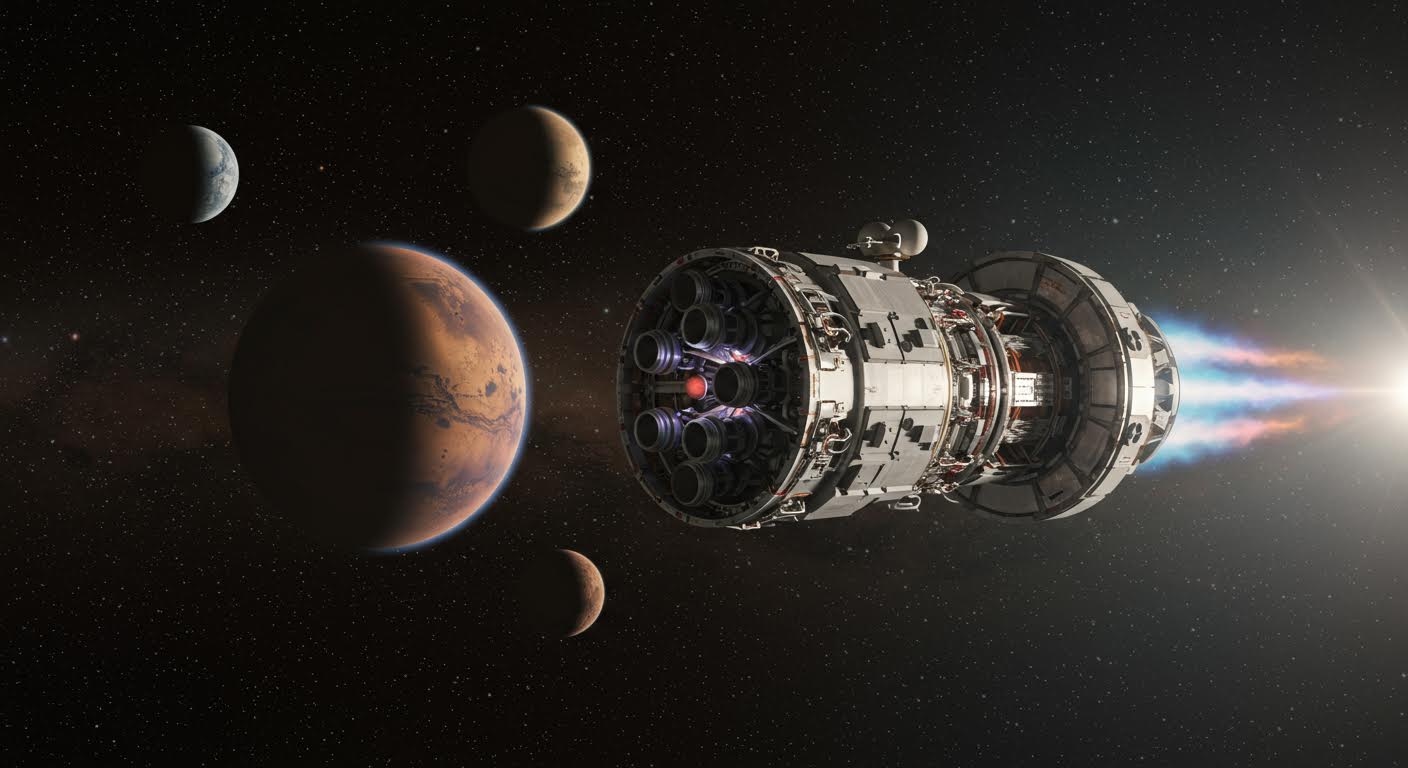
As humanity pushes deeper into space, a critical challenge emerges: how do we power missions to the outer solar system where sunlight barely reaches? The answer lies in nuclear energy—a proven technology that has quietly enabled our most ambitious space missions and promises to revolutionize deep space exploration.
Why Solar Power Falls Short in Deep Space
Distance from the Sun creates an insurmountable power challenge. Solar radiation weakens dramatically as spacecraft venture farther from home—Mars receives only 43% of Earth's solar energy, Jupiter just 4%, and Saturn a mere 1%.
This steep drop-off cripples solar-powered missions. Scientific instruments, communication systems, and propulsion require substantial energy that solar panels simply cannot deliver in the outer solar system. The power shortage becomes even more critical when considering the harsh environments where every system must operate flawlessly for years or decades without maintenance.
Past missions have hit these limits repeatedly. While engineers have pushed solar technology to its breaking point, spacecraft heading beyond Mars consistently need alternative power sources to accomplish their scientific goals.
RTGs: The Reliable Workhorses of Deep Space
Radioisotope Thermoelectric Generators have powered legendary deep space missions for over four decades. These ingenious devices convert heat from radioactive decay directly into electricity—no moving parts, no degradation from cosmic radiation, just steady power for decades.
The track record speaks for itself. Both Voyager spacecraft continue transmitting data after 45+ years in space. Cassini explored Saturn for 13 years. On Mars, nuclear-powered rovers like Curiosity and Perseverance operate through dust storms and harsh winters that would cripple solar-powered vehicles.
But RTGs have limits. Current models generate only 100-500 watts—enough for basic operations but inadequate for power-hungry applications. The fuel source, plutonium-238, faces production bottlenecks due to complex manufacturing and limited global capacity.
Despite these constraints, RTGs remain the gold standard for long-duration missions where solar power won't work. Their proven reliability makes them indispensable for current and planned deep space exploration.
Space Nuclear Reactors: The Next Power Revolution
Nuclear reactors designed for space operations represent a quantum leap in available power. While RTGs provide hundreds of watts, space reactors could deliver thousands—a 10 to 100-fold increase that enables entirely new mission categories.
The National Aeronautics and Space Administration's Kilopower project has already proven the concept, successfully testing compact reactor designs that generate 1-10 kilowatts of continuous power. This breakthrough opens doors to energy-intensive operations previously impossible in deep space.
The engineering challenges are immense. Space reactors must operate in zero gravity without traditional cooling systems, survive extreme temperature swings, and withstand years of radiation bombardment—all while maintaining perfect reliability with no possibility of repair.
These higher power levels transform what's possible. Advanced scientific instruments, high-speed data transmission, active cooling systems, and eventually human life support systems all become feasible with reactor-level power generation.
Nuclear Propulsion: Shrinking the Solar System
Nuclear propulsion could revolutionize space travel by slashing journey times to the outer planets. Two approaches show exceptional promise: nuclear thermal and nuclear electric propulsion.
Nuclear thermal systems use reactor heat to accelerate propellant, achieving much higher exhaust velocities than chemical rockets. This technology could cut Jupiter travel times from 6-7 years to just 2-3 years, fundamentally changing mission planning and scientific opportunities.
Nuclear electric propulsion takes a different approach, using reactor power to run highly efficient ion drives for months or years. While producing lower thrust, these systems offer incredible fuel economy for long-duration missions and complex orbital maneuvers.
Both technologies are advancing through ground testing and component development. Success could enable rapid transit throughout the solar system, making human missions to the outer planets a realistic possibility.
Safety, Regulation, and International Cooperation
Developing space nuclear systems requires unprecedented coordination between the National Aeronautics and Space Administration, the Department of Energy, and international partners like the European Space Agency. Each organization contributes unique expertise to advance these complex technologies safely.
Launch safety protocols are exhaustive. Multiple containment layers and rigorous testing ensure that even catastrophic launch failures cannot disperse radioactive materials. Operational procedures minimize risks throughout entire mission lifecycles, from assembly to disposal.
International treaties provide frameworks for responsible space nuclear development. These agreements balance scientific advancement with safety concerns, ensuring nuclear space power develops within established international law while maintaining public trust.
The Nuclear-Powered Future
The next decade promises major breakthroughs. The National Aeronautics and Space Administration's Artemis program includes nuclear power systems for lunar operations, while future Mars missions will likely depend on nuclear reactors for enhanced capabilities and human life support.
Advanced reactor designs, improved fuel cycles, and innovative power conversion systems are expanding nuclear space power applications. Technology roadmaps envision increasingly sophisticated systems with higher output, better efficiency, and enhanced reliability.
The long-term vision extends far beyond individual missions. Nuclear-powered infrastructure throughout the solar system could support permanent human settlements, industrial operations, and research stations completely independent of solar energy. This infrastructure becomes the foundation for humanity's expansion into interstellar space.
As we stand on the threshold of becoming a multi-planetary species, nuclear energy emerges not just as an option, but as an absolute necessity for powering our journey to the stars.