New Cooling Technologies for Overheating AI Servers
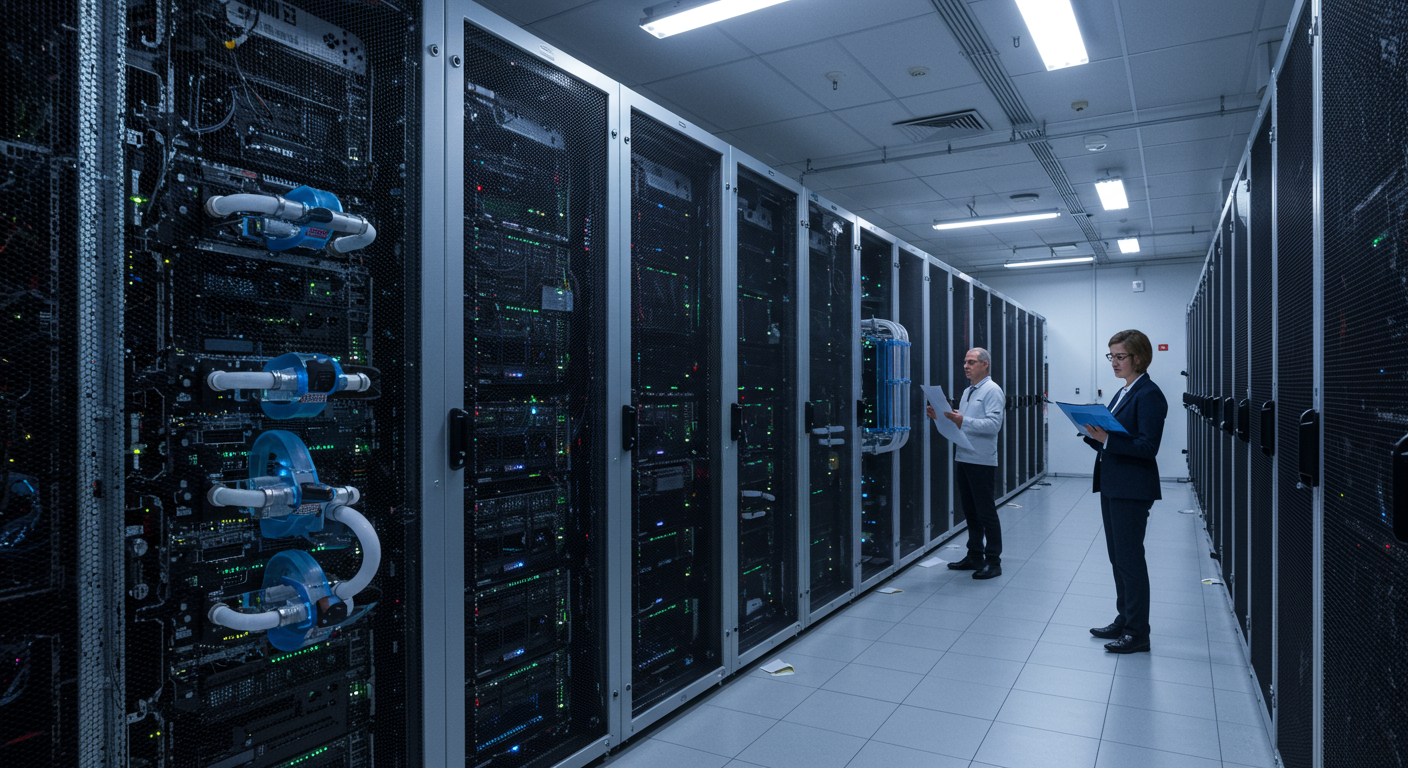
The explosive growth of artificial intelligence has created an unprecedented thermal challenge for data centers worldwide. As AI workloads push server hardware to its limits, traditional cooling methods are proving inadequate, forcing the industry to innovate rapidly or face catastrophic performance losses.
The Heat Crisis: Why Traditional Cooling Falls Short for AI Workloads
AI servers present a fundamentally different thermal challenge than traditional computing workloads. GPU-intensive AI computations generate 3 to 5 times more heat than conventional server applications, creating localized hotspots that can overwhelm standard air cooling systems within minutes.
The root of this challenge lies in power density. Modern AI accelerators like NVIDIA's H100 GPUs can consume up to 700 watts each, with multiple units packed into single servers. This concentration of heat generation creates thermal loads that exceed the capacity of traditional raised-floor air conditioning systems, leading to performance throttling that can reduce AI training speeds by 30% or more.
The cost implications extend beyond performance degradation. Inadequate cooling leads to accelerated hardware failures, with GPU lifespans potentially cut in half when operating temperatures exceed design specifications. For organizations investing millions in AI infrastructure, thermal management has become as critical as the computing hardware itself.
Liquid Cooling: The New Standard for AI Infrastructure
Direct-to-chip liquid cooling has emerged as the primary solution for managing AI server thermals. Unlike traditional air cooling that relies on ambient air circulation, liquid cooling systems pump coolant directly to heat-generating components through specialized cold plates and heat exchangers.
The thermal advantages are substantial. Liquid cooling systems can achieve thermal resistance improvements of 60-80% compared to air cooling, while simultaneously reducing energy consumption by eliminating the need for high-speed server fans. Modern closed-loop liquid cooling architectures provide the reliability and maintenance simplicity that data center operators demand.
Implementation presents distinct challenges depending on facility age. Greenfield data centers can integrate liquid cooling infrastructure from the ground up, incorporating cooling distribution units (CDUs) and piping systems into their initial design. Retrofitting existing facilities requires more complex planning, often involving hybrid approaches that combine liquid cooling for AI workloads with existing air cooling for traditional servers.
Immersion Cooling: The Extreme Solution for Maximum Density
For the highest-density AI deployments, immersion cooling represents the cutting edge of thermal management. This technology submerges entire servers in dielectric fluids that conduct heat away from components while remaining electrically non-conductive.
Two-phase immersion cooling offers the most dramatic results. In these systems, the dielectric fluid boils when it contacts hot components, carrying heat away through phase change and vapor condensation. This approach can handle thermal loads exceeding 200 kilowatts per rack—densities impossible with any other cooling method.
Early adopters in hyperscale AI training facilities report remarkable results. Microsoft's underwater data center experiments and specialized AI training clusters using immersion cooling have demonstrated both thermal performance and unexpected benefits like reduced component vibration and improved reliability.
The technology requires careful consideration of fluid selection and environmental impact. Modern dielectric fluids are designed for safety and environmental compatibility, but disposal and recycling protocols remain important factors in deployment decisions.
Hardware Manufacturer Solutions: Purpose-Built Cooling Integration
Major hardware manufacturers have responded to AI cooling challenges with purpose-built solutions. NVIDIA's liquid cooling roadmap for current H100 and future AI accelerators includes factory-integrated cooling solutions that eliminate retrofit complexity for data center operators.
Intel's approach focuses on thermal design optimization for AI-specific processors, incorporating advanced thermal interface materials and heat spreader designs that work synergistically with liquid cooling systems. The company's latest AI-optimized processors feature enhanced thermal monitoring and dynamic frequency scaling specifically tuned for sustained AI workloads.
AMD has partnered with cooling specialists to develop integrated solutions for their AI accelerators, while server OEMs like Dell, HPE, and Supermicro offer factory-integrated liquid cooling options that arrive ready for high-density AI deployments.
Infrastructure Redesign: Adapting Data Centers for Next-Generation Cooling
The shift to advanced cooling technologies requires fundamental changes in data center design and operation. Cooling distribution units must be strategically positioned to minimize pressure drops and maximize cooling efficiency across AI server clusters.
Modern facilities employ hybrid cooling strategies that match cooling technologies to workload requirements. Traditional air cooling handles standard enterprise workloads, direct liquid cooling manages high-performance AI training, and immersion cooling tackles the most extreme density requirements.
Advanced monitoring and control systems have become essential for managing these complex cooling architectures. Real-time thermal monitoring, predictive maintenance algorithms, and automated load balancing ensure optimal performance while preventing thermal emergencies that could damage expensive AI hardware.
Energy Efficiency and Sustainability Considerations
Advanced cooling technologies deliver significant improvements in Power Usage Effectiveness (PUE), a key metric for data center efficiency. Liquid-cooled AI facilities routinely achieve PUE ratings below 1.3, compared to 1.6-2.0 for traditional air-cooled facilities.
Heat recovery presents new opportunities for AI data centers. The high-grade waste heat from liquid cooling systems can be captured for building heating, industrial processes, or even district heating systems in urban areas. Some facilities report recovering 60-80% of waste heat for productive uses.
Environmental considerations extend to cooling fluid selection and lifecycle management. Modern dielectric fluids are increasingly designed for biodegradability and safe disposal, while liquid cooling systems use recyclable coolants that minimize environmental impact.
ROI calculations strongly favor advanced cooling investments. While initial capital costs for liquid or immersion cooling systems can be 40-60% higher than traditional air cooling, operational savings from improved efficiency and reduced hardware failures typically provide payback within 18-24 months for high-density AI deployments.
Looking Ahead: Future Cooling Technologies and Industry Trends
Emerging cooling technologies promise even greater efficiency gains. Thermosiphon cooling systems that rely on natural convection rather than pumps offer simplified maintenance and improved reliability. Advanced phase-change materials are being integrated directly into server components, providing thermal buffering for peak load conditions.
Integration with renewable energy systems presents new possibilities. Some facilities are experimenting with cooling systems that scale with renewable energy availability, using excess solar or wind power for enhanced cooling during peak generation periods.
Industry standardization efforts are accelerating as cooling becomes more critical. Organizations like the Open Compute Project are developing standards for liquid cooling interfaces, while ASHRAE continues updating thermal guidelines specifically for AI workloads.
As AI models continue scaling in size and computational requirements, thermal management will only grow in importance. The next generation of AI training clusters may require cooling technologies that don't exist today, driving continued innovation in this rapidly evolving field.