Inside the Hardware That Makes Modern Electric and Self-Driving Cars Possible
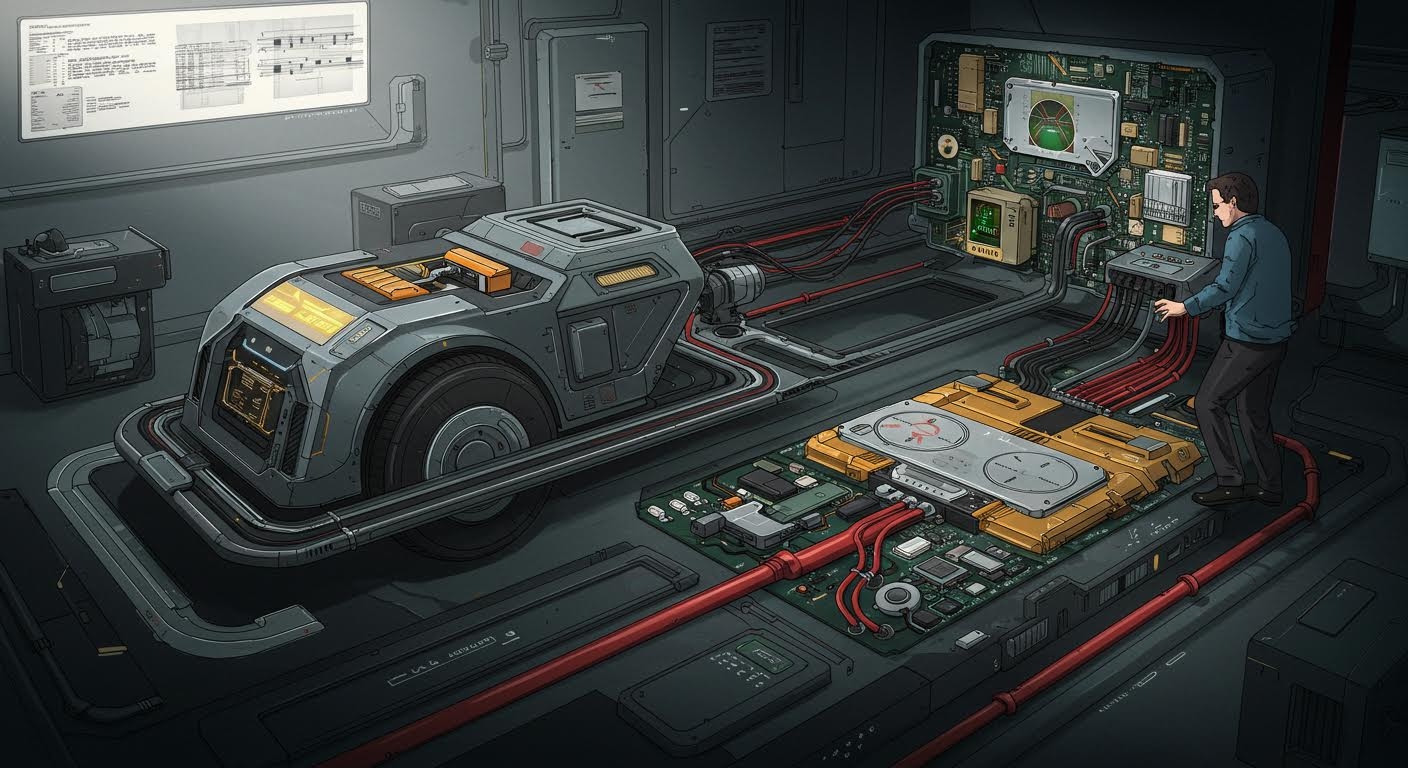
The Silicon Revolution on Wheels
Modern vehicles have evolved far beyond their mechanical origins to become sophisticated computing platforms on wheels. Today's electric and self-driving cars represent a remarkable convergence of electric powertrains and autonomous driving technology, powered by an intricate ecosystem of specialized hardware components.
The transformation from traditional automobiles to intelligent machines requires multiple categories of advanced hardware working in harmony: high-performance computing platforms for real-time decision making, specialized semiconductors optimized for automotive applications, comprehensive sensor systems that serve as the vehicle's eyes and ears, and sophisticated power management systems that handle electric propulsion efficiently.
Computing Platforms: The Brains Behind Autonomous Driving
At the heart of every self-driving vehicle lies a powerful computing platform capable of processing massive amounts of sensor data in real-time. NVIDIA's automotive AI computing platforms have emerged as industry leaders, offering the processing power necessary for complex machine learning inference and sensor fusion algorithms that enable autonomous navigation.
Tesla has taken a different approach with their custom Autopilot hardware, developing vertically integrated computing solutions specifically tailored to their autonomous driving algorithms. This custom silicon approach allows Tesla to optimize both hardware and software together, potentially achieving better performance and efficiency than general-purpose solutions.
Qualcomm contributes automotive processors that handle connectivity and infotainment integration, ensuring vehicles remain connected to cloud services while managing the computational demands of advanced driver assistance systems. The processing power requirements scale dramatically across SAE automation levels, with fully autonomous vehicles requiring significantly more computational resources than vehicles with basic driver assistance features.
Specialized Semiconductors: Purpose-Built for Automotive Applications
The automotive environment presents unique challenges that require specialized semiconductor solutions. Custom chips optimized for sensor fusion and AI inference must operate reliably in vehicles while meeting stringent automotive-grade requirements for temperature tolerance, vibration resistance, and long-term reliability.
Power efficiency considerations become particularly critical in battery-powered electric vehicles, where every watt of computing power directly impacts driving range. Engineers must balance computational performance with energy consumption to maximize vehicle efficiency.
Automotive hardware architectures incorporate redundancy systems and fail-safe mechanisms to ensure safe operation even when individual components fail. These safety-critical systems often require multiple independent processors that can take over vehicle control if the primary system encounters problems.
Sensor Systems: Eyes and Ears of Autonomous Vehicles
Autonomous vehicles rely on sophisticated sensor systems to perceive and understand their environment. LiDAR technology plays a crucial role in 3D environmental mapping, using laser pulses to create detailed point clouds that help vehicles navigate complex scenarios with precision.
Camera systems and computer vision hardware work together to interpret visual information, requiring specialized image processing capabilities that can identify objects, read road signs, and understand traffic patterns in real-time. These systems must process high-resolution video streams continuously while maintaining low latency for safety-critical decisions.
Radar sensors provide all-weather detection capabilities that remain functional in conditions where cameras and LiDAR might be compromised by rain, snow, or fog. Multiple radar units positioned around the vehicle create a comprehensive detection envelope for safe navigation.
Ultrasonic sensors handle close-proximity detection and parking assistance, providing the fine-grained distance measurements necessary for precise maneuvering in tight spaces.
Electric Vehicle Hardware: Power Management and Battery Systems
Electric vehicles require sophisticated power management systems that go far beyond traditional automotive electrical systems. Battery management systems monitor individual cell voltages, temperatures, and charging states while coordinating thermal control hardware to maintain optimal operating conditions.
Power electronics including inverters, converters, and motor controllers manage the flow of electrical energy between batteries, motors, and various vehicle systems. These components must efficiently handle high voltages and currents while maintaining precise control over motor performance.
Charging infrastructure hardware enables fast-charging capabilities that make electric vehicles practical for long-distance travel. The integration between charging systems and vehicle hardware requires sophisticated communication protocols and safety mechanisms.
Integration challenges arise when combining EV powertrains with autonomous driving systems, as both subsystems compete for electrical power and computational resources while maintaining safety and performance requirements.
Standards and Future Hardware Evolution
The SAE J3016 standard defines automation levels from 0 to 5, with each level requiring progressively more sophisticated hardware capabilities. These standards provide a framework for understanding the hardware requirements necessary to achieve different levels of autonomous driving functionality.
Industry standards for automotive computing and safety systems ensure interoperability and reliability across different manufacturers and suppliers. Organizations like SAE International and IEEE develop these standards to guide hardware development and deployment.
Emerging hardware technologies on the horizon include quantum sensors that could provide unprecedented precision for navigation and positioning, and neuromorphic chips that mimic brain-like processing to achieve better efficiency for AI workloads.
The timeline for next-generation automotive hardware platforms suggests continued rapid evolution, with new processor architectures, sensor technologies, and power management systems expected to enable even more advanced autonomous driving capabilities in the coming years.