Hyperscale AI Data Centers and the Energy Pressure Behind the Boom
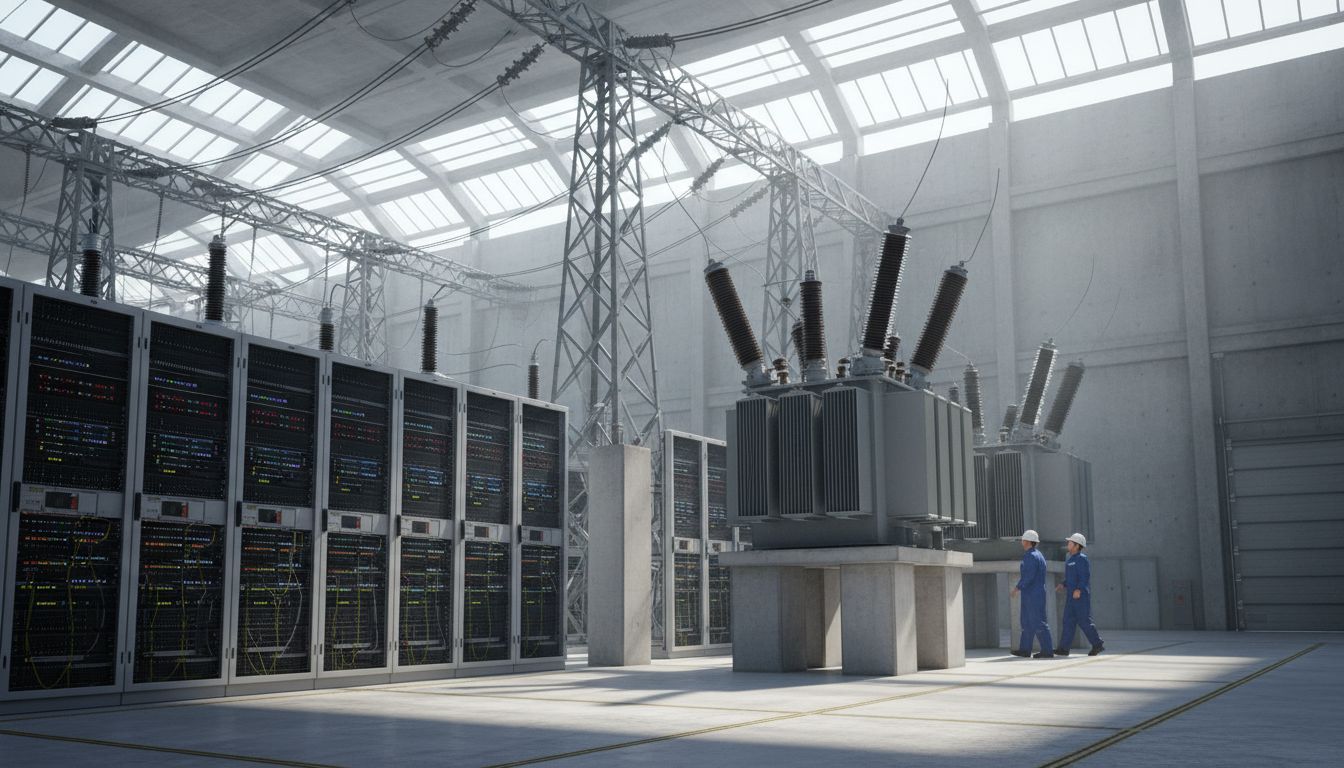
Artificial intelligence has become as much an energy story as a software story. The latest wave of hyperscale data centers is not simply adding more servers to the internet's backbone. It is concentrating enormous amounts of power-hungry computing into single campuses built for AI model training and always-on inference.
That shift matters because AI expansion is pushing electricity demand higher at a pace many grids, utilities, and permitting systems were not designed to handle. The result is growing tension between the push to scale AI quickly and the slower realities of power generation, transmission upgrades, substations, transformers, and local interconnection timelines.
It is also important to separate what is already visible from what is still forecast. The established trend is clear: data centers were already a meaningful and growing source of electricity demand before the generative AI boom, and AI is now accelerating that trajectory. The less certain question is how large the next jump will be, where it will hit first, and how quickly infrastructure can catch up.
Why AI data centers have become an energy story
Earlier eras of cloud computing consumed large amounts of electricity, but hyperscale AI facilities represent a different kind of load. Instead of supporting a broad mix of enterprise applications, storage, and conventional web services, these sites increasingly cluster dense arrays of accelerators running at high utilization for long periods. That changes both the scale and the shape of demand.
For utilities and grid planners, this is not just about annual electricity totals. A very large AI campus can create an immediate local need for transmission capacity, substation upgrades, and reliable power delivery that far exceeds what a site might have required in the past. In practical terms, the question is no longer only whether enough electricity exists somewhere on the system, but whether it can be delivered to a specific project on the timetable the operator wants.
The baseline: what the most credible energy data already shows
The clearest baseline comes from the International Energy Agency and the U.S. Energy Information Administration. Their data shows that electricity demand is rising in several regions and that data centers are already an important contributor to load growth, especially in the United States. That means the AI debate is building on top of an existing trend rather than creating one from scratch.
The U.S. picture matters because many of the world's largest hyperscale and AI infrastructure projects are concentrated there. Reporting from the U.S. Energy Information Administration shows that data center demand is becoming increasingly visible in utility planning and regional load forecasts. That does not mean every part of the country faces the same level of stress, but it does mean data centers have shifted from being a background load to a strategic planning issue in some markets.
Globally, the picture is more uneven. Some regions have stronger grid capacity, faster build-out potential, or more abundant low-cost power than others. That is why readers should be careful not to assume that a grid bottleneck in one U.S. market automatically describes Europe, Latin America, or Asia. The broad pattern is shared, but the intensity is local.
What makes AI workloads different from previous data-center growth
AI training is unusually power-dense because it relies on large clusters of GPUs or other accelerators running in parallel, often for extended periods. These systems are expensive, so operators are motivated to keep them busy. High utilization improves the economics of the hardware, but it also keeps electricity consumption elevated.
Inference may prove to be an even more persistent energy driver. Training runs are episodic, but inference becomes part of everyday products once AI features are embedded into search, productivity software, coding tools, customer service systems, and consumer applications. If those services become standard digital infrastructure, then compute demand shifts from occasional bursts to a more continuous load.
That is one reason AI differs from many earlier cloud workloads. Traditional enterprise applications often had lower compute intensity and more variable usage patterns. AI systems, especially the largest ones, combine dense hardware, cooling demands, and a business case that favors keeping expensive compute assets active.
Why hyperscale concentration turns demand growth into a grid problem
Even if national generation looks adequate in aggregate, hyperscale development can still create regional strain. A single large AI data center or campus can require so much power that local infrastructure becomes the real bottleneck. Transmission lines may need upgrades. Nearby substations may lack capacity. Utilities may face years-long lead times to provide service at the requested scale.
This is why data center siting is increasingly shaped by deliverable power rather than land alone. A developer may find a suitable parcel, but if the utility cannot interconnect the facility quickly, the project loses strategic value. In the AI race, time matters, and electrical readiness is becoming a competitive advantage.
These constraints can also ripple outward. When multiple hyperscalers target the same region for tax incentives, fiber connectivity, or favorable regulation, they can run into the same physical grid limits at once. What looks manageable on a spreadsheet can turn into a queue problem in the real world.
The forecasts are rising fast, but they are not all saying the same thing
Forward-looking estimates from banks, consultants, and industry analysts point in the same general direction: AI is likely to push data-center electricity demand significantly higher. Goldman Sachs has projected a major increase in power demand tied to AI and data centers, while McKinsey has highlighted the growing tension between compute needs and infrastructure capacity.
Still, these projections should be treated as directional rather than settled fact. Forecasts differ by geography, time horizon, and assumptions about how much demand will come from training versus inference. They also vary in how they account for efficiency gains, chip advances, workload optimization, and changes in business adoption.
That uncertainty matters, but only up to a point. The exact numbers are still debated. The broader conclusion is not. AI is increasing the electricity intensity of future data-center growth, and planning systems that were already under pressure must now accommodate larger and faster-moving loads.
The bottleneck is bigger than generation alone
When people hear about rising electricity demand, they often jump straight to generation. But generation is only part of the challenge. New transmission takes years to permit and build. Transformer supply has tightened in many markets. Interconnection queues are long. Utility service timelines do not always match the speed investors and operators want.
There are also physical constraints inside the facility footprint. Dense AI hardware creates more heat, which increases cooling requirements and can raise water or infrastructure concerns depending on the design and location. Suitable land near strong power infrastructure is limited. Local permitting can slow projects even when financing and equipment are available.
In other words, having capital and chips is no longer enough. AI infrastructure can be delayed by the same kinds of industrial bottlenecks that affect power plants, transmission corridors, and other heavy infrastructure projects.
How operators are trying to contain the energy burden
Data center operators are not standing still. One line of defense is efficiency: custom accelerators, better workload scheduling, software optimization, and more efficient model serving can all reduce the energy required per unit of useful AI output. Improvements at the hardware and software layers may not eliminate demand growth, but they can soften it.
Another response is facility design. Operators are investing in more advanced cooling systems, revised layouts, and siting strategies that place projects closer to stronger power resources or more expandable utility territories. Some are also structuring power procurement more aggressively through long-term contracts, utility partnerships, and, in limited cases, on-site generation or backup strategies that can support reliability goals.
These measures help, but they do not remove the core constraint. Efficiency can slow the rate of energy growth, yet rapid increases in AI adoption can still overwhelm those gains if usage expands faster than the underlying systems improve.
What this means for the future of AI growth
Access to power is becoming a strategic input for AI alongside semiconductors, capital, and talent. That has consequences for where new infrastructure gets built, which utilities become central to the AI economy, and which regions can realistically compete for hyperscale investment.
It may also shape the business model of AI itself. If electricity and grid access become scarcer or more expensive in prime markets, companies will have stronger incentives to optimize models, prioritize higher-value workloads, and rethink where training and inference are deployed.
The most balanced way to frame the moment is this: hyperscale AI data centers are not creating a uniform global energy crisis on their own. But they are creating real and growing regional electricity pressures, and those pressures are becoming serious enough to influence where AI expands, how fast it expands, and what infrastructure must be built to support it.