How Space Mining Technology Could Reshape the Global Economy
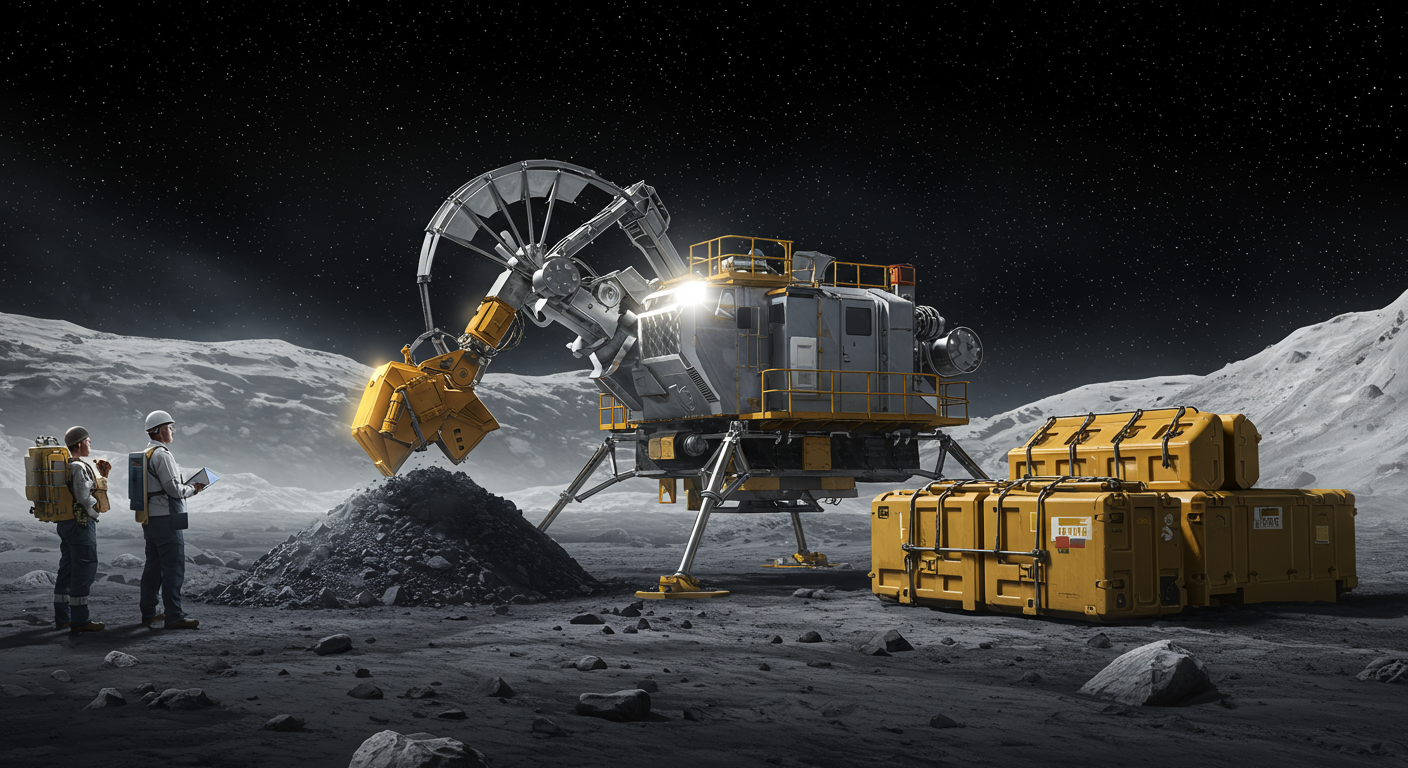
Space mining has a way of generating headlines that jump straight to visions of trillion-dollar asteroids and sudden economic upheaval. The more realistic story is slower, narrower, and arguably more important. If space mining reshapes the global economy, it will most likely do so first by changing the economics of space itself.
That matters now because the underlying conditions have changed. Launch costs have fallen from earlier eras, lunar programs are back on the agenda, and advances in robotics, autonomy, remote operations, and spacecraft servicing have made off-world resource extraction easier to imagine as an engineering challenge. But imagining it is not the same as industrializing it. The central question is no longer whether some form of space resource extraction is technically conceivable. It is whether it can become reliable, repeatable, and economically useful at scale.
Why space mining matters now
Renewed interest in space mining reflects a broader shift in space strategy. Governments and private firms are no longer thinking only in terms of isolated missions. They are increasingly planning for a sustained presence in cislunar space, activity on the lunar surface, satellite servicing, and longer-duration missions that would benefit from local supplies of fuel, water, and construction material.
From that perspective, space mining is less about shipping exotic wealth back to Earth in the near term and more about lowering the cost of operating beyond Earth. If resources can be found, extracted, and processed where they are needed, the logic of every mission changes. Launching less mass from Earth can reduce costs, ease mission-design constraints, and support infrastructure that would otherwise remain prohibitively expensive.
What space mining actually includes
The term covers several distinct activities. It can refer to extracting water ice from permanently shadowed lunar regions, harvesting volatiles that can be turned into propellant or life-support inputs, processing regolith for construction or shielding, or eventually obtaining metals and other materials from asteroids.
These are not all the same business. Lunar resource extraction and asteroid mining differ sharply in mission design, operational complexity, transport requirements, and likely timelines. The Moon is relatively close, strategically important, and increasingly central to national space plans. Asteroids may contain valuable materials, but reaching, extracting, processing, and transporting those resources involves a very different set of technical and economic hurdles.
There is also an essential distinction between mining for use in space and mining for return to Earth. The former has a clearer near-term rationale because resources like water can be extraordinarily valuable when they do not have to be launched from Earth. The latter faces a much tougher business case because any material returned to terrestrial markets must overcome transport costs, processing challenges, and the risk of depressing the very prices that made it attractive in the first place.
The technology is plausible, but the barriers are still enormous
Space agencies such as the National Aeronautics and Space Administration and the European Space Agency have spent years studying in-situ resource utilization, asteroid science, robotic extraction concepts, and the systems needed to make use of off-world materials. At a technical level, the concept is not fantasy. Prospecting systems can identify promising deposits. Autonomous robots can operate in remote environments. Processing techniques for extracting water or oxygen from local materials have been explored in laboratories and mission concepts.
Still, technical plausibility should not be confused with commercial readiness. Mining on Earth is difficult enough in environments with gravity, abundant power, hands-on maintenance, and developed logistics. Space adds vacuum, radiation, extreme temperature swings, communication delays, abrasive dust, limited repair options, and severe power constraints. A successful demonstration is one thing. Building an industrial system that works again and again at an acceptable cost is another.
That gap between feasibility and dependable operations is the central barrier. A company or agency does not just need to prove that extraction can happen once. It must show that prospecting is accurate, equipment can survive, processing yields are predictable, storage losses are manageable, and the final resource can be delivered where needed more cheaply or more reliably than launching it from Earth.
The most credible early market is water, not platinum
The strongest near-term economic case for space mining is not a rush of precious metals into terrestrial markets. It is water and other volatiles used in space. Water can support crews directly, provide radiation shielding, and potentially be split into hydrogen and oxygen for propellant. In orbit or on the Moon, that makes it a strategic commodity.
If propellant or life-support resources can be produced off Earth, missions no longer need to carry every kilogram from launch. That could support fuel depots, lunar operations, deep-space staging, and longer-lived orbital systems. In practical terms, it would turn resource extraction into a logistics play. The value would come less from the intrinsic rarity of a material and more from where it is available and how much mass it saves from being launched from Earth.
By contrast, the idea of returning platinum-group metals or other high-value asteroid materials to Earth is far more speculative. Even if such materials are present in meaningful quantities, the path to profitable recovery is uncertain. The cost of reaching a target, extracting usable material, refining it, and bringing it home safely is immense. There is also a market problem: a resource can look extraordinarily valuable on paper yet be far less valuable if new supply drives prices down or if recovery takes decades.
How space mining could change the economics of space itself
This is where the broader economic implications become more compelling. If off-world resources become usable, they could support a new supply chain beyond Earth. Water could feed propellant production. Regolith could be used for landing pads, shielding, or construction feedstock. Locally sourced materials could support lunar bases, servicing platforms, and potentially some forms of manufacturing in orbit.
That would not instantly transform the global economy, but it could create a new industrial layer with meaningful consequences. Space activity today is constrained by launch mass, mission duration, and the high cost of replacing or resupplying critical inputs. Local resource use could lower marginal mission costs, extend operational windows, and make more permanent infrastructure easier to justify. In that environment, entirely new business models become more plausible, from orbital logistics to persistent lunar operations.
In other words, the first major economic effect of space mining may be expansion within the space economy rather than disruption of mining and commodities on Earth. The companies and countries that build extraction, processing, storage, and transportation systems in space may gain influence over the next phase of aerospace commerce.
What this could mean for the global economy on Earth
The Earth-side impact is likely to be indirect for a long time. Space mining could matter less because it floods terrestrial markets with new raw materials and more because it changes who controls strategically important infrastructure. A nation or consortium that leads in cislunar logistics, resource mapping, extraction systems, and in-space fuel production could gain leverage across aerospace, defense, communications, and advanced manufacturing value chains.
That would have familiar economic effects. Industrial concentration could increase around firms with access to launch capacity, robotics, energy systems, and space-operations expertise. Strategic competition could intensify as major powers seek to avoid dependence on rivals for off-world infrastructure. Technological leadership in autonomy, remote extraction, materials processing, and power systems could also spill over into terrestrial industries.
Claims that space mining will soon overturn global commodity markets deserve caution. Even under optimistic assumptions, any impact on Earth-based resource prices would likely be slow and uneven. Terrestrial mining remains vastly more mature, better understood, and supported by existing infrastructure. For decades, off-world extraction is more likely to complement Earth economies by enabling new space activity than to replace major portions of conventional resource supply.
The geopolitical and regulatory stakes
Engineering is only part of the story. The economic winners in space resources may be determined as much by legal and political clarity as by hardware. Questions around licensing, property rights, environmental standards, priority access, and international norms remain unsettled. Different national approaches to space-resource law could shape investment incentives and create friction between commercial ambition and multilateral governance.
That makes space mining a geopolitical issue as much as a technological one. Major space powers already view cislunar space and lunar infrastructure through strategic lenses. Resource extraction, even when framed as commercial, can intersect with national prestige, security concerns, and long-term industrial planning. Whoever helps define the rules early may also help define the market.
This is one reason policy clarity matters. Investors are unlikely to commit to expensive, long-horizon projects without confidence that extracted resources can be owned, used, sold, or transferred under stable rules. A technically capable system without legal certainty may struggle to attract capital. A strong regulatory framework, by contrast, could accelerate development even before extraction becomes routine.
Why hype has outpaced the business case
Much of the public excitement around space mining comes from a simple but misleading calculation: estimate the amount of metal in an asteroid, multiply by Earth-market prices, and present the result as future wealth. That approach ignores nearly everything that matters commercially, including recoverability, mission cost, processing losses, financing, insurance, timing, and market absorption.
Theoretical resource value is not the same as realizable economic value. A deposit can be enormous and still be commercially irrelevant if it cannot be accessed at an acceptable cost. It can also be strategically useful without being profitable in a traditional mining sense. Water on the Moon, for example, may never produce sensational headline valuations, yet it could be more economically transformative for space operations than a distant metal-rich asteroid.
For that reason, any serious discussion has to separate three different questions: Is it technically possible? Can it become a viable business? And would it be large enough to matter at a macroeconomic level? Those questions are related, but they are not interchangeable.
A realistic outlook for the next few decades
The most plausible path is phased. First come prospecting missions, mapping, and technology demonstrations. After that, if results are promising, limited operational systems for extracting and using resources in place could emerge, especially around lunar water and construction materials. Only later would large-scale, repeatable logistics networks make space resources a normal input into commercial activity beyond Earth.
The milestones worth watching are not dramatic promises about asteroid fortunes. They are quieter indicators of industrial maturity: reliable detection of usable deposits, successful extraction demonstrations in relevant environments, routine conversion of local material into usable consumables, and repeated delivery of those consumables into actual mission operations. When off-world resources stop being experiments and start becoming part of logistics planning, the economics begin to change.
Over the long run, space mining could help reshape the global economy. But the mechanism is likely to be gradual. Rather than arriving as a sudden extraterrestrial windfall, its biggest impact may come from enabling a new off-world industrial system that changes transportation, manufacturing, strategic competition, and the cost structure of operating in space. If that system takes hold, the economic consequences on Earth will follow not as a single shock, but as the expansion of a new domain of industry.