How Quantum Computing Hardware Is Reaching Practical Limits
Quantum computing has long been heralded as the next revolutionary leap in computational power, promising to solve problems that would take classical computers millennia to crack. However, as the field matures, researchers and engineers are confronting fundamental physical and engineering limits that reveal just how challenging the path to practical quantum computing truly is.
The Current State of Quantum Hardware Limitations
Today's quantum computers exist in what researchers call the Noisy Intermediate-Scale Quantum (NISQ) era. These machines can perform quantum operations on 50 to several hundred qubits, but they're plagued by errors and instabilities that severely limit their practical applications. Unlike classical computers, where adding more transistors generally means more computational power, scaling quantum systems involves exponentially more complex challenges.
The practical limits of quantum hardware are measured by three critical metrics: coherence time (how long quantum states can be maintained), gate fidelity (the accuracy of quantum operations), and connectivity (how qubits can interact with each other). Current systems struggle to achieve the combination of all three metrics necessary for fault-tolerant quantum computation.
Decoherence: The Fundamental Challenge
Decoherence represents perhaps the most fundamental obstacle to practical quantum computing. Quantum states are extraordinarily fragile, easily disrupted by environmental noise, temperature fluctuations, electromagnetic interference, and even cosmic rays. When decoherence occurs, the quantum information that gives these computers their power is lost.
Current coherence times vary dramatically across different quantum systems. Superconducting qubits, used by companies like IBM and Google, typically maintain their quantum states for microseconds to milliseconds. Trapped ion systems can achieve longer coherence times, sometimes extending to seconds, but they face other scaling challenges. Even small vibrations, temperature changes measured in millikelvins, or stray magnetic fields can cause catastrophic loss of quantum information.
Engineering approaches to extend coherence times include sophisticated error correction codes, better isolation from environmental noise, and improved materials science. However, each improvement often comes with trade-offs in other areas, such as operational speed or system complexity.
Error Rates and the Quantum Error Correction Bottleneck
Current quantum systems exhibit error rates that make them unsuitable for most practical applications. Leading quantum computers have gate error rates ranging from 0.1% to 1% per operation. While this might sound reasonable, quantum algorithms often require thousands or millions of operations, causing errors to accumulate rapidly.
The mathematics of quantum error correction reveal a daunting challenge: achieving fault-tolerant quantum computation requires error rates below a critical threshold, typically around 0.01%. More challenging still, each "logical" qubit that can perform reliable computation may require hundreds or thousands of physical qubits for error correction.
This means that a quantum computer capable of running Shor's algorithm to break current cryptographic systems would need millions of physical qubits, while today's largest systems have only hundreds. The gap between current capabilities and practical requirements remains enormous.
Scaling Challenges Across Quantum Technologies
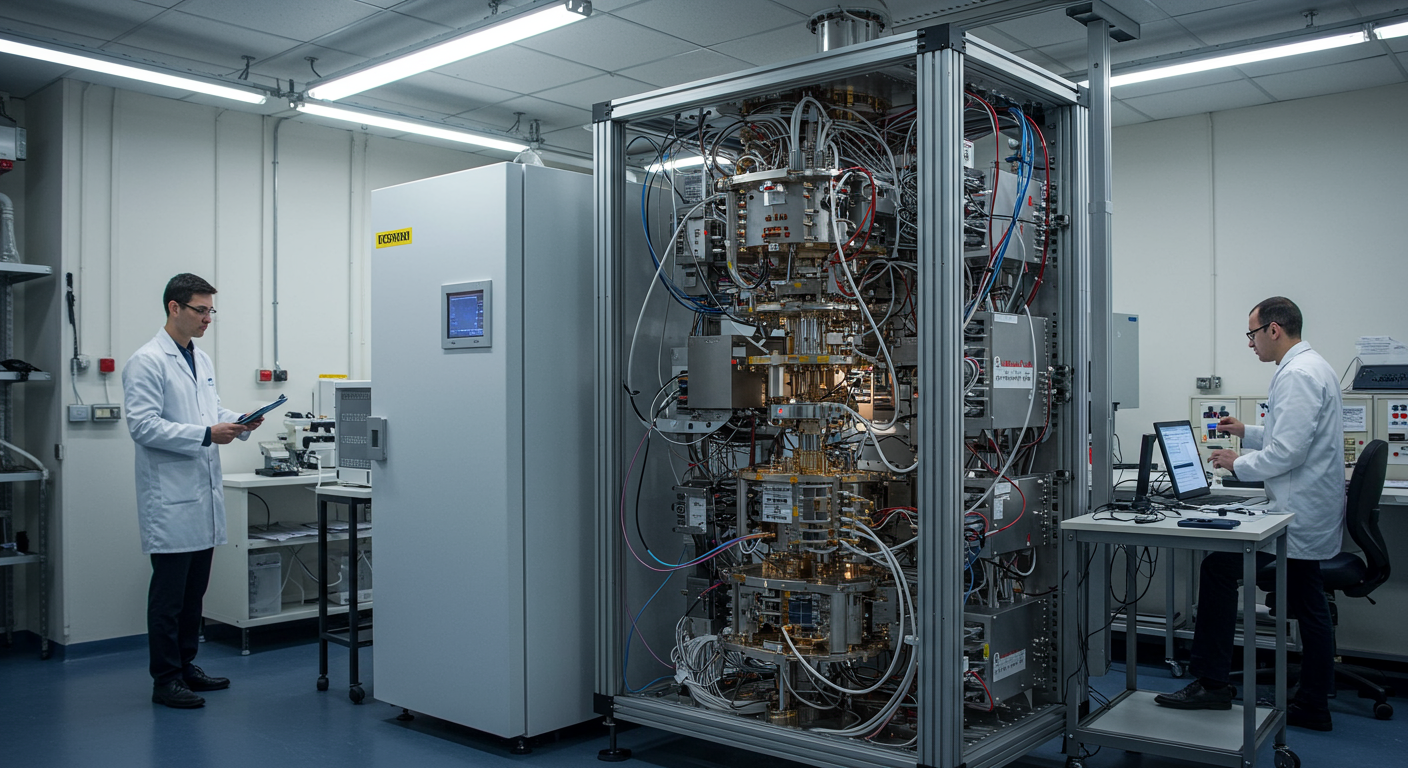
Different quantum computing approaches face distinct scaling challenges. Superconducting qubit systems, the most commercially advanced approach, require dilution refrigerators that cool systems to temperatures colder than outer space. As these systems grow larger, the cooling requirements become increasingly complex and expensive, and controlling hundreds or thousands of qubits simultaneously presents enormous engineering challenges.
Trapped ion systems offer excellent qubit quality and connectivity but face their own scaling obstacles. Each ion must be precisely controlled with laser light, and as systems grow larger, crosstalk between ions and the complexity of laser control systems become prohibitive. Current trapped ion computers are limited to dozens of qubits.
Photonic quantum computing approaches promise room-temperature operation and natural error resilience, but they suffer from high loss rates and low detection efficiency. Current photonic systems lose significant percentages of photons during operations, making large-scale quantum computation extremely challenging.
Industry Roadmaps and Reality Checks
Major technology companies have published ambitious roadmaps for quantum computing development. International Business Machines Corporation's quantum roadmap projects systems with thousands of qubits by the mid-2020s and aims for fault-tolerant quantum computing by the end of the decade. Google has similarly aggressive goals, focusing on achieving practical quantum advantage for commercially relevant problems.
However, there's often a significant gap between announced milestones and practical applications. While companies regularly announce new qubit count records, these raw numbers don't necessarily translate to increased computational capability. A 1000-qubit system with high error rates may be less useful than a 50-qubit system with exceptional fidelity.
Academic researchers and government funding agencies tend to offer more conservative timelines, often suggesting that fault-tolerant quantum computing for practical applications may still be 10-20 years away. The disconnect between industry marketing and technical reality reflects both the competitive pressure in the field and the genuine uncertainty about when key breakthroughs will occur.
The Path Forward: Engineering Solutions and Breakthroughs Needed
Given these fundamental challenges, researchers are pursuing multiple parallel approaches. Hybrid classical-quantum algorithms represent a promising near-term strategy, using quantum computers for specific tasks where they might offer advantages while relying on classical computers for the bulk of computation.
Materials science advances could provide crucial breakthroughs. Better superconducting materials with longer coherence times, improved fabrication techniques that reduce noise, and novel qubit designs could all contribute to more practical quantum systems. Control system improvements, including better electronics for qubit manipulation and more sophisticated software for error mitigation, offer additional paths forward.
Perhaps most importantly, the field may need to accept that the path to practical quantum computing will be longer and more complex than early optimistic projections suggested. Rather than a single breakthrough, quantum computing may require sustained progress across multiple fronts: materials science, engineering, software, and algorithm development.
The timeline for truly fault-tolerant quantum computing remains uncertain, but most experts now acknowledge that significant practical applications are likely still years away. However, incremental progress in specialized applications and the continued development of quantum technologies suggest that while the practical limits are real and challenging, they are not insurmountable barriers to the eventual realization of quantum computing's promise.