How Quantum Computing Hardware Is Reaching Practical Limits
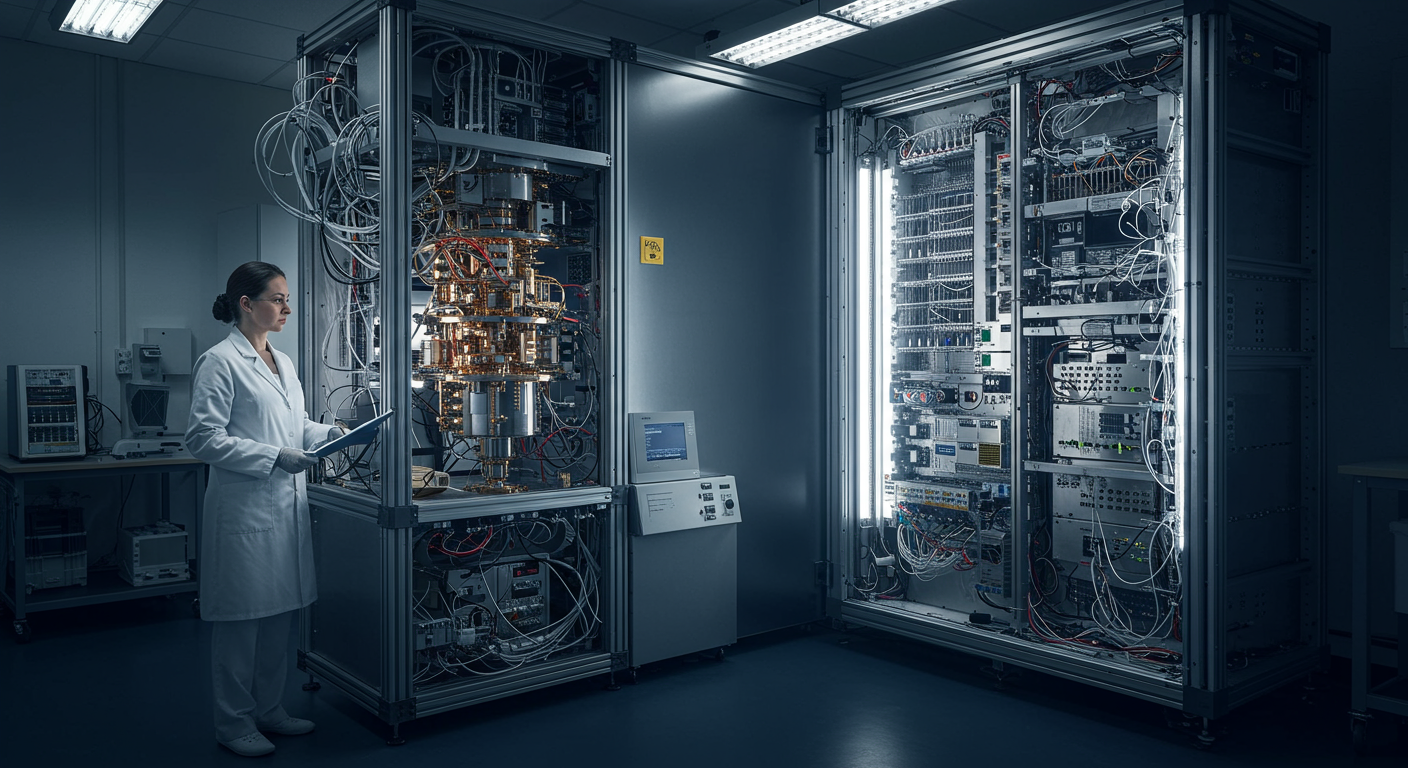
Quantum computing has captured imaginations with promises of revolutionary computational power, but the reality of building practical quantum computers reveals a landscape of formidable technical challenges. As the field matures, hardware limitations are becoming increasingly apparent, forcing researchers and industry leaders to confront fundamental barriers that may redefine expectations for quantum advantage.
The Current State of Quantum Hardware
Today's quantum computing landscape is dominated by several major players employing different technological approaches. International Business Machines Corporation leads with superconducting qubit systems, recently achieving over 1,000 qubits in their Condor processor. Google's approach focuses on superconducting circuits optimized for specific quantum algorithms, while IonQ pursues trapped ion technology that offers longer coherence times but faces scaling challenges.
Despite impressive qubit counts, a significant gap persists between theoretical potential and practical performance. Current systems operate as Noisy Intermediate-Scale Quantum (NISQ) devices—capable of interesting demonstrations but far from the fault-tolerant quantum computers needed for transformative applications. The disparity between raw qubit numbers and effective computational power highlights fundamental limitations in current architectures.
Fundamental Physical Barriers
Quantum decoherence represents perhaps the most fundamental challenge facing quantum hardware. Quantum states are inherently fragile, losing their quantum properties through interaction with the environment. Current coherence times range from microseconds to milliseconds, severely limiting the complexity of quantum algorithms that can be executed.
Error rates vary significantly across qubit technologies. Superconducting qubits typically exhibit gate error rates around 0.1% to 1%, while trapped ion systems achieve better fidelity but operate more slowly. Photonic qubits offer natural immunity to decoherence but face challenges in creating the strong qubit interactions necessary for universal quantum computing.
Environmental noise presents ongoing isolation challenges. Quantum computers require extreme conditions: near absolute zero temperatures for superconducting systems, ultra-high vacuum for trapped ions, and sophisticated electromagnetic shielding for all approaches. These requirements become exponentially more difficult as systems scale up.
Scaling Challenges at Critical Thresholds
Physical constraints become increasingly problematic as qubit counts grow. Superconducting quantum processors face limitations in qubit density due to the need for individual control lines and readout circuits. Each additional qubit requires more complex control systems and introduces potential sources of crosstalk and interference.
Crosstalk between qubits represents a critical scaling barrier. As qubits are packed more densely, unwanted interactions can corrupt quantum states and limit computational fidelity. Current architectures struggle to maintain isolation while enabling the controlled interactions necessary for quantum algorithms.
Classical processing bottlenecks emerge as control system complexity grows exponentially with qubit count. Real-time error correction and quantum state control require classical computers capable of processing vast amounts of data with microsecond latency—a challenge that pushes current classical hardware to its limits.
Cooling and power requirements scale dramatically with system size. Dilution refrigerators needed for superconducting quantum computers consume significant power and become prohibitively expensive for very large systems. The infrastructure needed to support thousands of high-quality qubits presents enormous engineering challenges.
The Error Correction Dilemma
Quantum error correction represents both the pathway to practical quantum computing and its greatest challenge. Current quantum computers exhibit error rates orders of magnitude higher than those required for fault-tolerant computation. While classical computers achieve error rates below one in a quadrillion, quantum systems struggle to reach one in a thousand.
The resource overhead of quantum error correction is staggering. Leading error correction codes require hundreds or thousands of physical qubits to create a single logical qubit with acceptable error rates. This means practical quantum computers may need millions of physical qubits to run meaningful fault-tolerant algorithms.
Progress in logical qubit implementations has been incremental rather than revolutionary. Recent demonstrations have shown proof-of-concept logical qubits, but the path to large-scale error correction remains daunting. The classical processing power needed for real-time error syndrome decoding represents an additional bottleneck.
Timeline challenges for achieving practical error correction suggest that fault-tolerant quantum computers remain years or decades away. The exponential resource requirements and incremental progress in error rates indicate that breakthrough innovations, rather than gradual improvements, may be necessary.
Materials Science and Engineering Hurdles
Manufacturing consistency poses significant challenges for quantum hardware scaling. Current fabrication processes struggle to produce qubits with uniform properties, leading to variations in coherence times, gate fidelities, and operating frequencies that complicate system optimization and control.
Materials research for improved coherence and stability represents an active area of investigation. Researchers are exploring new superconducting materials, improved dielectric interfaces, and novel qubit designs to extend coherence times and reduce error rates. However, fundamental materials limitations may constrain achievable improvements.
Fabrication limits in semiconductor processes affect the precision needed for quantum devices. Quantum systems require nanoscale control and atomic-level precision that pushes manufacturing capabilities to their limits. Variations at the atomic scale can significantly impact quantum device performance.
Breakthrough materials and manufacturing techniques may be necessary to overcome current limitations. This includes development of topological qubits, improved ion trap electrodes, better photonic quantum devices, and novel approaches to quantum state control and measurement.
Industry Response and Future Pathways
Major technology companies are pursuing diverse investment strategies to address quantum hardware limitations. IBM focuses on modular quantum systems and improved error correction, while Google emphasizes algorithmic improvements and specialized quantum processors. Microsoft bets on topological qubits for inherently error-resistant quantum computing.
Alternative approaches are gaining attention as conventional gate-model quantum computers face scaling challenges. Analog quantum computing and quantum annealing offer specialized capabilities without requiring full fault tolerance. These approaches may provide practical quantum advantage in specific applications before universal quantum computers mature.
Hybrid classical-quantum algorithms represent promising interim solutions. By carefully dividing computational tasks between classical and quantum processors, these approaches may achieve practical benefits with current NISQ devices while researchers work toward fault-tolerant systems.
Realistic timelines from industry leaders suggest practical quantum advantage in most applications remains years away. While quantum computing will likely find niche applications in the near term, transformative impact across industries may require fundamental breakthroughs in hardware technology.
Implications for the Quantum Computing Timeline
Current hardware limitations necessitate reassessing expectations for quantum advantage in practical applications. While quantum computers excel at specific problems like quantum simulation and certain optimization tasks, general-purpose quantum advantage requires overcoming formidable technical barriers.
Near-term utility may emerge in specialized areas where current quantum computers provide meaningful benefits despite their limitations. These include quantum chemistry simulations, certain machine learning tasks, and cryptographic applications where even modest quantum speedups prove valuable.
The path forward likely requires both incremental improvements and revolutionary breakthroughs. Gradual progress in error rates, coherence times, and system scaling must be coupled with innovations in error correction, materials science, and quantum architectures to achieve transformative quantum computing capabilities.
As the quantum computing field matures, a realistic assessment of hardware limitations provides essential context for investment decisions, research priorities, and timeline expectations. While the challenges are significant, continued progress in addressing fundamental barriers offers hope for eventual practical quantum advantage.