How Quantum Computing Hardware Is Reaching Practical Limits
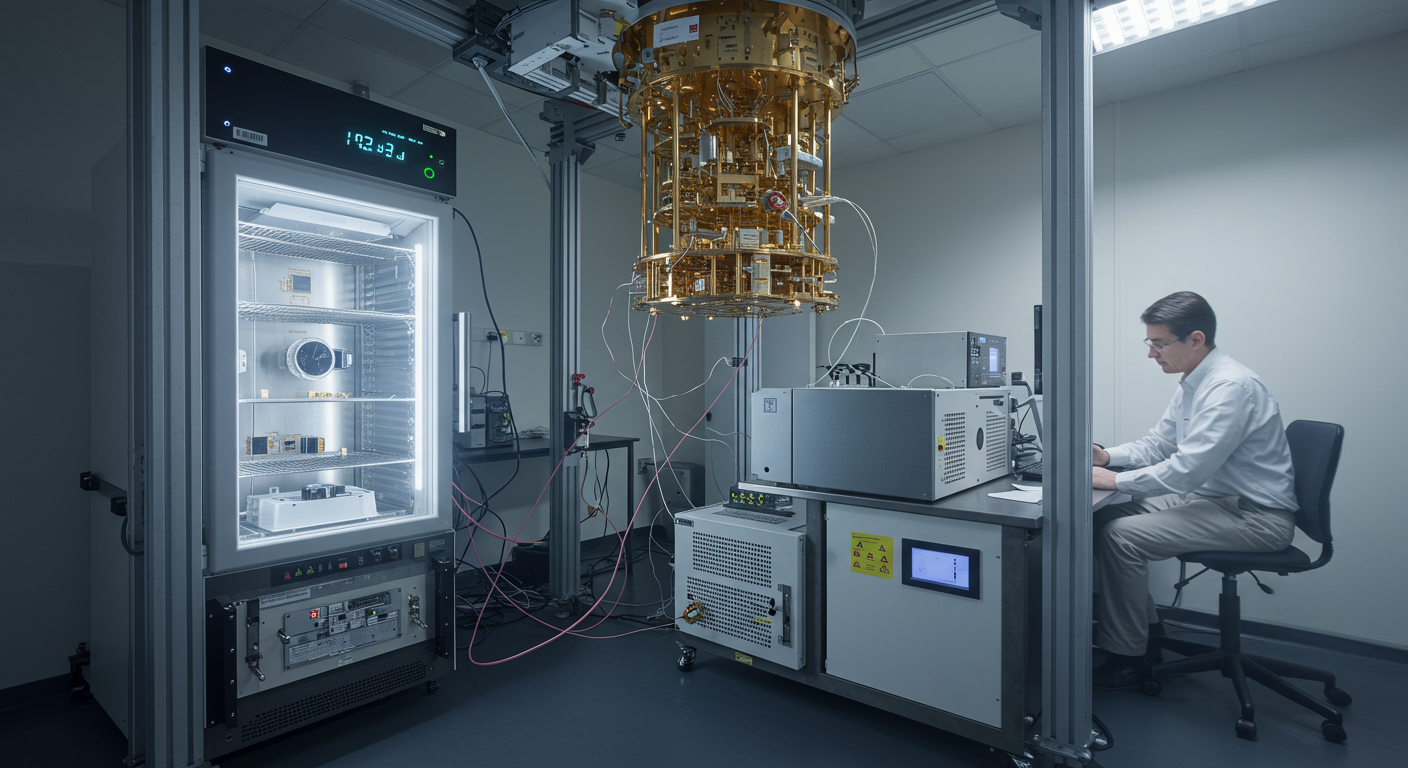
The quantum computing revolution has captured headlines and investment dollars, but behind the hype lies a sobering engineering reality. As quantum hardware matures beyond laboratory demonstrations, fundamental physical constraints are becoming apparent that challenge ambitious timelines for practical quantum advantage.
While companies like IBM, Google, and others have achieved impressive quantum milestones, the gap between current capabilities and commercially viable systems remains substantial. Understanding these limitations is crucial for realistic expectations about when quantum computers will solve real-world problems at scale.
Physical Constraints of Leading Qubit Technologies
Each major quantum computing approach faces distinct physical limitations that constrain performance and scalability. Superconducting qubits, the foundation of IBM and Google's systems, require operation at temperatures near absolute zero and suffer from coherence times measured in microseconds. These brief windows limit the complexity of calculations possible before quantum information degrades.
Trapped ion systems offer longer coherence times but face scaling challenges as the number of ions increases. The laser control systems required become exponentially more complex, and maintaining precise individual ion manipulation becomes increasingly difficult with larger arrays.
Photonic quantum systems promise room-temperature operation but struggle with photon loss rates and detection inefficiencies that compound with system size. Each approach represents fundamental trade-offs between different physical constraints rather than clear technological superiority.
The Quantum Error Correction Bottleneck
Perhaps the most significant challenge facing quantum computing is the error correction problem. Current quantum processors operate with error rates between 0.1% and 1% per gate operation, while fault-tolerant quantum computing requires error rates below 0.01%.
More critically, achieving error correction requires thousands of physical qubits to create a single logical qubit that can perform reliable calculations. Conservative estimates suggest ratios of 1000:1 or higher, meaning a useful quantum computer might need millions of physical qubits to run meaningful algorithms.
This requirement fundamentally changes the engineering challenge from building hundreds of qubits to maintaining coherence across millions of quantum elements simultaneously. The timeline for achieving such systems extends well beyond current industry projections.
Engineering Challenges at Scale
Scaling quantum systems to practical sizes introduces engineering challenges that extend far beyond the qubits themselves. Refrigeration systems capable of cooling millions of qubits to millikelvin temperatures would require massive infrastructure and consume enormous amounts of energy.
The classical control electronics needed to manage quantum operations grow in complexity with system size. Each qubit requires precise microwave or laser control, real-time feedback systems, and nanosecond timing coordination across the entire processor.
Manufacturing precision requirements become increasingly demanding as systems scale. Small variations in qubit parameters that are manageable in 100-qubit systems become systematic problems in million-qubit arrays, requiring manufacturing tolerances that push current semiconductor fabrication capabilities.
Decoherence: The Quantum Computing Speed Limit
Environmental noise represents perhaps the most fundamental limitation facing quantum computers. Quantum states are extraordinarily fragile, and any interaction with the environment destroys the delicate superposition states that enable quantum advantage.
Current systems maintain quantum coherence for microseconds to milliseconds, depending on the technology. During this time, quantum algorithms must complete all necessary operations before decoherence renders the calculation meaningless.
This creates a fundamental speed limit for quantum algorithms. Complex calculations requiring many sequential operations may simply be impossible on current or near-term hardware due to decoherence, regardless of the number of qubits available.
Industry and Research Community Responses
Major quantum computing companies are beginning to acknowledge these hardware realities in their roadmaps and timelines. IBM's quantum development plan now emphasizes incremental improvements and hybrid approaches rather than revolutionary breakthroughs.
Government quantum initiatives, including the U.S. National Quantum Initiative, are adjusting funding priorities toward understanding and overcoming fundamental physical limitations rather than simply scaling current technologies.
Academic research is increasingly focused on near-term applications that work within current hardware constraints rather than assuming fault-tolerant quantum computers will arrive on schedule. This shift reflects growing recognition of the engineering challenges involved.
The Path Forward: Working Within Physical Reality
The quantum computing community is adapting to hardware realities through several strategic approaches. Hybrid quantum-classical algorithms are being developed that leverage quantum processors for specific subtasks while using classical computers for the majority of computation.
Research is focusing on problem domains where quantum advantage might be achievable with imperfect, small-scale systems rather than waiting for fault-tolerant machines. These include certain optimization problems, quantum simulation tasks, and cryptographic applications.
Next-generation hardware approaches are being explored that might circumvent current limitations, including topological qubits, neutral atom systems, and novel materials that could extend coherence times or reduce error rates.
Realistic timelines for fault-tolerant quantum computing now extend into the 2040s or beyond, a significant revision from earlier predictions of quantum advantage within the current decade.
The quantum computing field is maturing from revolutionary promises to evolutionary engineering challenges. While the fundamental physics supporting quantum advantage remains sound, the hardware realities suggest a longer, more complex path to practical quantum computing than initially anticipated.