How AI-Controlled Systems Manage Hyperscale Infrastructure
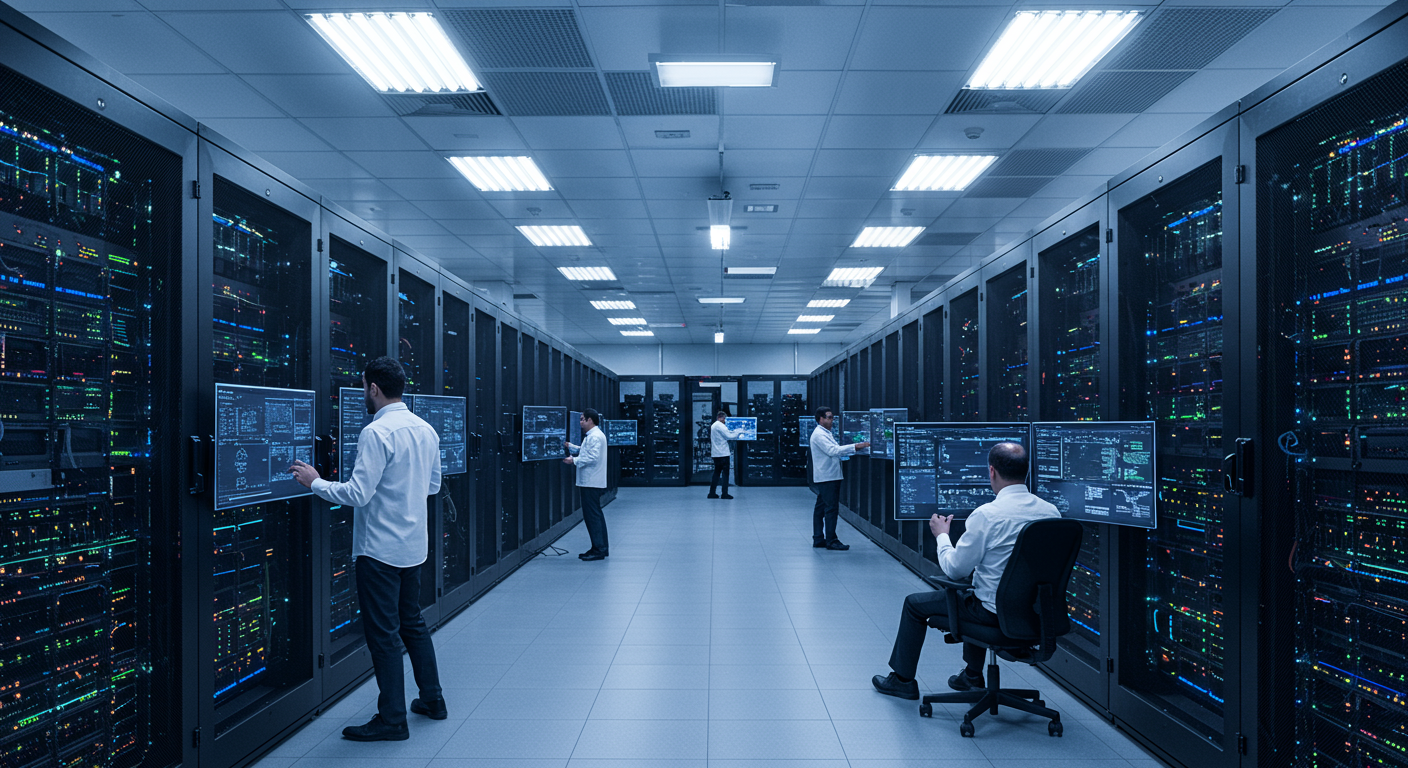
Hyperscale infrastructure refers to the enormous technical estates behind major cloud platforms and internet services: vast data centers, dense server fleets, high-capacity networks, and the power and cooling systems that keep everything running continuously. When people describe these environments as AI-controlled, the practical reality is usually more specific. In most documented cases, AI is used to optimize parts of operations within tightly defined control loops, while human oversight and conventional safety systems continue to play a central role.
That distinction matters. The strongest evidence for AI in hyperscale management is not a story of infrastructure running itself without supervision. It is a story of prediction, recommendation, and bounded automation applied where the scale of telemetry and the speed of change make manual tuning increasingly inadequate.
What AI-controlled hyperscale infrastructure actually means
Hyperscale systems generate continuous streams of operational data. Servers report utilization and health, cooling systems expose temperature and airflow readings, electrical equipment provides power metrics, and workloads shift across regions and clusters in real time. Operators must balance performance, cost, reliability, and energy use across these interconnected systems.
In that setting, AI-controlled usually means software models help decide how infrastructure should respond within approved limits. A model might predict thermal behavior in a data hall, estimate future demand for compute, flag an abnormal pattern in power usage, or recommend changes to workload placement. In some cases, operators review those recommendations. In others, approved actions can be executed automatically as long as they remain within predefined guardrails.
This is a narrower and more defensible definition than the popular image of a fully autonomous digital facility. In the clearest examples, AI is best understood as an optimization layer embedded within broader operational systems.
Why hyperscale operations are a natural fit for AI
Hyperscale environments are especially well suited to AI because they produce enormous amounts of telemetry and involve many interacting variables that change constantly. Cooling depends on workload intensity, weather conditions, airflow, rack density, and equipment performance. Capacity planning depends on user demand, regional growth, maintenance schedules, and service priorities. Network behavior, power draw, and compute utilization are all linked in ways that are difficult to tune manually at very large scale.
Human operators can set policies and respond to exceptions, but they cannot continuously optimize every variable in real time across giant estates. That is where machine learning becomes useful. It can detect patterns in historical and live data, forecast likely conditions, and support faster decisions than a human-only process could manage.
Even modest gains become meaningful at hyperscale. A small percentage improvement in cooling efficiency, utilization, or failure prediction can translate into major cost savings and lower energy consumption when multiplied across massive infrastructure footprints.
How AI improves cooling and energy efficiency
Cooling optimization is the best-known and best-documented use of AI in hyperscale data center operations. Google and DeepMind have published some of the most widely cited examples, describing how machine learning systems were used to improve data center cooling efficiency. In these setups, sensors feed operational data into models that estimate thermal behavior and identify better control settings for equipment such as fans, pumps, and cooling units.
The core loop is straightforward in concept. First, sensors collect data from the environment and from cooling infrastructure. Next, models analyze those inputs and predict which adjustments are most likely to maintain safe temperatures while using less energy. Then the system either recommends actions to operators or applies approved changes automatically within preset thresholds.
What makes these deployments notable is not only the optimization itself, but also the safety architecture around it. DeepMind has described validation and control mechanisms designed to ensure that automated actions stay within acceptable operating bounds. Google has likewise framed these systems as a way to improve efficiency in a constrained domain, not as a substitute for all operational oversight.
This is an important pattern for understanding AI at hyperscale more broadly. The gains often come from narrow, high-value control problems where inputs are measurable, objectives are clear, and the consequences of each action can be constrained.
Beyond cooling: forecasting, scheduling, and orchestration
AI's role in hyperscale infrastructure extends well beyond the mechanical systems of a data center. Another major application area is forecasting demand and orchestrating compute resources across large cloud environments. Here, the challenge is not only keeping hardware cool, but also deciding where workloads should run, when capacity should be reserved, how resources should be balanced, and how competing goals should be prioritized.
Microsoft Research has published work showing how AI can help shape cloud infrastructure through workload prediction and scheduling. These systems can analyze historical usage patterns and live signals to anticipate demand, improve placement decisions, and reduce waste. In practice, that can help operators increase utilization while preserving service quality and resilience.
These orchestration problems are more complex than a single-metric optimization task. A scheduler may need to weigh latency, energy use, hardware availability, redundancy requirements, cost, and expected spikes in demand at the same time. AI is useful in this environment because it can model tradeoffs that would be difficult to manage through static rules alone.
Still, orchestration platforms rarely depend on machine learning alone. They typically combine predictive models with policy engines, capacity constraints, and conventional automation systems that enforce service-level and reliability requirements.
The core technical functions inside AI-driven operations
Across hyperscale infrastructure, a handful of recurring AI functions appear again and again.
Anomaly detection identifies unusual behavior in servers, power systems, cooling equipment, or network traffic before an issue becomes a larger incident.
Predictive maintenance uses historical and live equipment data to estimate when components may need attention, helping reduce unplanned downtime.
Workload forecasting estimates future demand so operators can prepare compute, storage, and network capacity more efficiently.
Thermal management models how heat moves through facilities and helps tune cooling behavior for efficiency and stability.
Power optimization supports better matching between electrical supply, workload placement, and energy use across facilities.
These functions do not operate in isolation. Demand forecasting can influence scheduling decisions, which then change server utilization patterns, which in turn affect heat generation and power draw. That interdependence is one reason hyperscale management increasingly relies on integrated software stacks rather than isolated tools.
It is also why many production systems are hybrids. A machine learning model may generate a forecast or score a risk, but a rules engine determines whether action is permitted, and a conventional control system executes it reliably.
Why AI is bounded by safety constraints
Hyperscale infrastructure is safety-critical. Failures can ripple across clusters, services, and facilities, affecting customers and raising the risk of costly outages. For that reason, AI in these environments is usually bounded by strict operational limits.
Those limits can take several forms. Operators define approved action spaces so models cannot make arbitrary changes. Validation layers check whether a recommendation is reasonable before it is applied. Rollback paths allow the system to return to a known safe state if performance deteriorates. Fallback logic ensures that traditional control methods remain available if an AI component behaves unexpectedly. At every stage, human operators retain the ability to override automated behavior.
This safety framing helps explain why the phrase AI-controlled can be misleading if taken too literally. In production hyperscale environments, reliability matters just as much as optimization. A system that saves energy but introduces instability is not a successful operational system. As a result, real-world deployments tend to advance carefully in domains where the control problem is well understood and the consequences of action can be contained.
Where human operators still matter most
Human operators remain essential, even as AI takes on more optimization work. People set policy, define risk tolerance, interpret business priorities, investigate incidents, and handle novel failures that do not match historical patterns. They also validate whether a model is behaving as intended and decide when automation should be expanded, limited, or suspended.
AI performs especially well on repetitive optimization tasks with abundant data, such as tuning within known operating envelopes or forecasting near-term demand. Humans remain more important when circumstances are ambiguous, when systems interact in unexpected ways, or when an incident requires judgment across technical and organizational boundaries.
That makes the most accurate description of hyperscale AI a collaborative one. These systems augment infrastructure teams by surfacing patterns, narrowing decision windows, and automating well-bounded actions. They do not eliminate the need for experienced operators.
What the next phase of hyperscale management looks like
The broader trajectory is clear: as cloud and data center environments become larger and more interdependent, operations are becoming more software-defined and more AI-assisted. The next phase is likely to come not from one all-powerful control system, but from tighter integration across forecasting, scheduling, power management, and cooling.
That integration matters because the biggest infrastructure gains often emerge at the boundaries between systems. Better workload placement can reduce thermal stress. Better thermal prediction can improve energy efficiency. Better anomaly detection can support stronger reliability. The challenge is not only developing smarter models, but also connecting them safely to the operational layers that run critical infrastructure.
The evidence so far supports a balanced conclusion. AI is already helping manage important parts of hyperscale infrastructure, especially in areas such as cooling, energy optimization, and resource orchestration. But the most credible examples involve constrained, carefully monitored systems with human oversight, not unrestricted autonomy. As adoption expands, claims about performance and control should be sourced carefully and attributed precisely.