How AI-Controlled Systems Manage Hyperscale Infrastructure
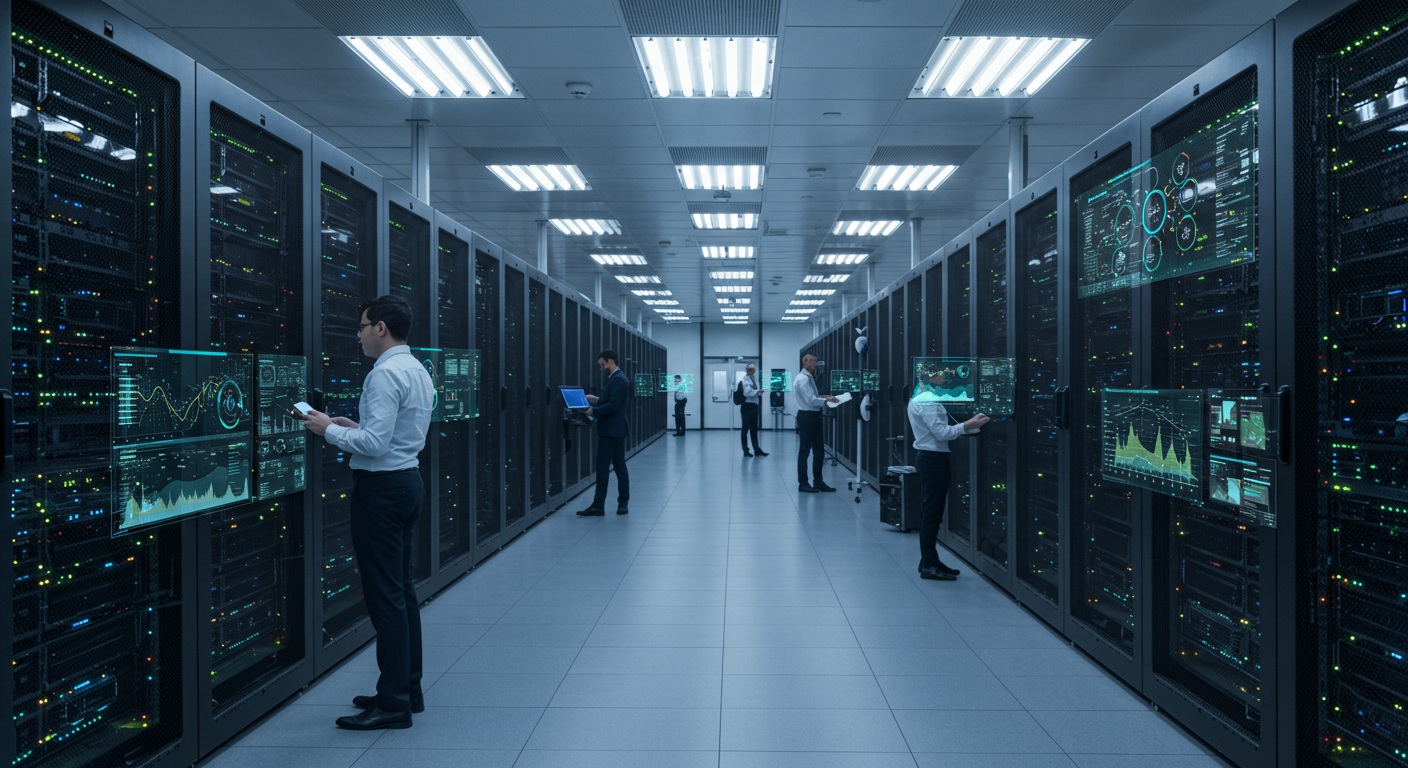
The modern digital economy runs on hyperscale infrastructure—massive networks of data centers with hundreds of thousands of servers handling billions of requests daily. Companies like Amazon, Google, Microsoft, and Meta operate these complex systems that power everything from web searches to social media platforms. Managing infrastructure at this scale far exceeds human capacity, making artificial intelligence essential rather than optional.
Traditional manual approaches simply can't handle hyperscale operations. Human operators can't process the volume of performance metrics, respond quickly enough to system failures, or optimize resource allocation across thousands of servers in real-time. AI systems bridge this gap with autonomous management capabilities that operate continuously, processing vast amounts of operational data to make split-second decisions that keep services running smoothly.
Intelligent Resource Allocation and Workload Distribution
Machine learning algorithms have transformed how hyperscale systems allocate computational resources. These AI systems continuously analyze incoming workloads, server performance metrics, and resource utilization patterns to make optimal placement decisions. Unlike static allocation rules, machine learning models adapt to changing usage patterns and identify subtle correlations between workload characteristics and optimal server configurations.
Real-time workload analysis enables dynamic server allocation that responds instantly to demand fluctuations. AI systems predict which computational tasks will perform best on specific hardware configurations, considering factors like CPU architecture, memory capacity, storage speed, and network connectivity. This intelligent matching significantly improves both performance and resource efficiency.
Major cloud providers report substantial efficiency gains from AI-driven resource allocation. Google's machine learning systems have improved data center cooling efficiency by up to 40%, while Amazon's predictive algorithms reduce resource waste by dynamically rightsizing compute instances based on actual usage patterns rather than peak capacity estimates.
Predictive Scaling and Capacity Management
Predictive analytics allow hyperscale systems to anticipate demand spikes before they occur, enabling proactive capacity adjustments rather than reactive scaling. These AI systems analyze historical usage patterns, external factors like time zones and seasonal trends, and real-time indicators to forecast future resource needs with remarkable accuracy.
Automated capacity planning across data center networks involves complex optimization problems considering geographic distribution, network latency, disaster recovery requirements, and cost factors. Machine learning algorithms excel at balancing these multiple constraints to determine optimal capacity allocation across global infrastructure networks.
Cost optimization through intelligent pre-scaling strategies provides significant competitive advantage. Rather than maintaining excess capacity constantly, AI systems predict when and where additional resources will be needed, spinning up capacity just ahead of demand spikes and scaling down during lower usage periods. This dynamic approach can reduce infrastructure costs by 20-30% compared to traditional over-provisioning strategies.
Autonomous Fault Detection and Recovery
AI systems excel at real-time anomaly detection, continuously monitoring thousands of performance metrics to identify patterns indicating potential system failures. Machine learning models trained on historical failure data recognize early warning signs that might escape human attention, often detecting problems hours before they cause service disruptions.
Automated incident response and self-healing mechanisms represent the cutting edge of autonomous infrastructure management. When AI systems detect anomalies, they automatically trigger remediation procedures, reroute traffic away from failing components, spin up replacement resources, and perform complex diagnostic procedures without human intervention.
The speed advantage of AI response systems dramatically exceeds human capabilities. While human incident response typically takes minutes to hours from detection to resolution, AI systems can identify, diagnose, and remediate many failures within seconds. This rapid response capability is crucial for maintaining high availability standards in hyperscale environments.
Energy Optimization and Environmental Controls
AI-driven cooling system management has become a major focus for hyperscale operators seeking to reduce energy consumption and environmental impact. Machine learning algorithms continuously optimize cooling systems by analyzing server heat generation patterns, external weather conditions, and facility airflow dynamics to minimize energy usage while maintaining optimal operating temperatures.
Power usage effectiveness improvements through machine learning have yielded significant industry results. Meta's AI systems have reduced cooling energy consumption by over 15% at their data centers, while Microsoft's intelligent power management systems optimize energy distribution to reduce waste and improve overall efficiency.
Environmental impact reduction strategies increasingly rely on AI systems to coordinate renewable energy usage, predict optimal times for energy-intensive operations, and optimize cooling systems based on external weather conditions. These systems can shift computational workloads to data centers with cleaner energy sources or schedule maintenance operations during periods of renewable energy abundance.
Network Traffic and Load Balancing Intelligence
Reinforcement learning algorithms have proven particularly effective for traffic routing optimization in hyperscale networks. These AI systems continuously learn from routing decision outcomes, developing increasingly sophisticated strategies for directing network traffic to minimize latency and maximize throughput.
Dynamic load balancing across global infrastructure requires real-time analysis of network conditions, server capacity, and user distribution patterns. AI systems make routing decisions considering not just current conditions but predicted future states, preemptively adjusting traffic flows to prevent congestion before it occurs.
Latency reduction through intelligent path selection involves complex calculations considering network topology, current congestion levels, and specific requirements of different traffic types. Machine learning models identify optimal routing strategies that human network engineers might never discover through manual analysis.
Implementation Challenges and Integration Issues
Compatibility with existing infrastructure management tools presents significant challenges for organizations implementing AI-controlled systems. Legacy monitoring and management platforms often lack the APIs and data formats needed to integrate effectively with machine learning systems, requiring substantial infrastructure modernization efforts.
Data quality and training requirements for AI systems are substantial. Effective machine learning models require large volumes of high-quality operational data, comprehensive labeling of historical incidents and outcomes, and ongoing data curation to maintain model accuracy as systems evolve.
Organizational change management for autonomous operations involves fundamental shifts in how infrastructure teams work. Traditional hands-on management approaches must evolve toward oversight and exception handling roles, requiring significant retraining and cultural adaptation within IT organizations.
Security and Reliability Considerations
Risk assessment for autonomous infrastructure decisions requires careful analysis of potential failure modes and unintended consequences. AI systems making automated changes to production infrastructure must include comprehensive safeguards to prevent cascading failures or security vulnerabilities.
Fail-safe mechanisms and human override capabilities remain essential components of AI-controlled infrastructure systems. While automation provides significant benefits, human operators must retain the ability to intervene during unusual situations or when AI systems behave unexpectedly.
Security implications of AI-controlled systems include new attack vectors and the need for robust authentication and authorization systems. Adversaries might attempt to manipulate AI decision-making through data poisoning or exploit automated systems to amplify security breaches across infrastructure networks.
Future Outlook and Industry Trends
Emerging AI techniques for infrastructure management include advanced reinforcement learning models, federated learning approaches that optimize across multiple data centers while preserving operational privacy, and neuromorphic computing systems designed specifically for real-time infrastructure control.
Industry adoption patterns show increasing convergence toward fully autonomous operations, with competitive advantages accruing to organizations that most effectively implement AI-controlled infrastructure management. The gap between leaders and laggards continues to widen as AI capabilities advance.
Predictions for fully autonomous data center operations suggest that human operators will transition from hands-on management to high-level strategic oversight within the next decade. The most advanced hyperscale operators are already approaching this vision, with AI systems handling the vast majority of routine operational decisions and human involvement limited to exception handling and strategic planning.
The transformation of hyperscale infrastructure management through AI represents one of the most significant operational advances in computing history, enabling the massive digital services that define the modern economy while pointing toward a future of increasingly autonomous technological systems.