How Advanced Sensors Are Expanding Our Understanding of the Universe
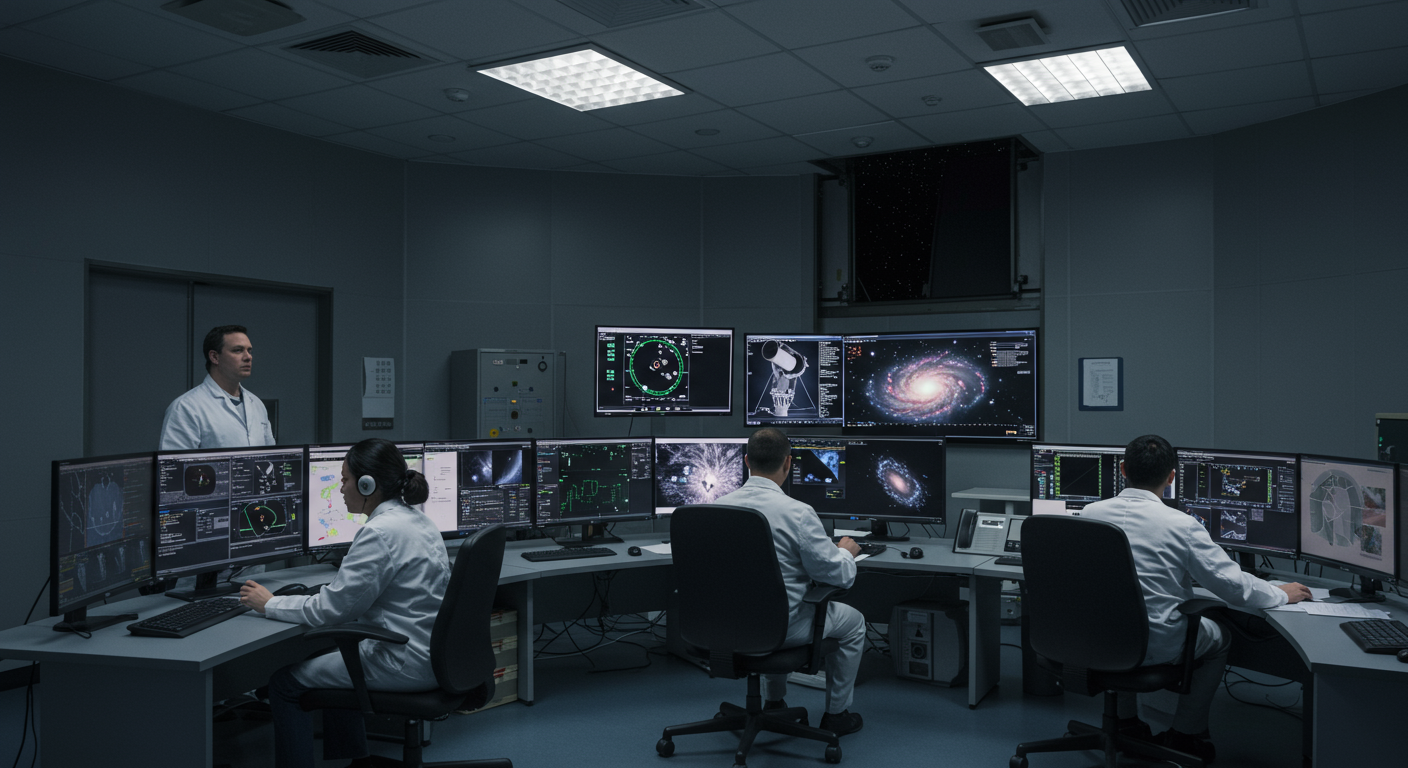
Astronomy depends on telescopes, but telescopes alone do not produce discovery. What turns distant light, particles, and distortions in spacetime into usable knowledge is the sensor technology attached to those instruments. In modern space science, advances in detectors, timing systems, spectrographs, and signal-processing hardware allow researchers to measure phenomena that would once have been too faint, too distant, too brief, or entirely invisible.
That shift matters because the universe does not communicate only in visible light. Many cosmic events are best studied through radio waves, infrared radiation, ultraviolet light, X-rays, gamma rays, energetic particles, or gravitational waves. As sensors improve, scientists are extending human perception across those channels and building a broader picture of how stars, galaxies, black holes, planets, and the large-scale universe behave.
Why Astronomy Depends on Sensors, Not Just Telescopes
A telescope gathers incoming signals, but the detector determines whether those signals can be measured accurately enough to matter. In practice, astronomy moves forward when instruments can convert extremely weak cosmic input into reliable data. That means better sensitivity, lower noise, finer timing, stronger calibration, and the ability to distinguish a real signal from background interference.
This is why sensor innovation often changes science more dramatically than a simple increase in magnification. A more capable detector can reveal wavelengths that were previously inaccessible, track changes that happen in fractions of a second, or pull a faint object out of a noisy background. In many cases, better sensors do not merely sharpen an existing view of the cosmos. They open entirely new windows onto it.
How Better Sensitivity and Resolution Change What Scientists Can Detect
Sensitivity is one of the most important qualities in any astronomical detector. The more sensitive an instrument is, the better it can register dim, distant, or short-lived signals. That is essential for studying early galaxies, small exoplanets, fast transient events, and subtle structures in nebulae or the cosmic background.
Resolution also matters, but in several different ways. Spatial resolution helps separate objects that appear close together. Spectral resolution helps scientists distinguish fine details in the light emitted or absorbed by matter. Time resolution makes it possible to study pulsars, stellar flares, and other rapidly changing sources. When these forms of precision are paired with lower-noise electronics and better data processing, observatories can detect patterns that once would have been lost in interference.
Wider wavelength coverage adds another layer of insight. A galaxy that looks calm in visible light may reveal active star formation in infrared, jets from a black hole in radio, or high-energy behavior in X-rays. Better sensors let scientists compare those views and build a more complete explanation of how cosmic objects form, evolve, and interact.
Why Space-Based Sensors Open Windows the Atmosphere Closes
Earth’s atmosphere makes life possible, but it limits astronomy. It absorbs or distorts much of the incoming radiation from space, especially in ultraviolet, infrared, X-ray, and gamma-ray bands. Even visible-light observations can be blurred by atmospheric turbulence. For that reason, agencies such as NASA and the European Space Agency place many scientific sensors above the atmosphere, where they can capture cleaner and broader streams of information.
Space-based observatories have transformed the study of hidden regions of the cosmos. Infrared sensors can peer through dust clouds that block visible light, helping researchers investigate stellar nurseries and distant galaxies. X-ray and gamma-ray detectors can observe violent environments around black holes, neutron stars, and supernova remnants. Ultraviolet instruments can trace hot stars and energetic processes that are difficult or impossible to measure from the ground.
Putting sensors in space also gives scientists access to older chapters of cosmic history. Because light takes time to travel, observing distant objects means looking backward in time. More sensitive space instruments can detect fainter signals from earlier eras, helping researchers study how the first galaxies assembled and how the universe changed over billions of years.
How Ground-Based Detector Arrays Still Drive Major Discoveries
Space observatories are powerful, but ground-based facilities remain central to astronomy. Large optical telescopes, radio observatories, and distributed detector arrays supported by institutions including the National Science Foundation continue to produce major discoveries because they can be upgraded, expanded, and coordinated in ways that are often more difficult in orbit.
Modern ground astronomy relies heavily on advanced detector systems, adaptive optics, and interferometry. Adaptive optics compensates for atmospheric distortion, allowing telescopes to recover sharper images. Radio arrays combine signals from many antennas spread across large distances, effectively creating much larger virtual instruments. These methods dramatically increase what researchers can resolve and measure, from the structure of protoplanetary disks to the environment around supermassive black holes.
Ground facilities are also valuable because they can work together across continents and across wavelengths. A single event, such as an exploding star or the aftermath of a compact-object merger, can be tracked by optical telescopes, radio arrays, neutrino detectors, and other systems in coordinated campaigns. That flexibility makes terrestrial infrastructure an essential part of modern observational science.
Beyond Pictures: The Sensors That Analyze Cosmic Fingerprints
Some of astronomy’s most important sensors are not designed primarily to make images. Spectrographs, for example, spread incoming light into its component wavelengths. That allows scientists to identify the chemical composition of stars and planets, estimate temperature, measure motion through Doppler shifts, and infer the history of matter in galaxies.
This kind of analysis is one reason astronomy can learn so much about places humans cannot physically visit. A distant world may appear only as a tiny point of light, but its spectrum can reveal the presence of specific gases in its atmosphere. A galaxy may be far too remote for direct sampling, yet its light can still show whether it contains young stars, heavy elements, fast-moving gas, or evidence of a central black hole.
Interferometry pushes this further by combining signals from multiple instruments to achieve higher effective resolution than any one device could reach alone. Whether used in radio astronomy or other precision measurements, the technique helps turn distributed sensors into a more powerful unified system. The result is a richer ability to reconstruct the properties of objects that are otherwise beyond direct access.
The Rise of New Messengers: Gravitational-Wave and Particle Detection
One of the biggest changes in astronomy is that it no longer relies only on electromagnetic radiation. Advanced detectors now allow scientists to observe gravitational waves and high-energy particles, opening new ways to study the most extreme events in the universe.
Gravitational-wave observatories detect incredibly small distortions in spacetime caused by events such as black hole mergers and neutron star collisions. These signals provide information that light alone cannot fully capture, especially when the source is obscured or when the most important physics occurs in violent, compact systems. Particle detectors add still more evidence by tracking cosmic rays, neutrinos, and other energetic messengers that travel across enormous distances.
Together, these tools have helped establish multi-messenger astronomy, in which the same event is studied through several kinds of signals at once. That approach improves confidence in detections and yields a more complete account of what happened, when it happened, and how much energy was involved.
What These Sensors Are Teaching Us About the Universe
Advances in sensors have shaped discoveries across nearly every major area of astronomy. They have improved the search for exoplanets by enabling more precise measurements of tiny changes in starlight. They have sharpened studies of black holes through radio interferometry and high-energy observatories. They have refined models of galaxy formation by revealing faint early structures and tracing the movement of gas and dust. They have also deepened analysis of background radiation and transient events, helping scientists investigate both the large-scale history of the cosmos and short-lived phenomena unfolding in real time.
Just as important, combining data from different sensor types often produces answers no single instrument could provide. An object seen in infrared may be interpreted differently once matched with X-ray emissions, radio structure, and spectral data. A gravitational-wave event becomes more informative when linked to optical and gamma-ray observations. In this way, astronomy increasingly works as a synthesis of sensor systems rather than as a series of isolated observations.
That broader view also means new tools frequently create new mysteries. Instruments built to answer one question often uncover phenomena researchers did not expect to find. As reporting from publications such as Nature and Scientific American has repeatedly shown, expanding observational capability tends to enlarge the map of the unknown as much as it fills in the known.
Why Sensor Innovation Will Keep Reshaping Cosmic Knowledge
The future of astronomy will depend as much on detector engineering and data quality as on rocket launches or mirror size. Better calibration, improved noise suppression, more efficient sensors, and faster analysis pipelines all affect whether an observatory can identify weak and meaningful signals. In many cases, a breakthrough comes not from looking harder at the same target, but from building a tool capable of noticing something that previous generations of instruments could not detect.
That is why agency-backed missions, major observatory programs, and peer-reviewed science reporting remain so important. They help validate which discoveries are robust, which interpretations hold up under scrutiny, and which new measurements genuinely change our understanding of the universe.
Every improvement in sensing extends the reach of science a little further. By capturing forms of information that once slipped past us, advanced sensors are not just refining astronomy. They are expanding the boundaries of what the universe allows humanity to know.