European physicists report quantum-dot photons improved from 60% to 90% indistinguishability
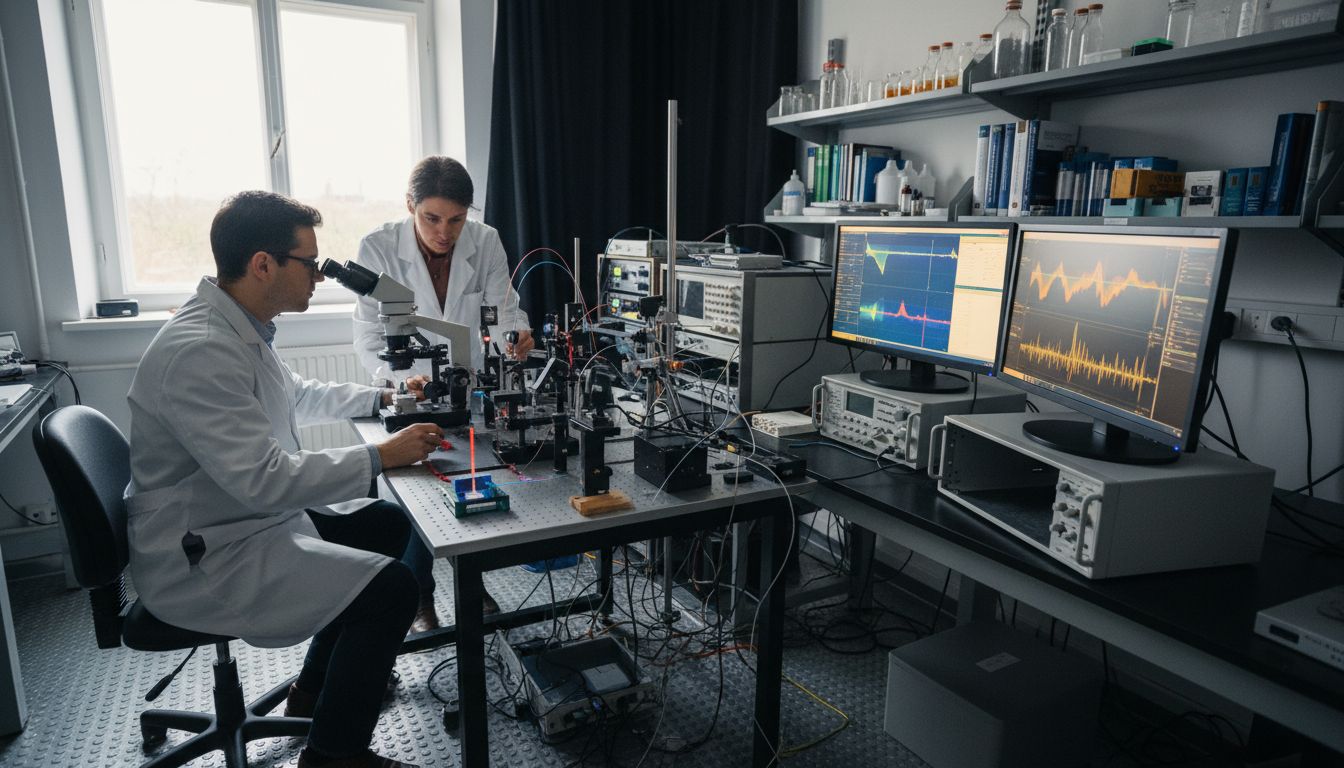
A European research collaboration says it has improved photon indistinguishability in semiconductor quantum dots from about 60% to about 90%, a notable gain for efforts to build practical quantum communication systems. The work is attributed to teams at Paderborn University, the University of Basel, and Ruhr University Bochum.
In quantum photonics, many researchers see indistinguishable photons as a basic requirement for networking quantum devices. When separate photons are similar enough to behave as effectively identical, they can interfere in the precise ways needed for entanglement distribution, repeater designs, and other core parts of quantum communication.
That said, the result deserves careful framing. Much of the initial coverage appears to come from university communications and republished press-release material, even though the underlying work is described as peer reviewed. That makes the advance promising, but not yet a settled milestone.
What photon indistinguishability means and why it is difficult
In simple terms, indistinguishable photons are particles of light that match so closely in properties such as frequency, timing, and quantum state that a quantum system cannot tell them apart. That matters because many quantum information protocols rely on interference effects that weaken or disappear when photons differ too much.
Semiconductor quantum dots have long attracted interest as single-photon sources because they could, in principle, be integrated into scalable devices. Compared with some bulkier or more specialized photon-generation methods, quantum dots are often seen as a more practical path toward mass-manufactured components for future quantum hardware.
One recurring obstacle is the solid-state environment itself. Vibrations in the crystal lattice, often described as phonon interactions, can disturb the emitted light and reduce photon purity. In practice, that means a source may emit one photon at a time but still miss the uniformity required for demanding quantum network applications.
The reported method: biexciton decay inside an optical cavity
According to the available reports, the researchers used biexciton decay in semiconductor quantum dots embedded in an optical cavity. The goal is to shape the local optical environment so the quantum dot emits light under conditions that better preserve the qualities needed for indistinguishability.
The coverage describes the cavity as helping suppress or reduce phonon-related effects that would otherwise blur the photons' characteristics. In that sense, the advance is not only about generating photons, but also about controlling the emission process so the particles are much more alike from one event to the next.
The findings have been linked in coverage to publications in Physical Review Letters and Physical Review Research, or related American Physical Society outlets. Based on the sourcing available here, that gives the claim a stronger footing than a standalone press release would. Even so, the exact paper-to-claim mapping behind every headline figure is not fully clear from the early reports alone.
Why a jump from 60% to 90% stands out
If the reported numbers hold up, moving from roughly 60% to 90% indistinguishability would be more than a minor tuning improvement. In quantum networking, performance is often highly sensitive to source quality, so what looks like an incremental change can have a large effect on interference visibility and overall system fidelity.
Earlier quantum-dot research has shown that high-quality photon generation is possible, but the harder challenge has been making those results robust, repeatable, and compatible with realistic device designs. In that context, a move toward 90% from a lower baseline could represent a meaningful engineering step rather than just a laboratory demonstration.
Still, caution is warranted. The strongest descriptions of the advance currently come from institutional announcements and trade-style coverage, not from extensive independent science reporting or a broad set of outside expert reactions. That does not weaken the work itself, but it does support using measured language.
Why this matters for quantum networks
Quantum networks aim to connect quantum processors, sensors, or memory nodes using light as the information carrier. For that to work at scale, the photons linking those devices must be reliable and highly uniform. That is why source quality remains such a central issue in photonics research.
Many researchers see quantum dots as especially attractive because they could support compact, scalable photon sources that fit established manufacturing approaches more naturally than some competing platforms. If cavity-enhanced biexciton decay can repeatedly deliver near-identical photons, it may help narrow the gap between elegant lab demonstrations and components suited for larger systems.
Even so, a better photon source is only one part of a much larger stack. Quantum repeaters, error management, chip integration, cryogenic constraints, and overall network architecture remain major challenges. The reported advance is best understood as one potentially important building block, not as a sign that deployment-ready quantum networks are suddenly close at hand.
Sourcing caveats and what to watch next
Readers should note that the first wave of coverage appears to rely heavily on university announcements and republished release material. That is common in fast-moving science news, but it can produce optimistic framing before the broader research community has had time to respond.
The next things to watch are fairly clear: independent expert commentary, firmer confirmation of the exact journal papers tied to the headline numbers, and follow-on citations or replication efforts showing whether the approach is broadly usable. If those arrive, this result could become an important reference point in the push toward practical quantum photonic links.