Columbia embryo base-editing study sharpens debate over heritable gene editing
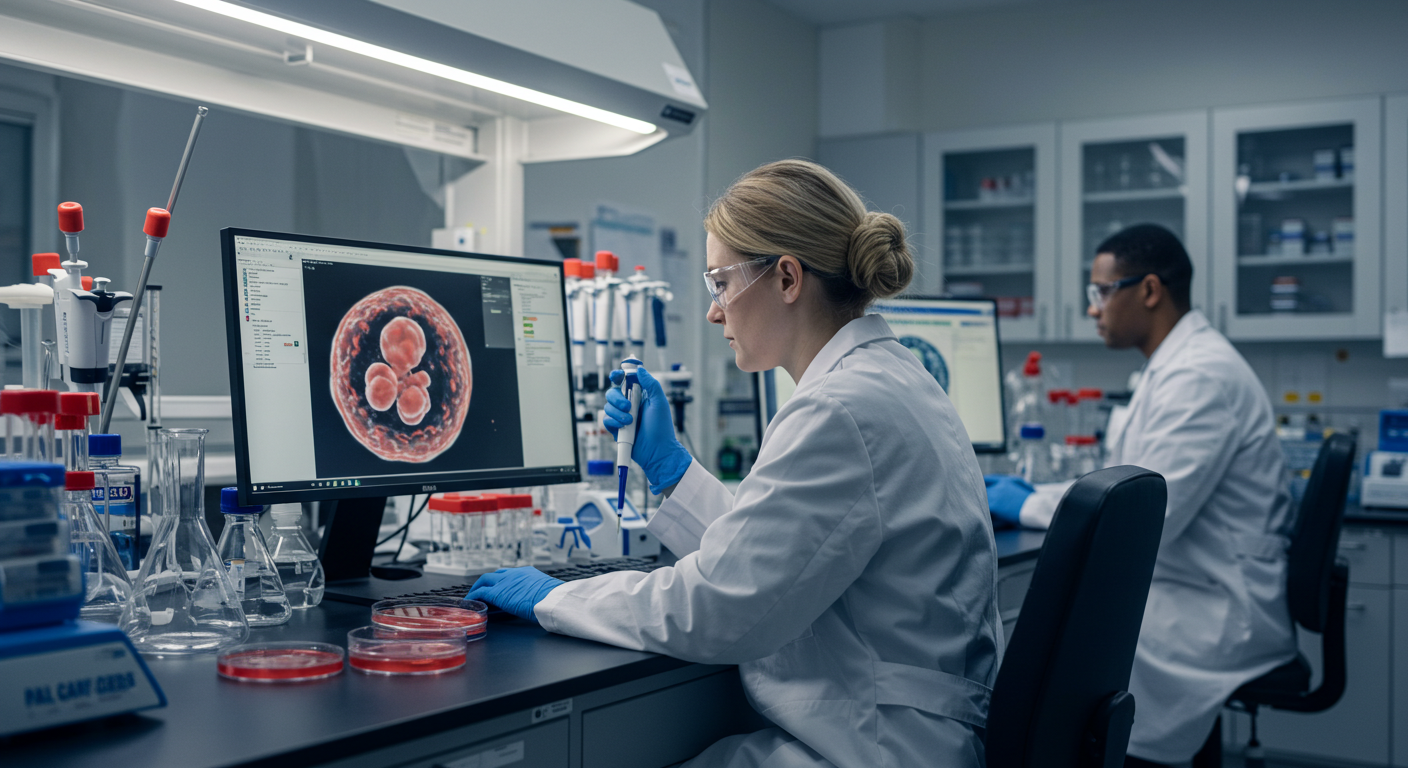
Researchers at Columbia University have reported what the university and related coverage describe as a milestone in human embryo gene-editing research: the use of base editing in viable human embryos. The result is drawing close attention because base editing is often presented as a more targeted alternative to earlier CRISPR methods, and because any progress in embryo editing quickly revives the scientific and ethical debate over human germline engineering.
That headline needs an immediate boundary. In this context, viable human embryos refers to embryos capable of continued development in a research setting, not embryos used to initiate a pregnancy or clinical treatment. The reported work is a laboratory experiment, not a reproductive application, and it does not mean germline editing is ready for medical use.
The study has drawn notice in part because it has been discussed by Columbia University Irving Medical Center, Columbia News, and independent science outlets. But as with many “first” claims, the wording matters. Whether this is the first demonstration of its exact kind should be attributed to the paper, the institution, or outside coverage unless the broader literature clearly settles the point.
What Columbia researchers say they achieved
Base editing is a form of gene editing designed to change a single DNA letter into another without making the classic double-strand cut associated with early CRISPR-Cas9 approaches. In theory, that can reduce some of the damage risks tied to cutting both DNA strands while making it easier to target certain disease-causing mutations.
In the Columbia work, researchers reportedly applied this method to viable human embryos and evaluated whether the edits could be introduced during early development. That matters because embryo biology presents unusual challenges: cells divide quickly, edits may not be distributed evenly, and unintended changes can become embedded in some cells but not others.
The appeal of the approach is straightforward. If a harmful inherited variant could eventually be corrected at the embryo stage, every cell in the resulting person could carry the corrected sequence, and the change could also be passed to future generations. That same possibility is exactly why the research is so contentious.
How base editing differs from earlier CRISPR techniques
Earlier CRISPR-Cas9 systems usually work by cutting both DNA strands at a chosen site and relying on the cell’s repair machinery to disable, remove, or replace a sequence. That opened the door to powerful new biology, but double-strand breaks can also produce unwanted insertions, deletions, or larger genomic rearrangements.
Base editors aim to avoid that specific mechanism. Instead of cutting all the way through the DNA double helix, they chemically convert one base into another at a targeted location. Researchers often describe this as a more precise way to fix mutations that involve a single-letter change.
Even so, more precise does not mean risk-free. Base editing can still produce bystander edits, in which nearby bases are altered unintentionally, and it can still miss some cells or create a mixed embryo in which some cells are edited and others are not. Precision in concept is not the same as perfect control in practice.
What the study found and where the technical limits remain
The central scientific question is not just whether editing happened, but how well it happened. In embryo-editing studies, researchers and outside experts typically focus on several points at once: editing efficiency, how many cells received the intended change, whether unwanted edits appeared elsewhere, and whether mosaicism remained a problem.
Mosaicism is one of the field’s biggest recurring obstacles. If an embryo develops with a patchwork of edited and unedited cells, the biological result becomes harder to predict and much less suitable for any future clinical consideration. The same is true for incomplete editing or evidence that the edit worked better in some lineages than others.
Another concern is bystander editing. A base editor may reach the intended region but still alter adjacent DNA letters inside its activity window. Depending on where those changes occur, they could be harmless, functionally meaningful, or difficult to interpret. Off-target changes elsewhere in the genome remain a separate and important issue, even if a method reduces the odds of the kinds of damage associated with double-strand cuts.
Independent coverage in Nature, Science, and STAT often emphasizes that promising early numbers do not settle these concerns. What matters is not only whether a technique can produce the desired edit in some embryos, but whether it can do so consistently, with low unintended editing and robust genomic characterization. Those standards are especially high when the edited cells would, in principle, contribute to every tissue in a future person.
Why embryo research does not equal clinical germline editing
It is crucial to separate embryo research from reproductive use. A laboratory study in embryos can reveal how a tool behaves in early human development, but that does not place the technology on the verge of clinical deployment. The leap from proof-of-concept research to any reproductive application is enormous.
If an embryo edit were used to establish a pregnancy, the resulting genetic change would likely be heritable. That means any mistake, uncertainty, or unintended consequence could extend beyond one person to future generations who never consented. For that reason, the scientific, legal, and ethical threshold is far higher than for somatic gene editing, which affects only the treated patient and is not passed on to children.
There are also practical and regulatory barriers. Many countries sharply restrict or prohibit clinical germline editing, and professional bodies have repeatedly argued that the technology is not ready for reproductive use. Even if technical performance improves, governance, oversight, and social legitimacy would remain central obstacles.
Why this reignites the germline engineering debate
Supporters of continued embryo-editing research argue that the work could eventually help scientists understand early development and, in the long run, might offer ways to prevent some severe inherited diseases. For families facing devastating single-gene disorders, that future possibility remains a powerful argument for keeping the science moving under strict controls.
Critics respond that the stakes are unusually high because the changes would affect future generations. They point to unresolved safety risks, the impossibility of consent from descendants, the chance of widening inequality if advanced reproductive genetics becomes expensive and exclusive, and the danger that therapeutic goals could blur into enhancement or social selection.
The field is also still shaped by past human embryo-editing controversies, which hardened public and institutional concern about moving too quickly. Since then, many scientists and bioethics groups have drawn a line between tightly regulated laboratory research and any attempt at reproductive germline editing. New technical advances may shift what is scientifically possible, but they do not erase that line.
What to watch next
The next test is replication. Other groups will likely compare the Columbia results with earlier embryo-editing work and ask whether the reported gains hold up across embryos, targets, and editing conditions. In fast-moving fields, a single paper can be influential without being definitive.
Researchers will also be looking for improvements in three areas: higher rates of intended editing, lower mosaicism, and better detection of unintended genomic changes. Those are the benchmarks that will determine whether base editing in embryos is seen mainly as an interesting technical step or as a genuinely important shift in the field.
Just as important will be the response from journals, regulators, and bioethics bodies. Human embryo research is never only a technical story. Each advance also forces a broader public question: not just what scientists can do, but what society is willing to permit when the genome changes could be inherited.