Chicago-area researchers report an anode-free sodium solid-state battery concept
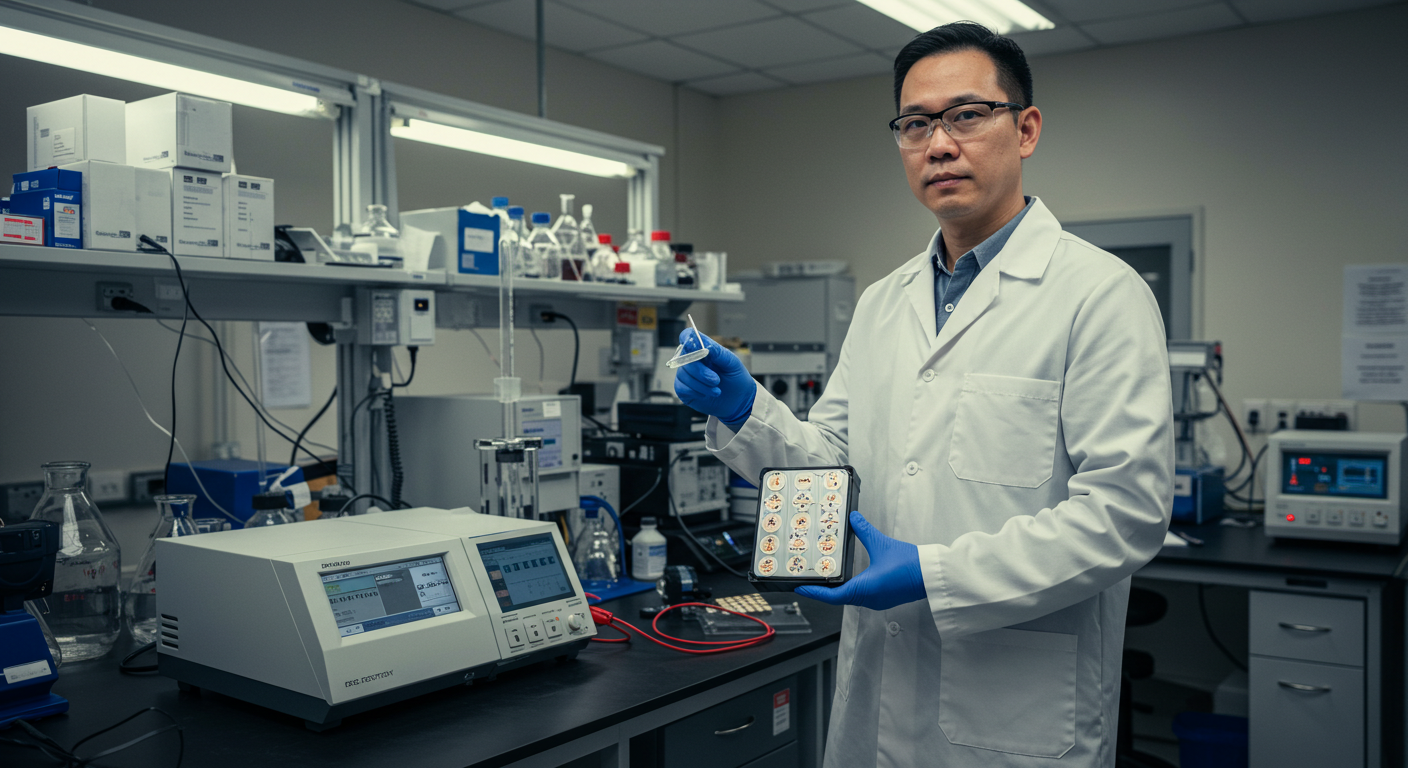
Chicago-area researchers have reported an anode-free sodium solid-state battery design, a notable step in the broader effort to develop battery chemistries that rely less on lithium. The concept combines three difficult ideas in one system: sodium-based chemistry, a solid-state electrolyte, and an anode-free cell architecture.
That combination helps explain the attention the work is receiving. Sodium is widely seen as a more abundant and potentially lower-cost raw material than lithium, while anode-free designs are often studied for their potential to reduce inactive material inside a battery. Still, those theoretical advantages do not automatically translate into a cheaper or market-ready product.
What the battery design means
In an anode-free battery, the cell is assembled without a thick store of anode material already in place. Instead, the metal forms during charging. In simple terms, that can streamline the battery structure and, in principle, improve energy density because less space is devoted to inactive components.
The solid-state part refers to the electrolyte that carries ions through the battery. Unlike conventional liquid electrolytes, a solid electrolyte is intended to improve stability and enable new battery configurations. But solid-state is a broad category that includes inorganic, polymer, and hybrid materials, and the specific electrolyte chosen has a major effect on performance.
The challenge is that metal plating and stripping must happen cleanly and repeatedly. If the interface becomes unstable, the cell can lose efficiency, degrade quickly, or form structures that lead to short circuits. That makes reversibility one of the central hurdles for any anode-free metal battery design, including sodium-based versions.
Why sodium keeps coming up as a lithium alternative
Sodium has become a major focus in battery research because it is more abundant than lithium and is often discussed as a way to ease supply-chain pressure. That does not mean every sodium battery will be cheaper than every lithium battery. Full-system cost depends on many factors, including electrolyte materials, cathodes, manufacturing methods, yield, cycle life, and the operating conditions required by the cell.
Even so, sodium-based systems matter strategically. They give researchers and manufacturers another path to explore as demand for energy storage grows across grid applications, electronics, and transportation.
Why this result matters scientifically
This advance is best understood as a proof of concept, not a finished commercial battery. For work like this, the key questions involve the testing format, cathode pairing, electrolyte composition, current density, cycle performance, and whether the cell works only under narrow lab conditions or under more practical ones.
Those details determine how meaningful the result is beyond the initial demonstration. A strong laboratory result can show that a concept is viable, but it does not by itself answer whether the design can be manufactured at scale, maintain performance over long lifetimes, or compete economically with established battery chemistries.
Why caution is needed around the headline language
Phrases like "world's first" and "cheaper path beyond lithium" deserve careful treatment. Unless a peer-reviewed paper explicitly establishes a novelty claim, it is safer to attribute that wording to the researchers or institution rather than present it as settled fact.
Battery headlines also tend to collapse several different questions into one dramatic takeaway. Abundance is not the same as low manufacturing cost. Solid-state does not automatically mean safer in every design. And a successful coin-cell or other lab-scale demonstration is not the same as commercial readiness.
That does not make the research less important. It simply means the significance lies in showing a promising direction, not in proving that a post-lithium battery industry has already arrived.
What would need to happen next
The next steps are familiar in advanced battery research: independent replication, longer cycle life, testing under more practical conditions, larger-format cells, and evidence that the design can work without highly restrictive requirements. Researchers will also need to show whether the approach depends on specialized materials, tight pressure control, dry-room handling, or narrow temperature windows that could complicate scale-up.
If follow-up studies confirm robust performance, the work could become an important milestone in sodium battery development. For now, the measured takeaway is that Chicago-area scientists appear to have demonstrated a noteworthy new battery concept, one that could broaden the conversation beyond lithium but still faces a long engineering path ahead.