Can Technology Really Overcome Earth's Gravity Barrier?
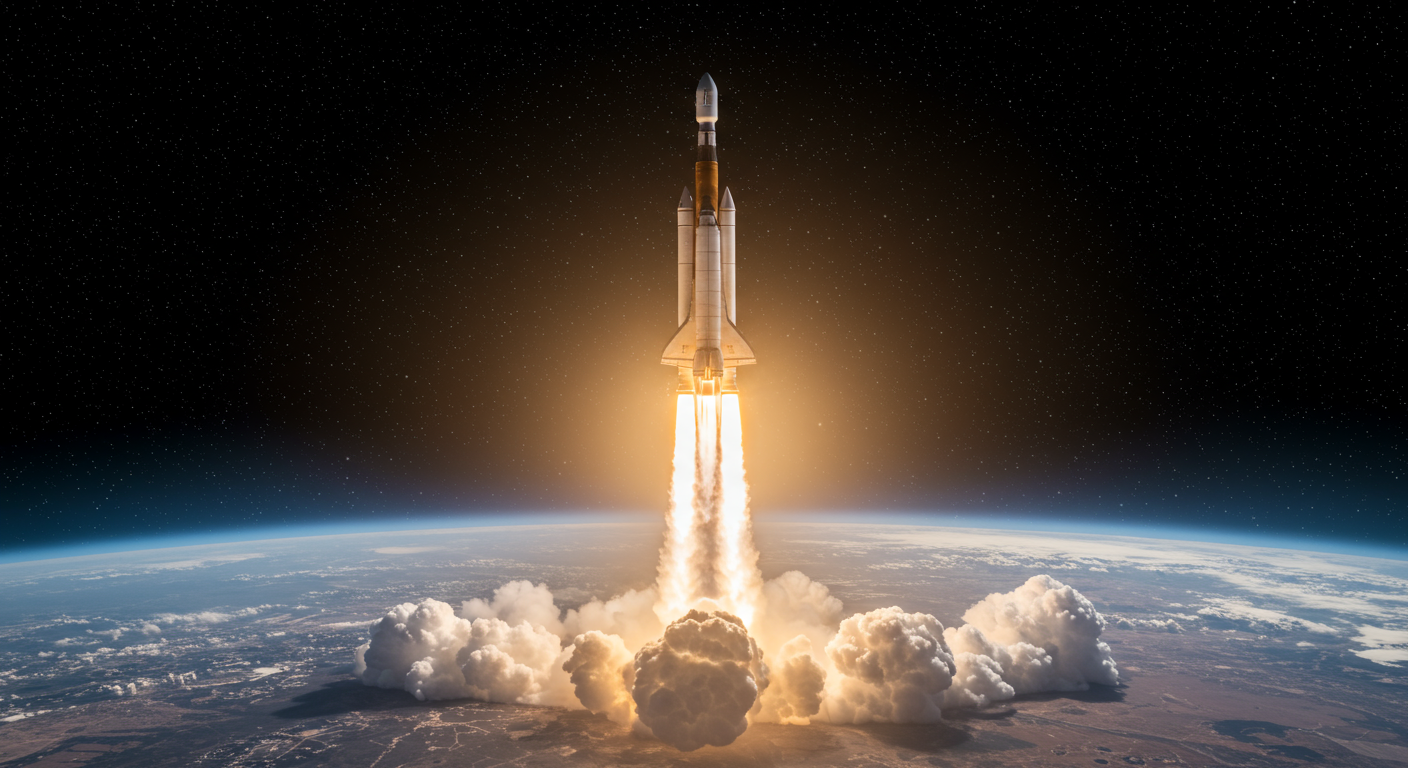
Earth's gravity has been humanity's greatest barrier to space exploration since we first dreamed of reaching the stars. Despite decades of technological advancement, escaping our planet's gravitational well remains one of the most challenging and expensive endeavors in human history. But can modern technology truly overcome this fundamental physics problem?
The Physics Challenge: Understanding Earth's Gravitational Prison
To escape Earth's gravitational influence, any object must reach an escape velocity of 11.2 kilometers per second. This isn't just a speed limit—it's a fundamental energy requirement that cannot be negotiated with or engineered around.
The energy calculations are staggering. To lift just one kilogram of mass to escape velocity requires approximately 62.6 megajoules of energy, equivalent to about 17.4 kilowatt-hours of electricity. When scaled up to spacecraft weighing thousands of tons, the energy requirements become astronomical.
Humanity's attempts to break free from Earth began with simple fireworks and gunpowder rockets in ancient China. The theoretical foundations were laid by pioneers like Konstantin Tsiolkovsky, who first described the rocket equation that governs all space propulsion, and later realized through the practical engineering of visionaries like Wernher von Braun.
Current Chemical Propulsion: Brute Force Solutions
Today's rockets overcome gravity through staged combustion systems that burn chemical fuels to generate thrust. The Saturn V that carried astronauts to the moon exemplified this brute-force approach, using three massive stages to progressively accelerate payloads beyond Earth's gravitational reach.
However, chemical propulsion faces fundamental efficiency limitations. The best chemical rockets achieve specific impulses of around 450 seconds, meaning they can only convert a small fraction of their fuel's energy into useful thrust. Most of a rocket's mass consists of fuel needed to accelerate the remaining fuel.
This creates what rocket engineers call the tyranny of the rocket equation. As mission requirements increase, the fuel needs grow exponentially, leading to diminishing returns where adding more fuel requires even larger rockets to carry that additional mass.
Reusable Systems: Making Gravity Cheaper to Beat
SpaceX's Falcon 9 has revolutionized space access by making rocket stages reusable. Instead of discarding expensive hardware after each flight, the system lands its first stage for refurbishment and reuse. This doesn't change the physics of escaping gravity, but it dramatically alters the economic equation.
Blue Origin has taken a similar approach with its New Shepard vehicle, focusing on reusability for suborbital flights while developing the larger New Glenn for orbital missions. Their philosophy centers on making space access routine through operational reusability.
These reusable systems demonstrate that while we cannot eliminate gravity's energy requirements, we can dramatically reduce the cost per kilogram to orbit. SpaceX has reduced launch costs from over $10,000 per kilogram to under $3,000 for many missions.
Advanced Propulsion: Beyond Chemical Rockets
Ion drives and electric propulsion systems offer dramatically higher efficiency than chemical rockets, though with much lower thrust. These systems use electricity to accelerate ions to extremely high velocities, achieving specific impulses of 3,000 seconds or more.
Nuclear propulsion concepts promise even greater capabilities. Nuclear thermal rockets could double the specific impulse of chemical systems, while theoretical nuclear pulse propulsion could enable rapid transit throughout the solar system.
Air-breathing engines like scramjets could theoretically operate within Earth's atmosphere, using atmospheric oxygen as an oxidizer and reducing the fuel mass penalty. However, these systems face enormous technical challenges in managing hypersonic airflow and extreme temperatures.
Speculative Technologies: The Far Future of Anti-Gravity
Theoretical concepts like space elevators could bypass rocket propulsion entirely. By extending a carbon nanotube cable from Earth's surface to geosynchronous orbit, payloads could climb to space using electric motors, dramatically reducing energy requirements.
The Alcubierre drive represents perhaps the most exotic propulsion concept, theoretically enabling faster-than-light travel by warping spacetime itself. However, such systems would require exotic matter with negative energy density that may not exist.
Electromagnetic propulsion systems and fusion-powered rockets offer more near-term possibilities, though significant engineering challenges remain. Many claimed "gravity-defying" technologies continue to violate well-established physics principles and remain scientifically questionable.
Learning in Microgravity: Research Beyond Earth's Pull
The International Space Station serves as humanity's primary laboratory for zero-gravity operations, enabling research impossible on Earth's surface. The National Aeronautics and Space Administration conducts protein crystallization experiments, materials science research, and biological studies that all benefit from the microgravity environment.
This research directly informs future propulsion development by helping scientists understand how materials and biological systems behave without gravitational influence. Manufacturing processes that require perfect spheres or uniform mixing become practical in microgravity.
The knowledge gained from microgravity research also helps engineers design more efficient spacecraft systems and life support technologies for long-duration missions beyond Earth's gravitational influence.
The Commercial Revolution: Market Forces vs. Gravity
Private industry has emerged as the primary driver of launch innovation and cost reduction. Companies like SpaceX, Blue Origin, Rocket Lab, and Virgin Orbit compete intensely to reduce the cost and complexity of reaching space.
This competition has spurred rapid technological advancement in propulsion systems, manufacturing techniques, and operational procedures. Market incentives reward efficiency and cost reduction in ways that government programs historically have not.
Economic forces are shaping a future where space access becomes increasingly routine and affordable, even if the fundamental physics of escaping gravity remains unchanged.
While technology cannot eliminate Earth's gravitational barrier, it has already made overcoming that barrier dramatically more practical and affordable. From reusable rockets to advanced propulsion concepts, human ingenuity continues to find new ways to escape our planetary cradle and explore the cosmos beyond.