Can Technology Really Overcome Earth's Gravity Barrier?
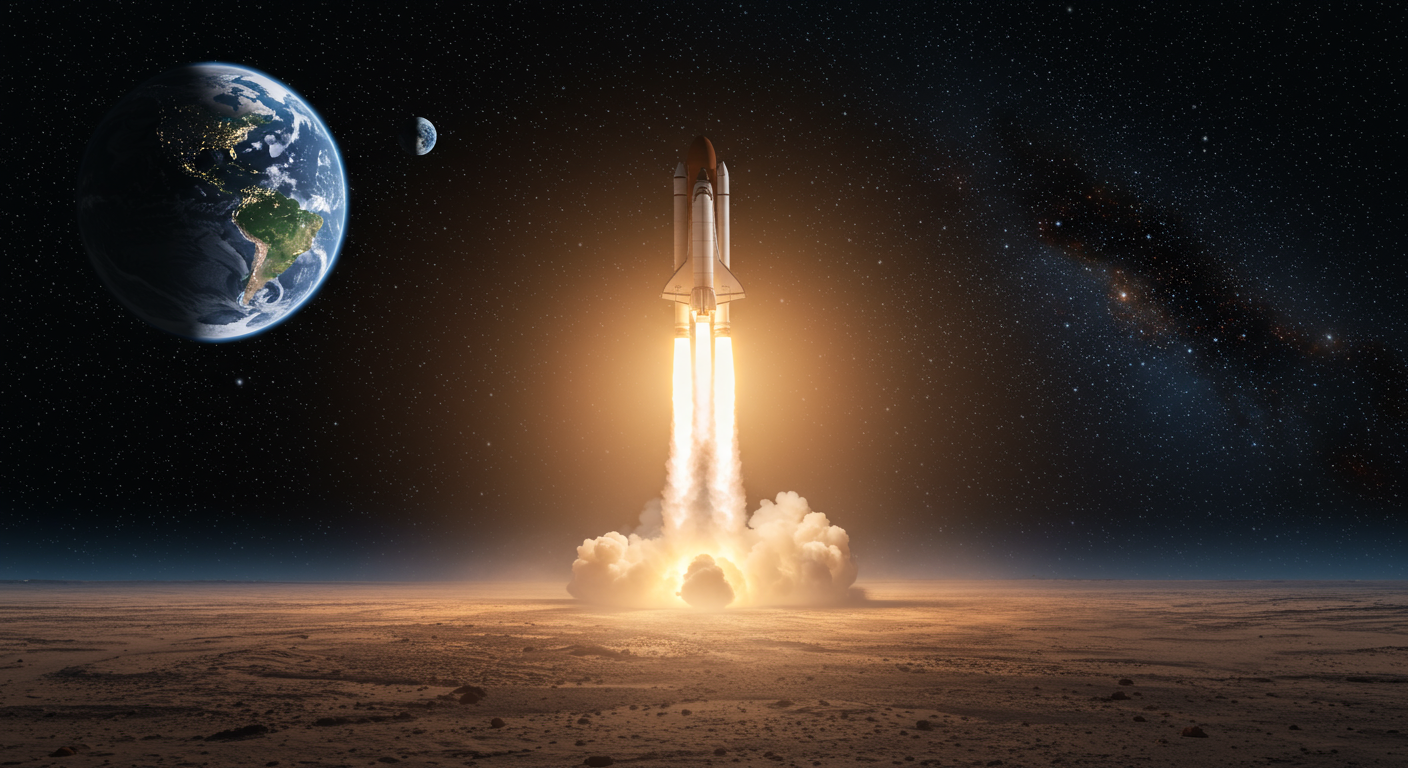
For as long as humans have gazed at the stars, we've dreamed of escaping Earth's gravitational embrace. But overcoming gravity isn't just about wanting to reach space—it's about confronting one of physics' most fundamental challenges. The question isn't whether we can escape gravity, but whether technology can make it efficient, affordable, and routine.
The Physics Challenge: Understanding Earth's Gravity Well
Earth's gravity creates what physicists call a "gravity well"—imagine a deep pit that requires enormous energy to climb out of. To permanently escape Earth's gravitational pull, any object must reach escape velocity: exactly 11.2 kilometers per second, or about 25,000 miles per hour.
This number represents more than just speed—it reveals the fundamental challenge of space access. The rocket equation, developed by Konstantin Tsiolkovsky, shows that achieving such velocities requires exponentially more fuel as payload increases. This creates what engineers call "the tyranny of mass problem": the more fuel you need, the heavier your rocket becomes, requiring even more fuel to lift that additional weight.
The energy requirements are staggering. Lifting just one kilogram to low Earth orbit requires roughly 30 megajoules of energy—equivalent to the energy stored in 8.3 kilowatt-hours of electricity. But due to inefficiencies in chemical rockets, the actual energy used is typically 10 to 20 times higher.
Current Chemical Propulsion: Brute Force Success
Today's rockets overcome gravity through sheer brute force, burning massive amounts of chemical fuel to generate thrust. A typical rocket carries 85-95% fuel by weight, with the actual payload representing just a tiny fraction of the total mass at launch.
However, recent innovations have dramatically improved the economics of space access. SpaceX's Falcon Heavy and the developing Starship system demonstrate how reusability can reduce costs without changing fundamental physics. Instead of throwing away multi-million-dollar rocket stages after one use, these systems land and fly again, spreading their manufacturing costs across multiple missions.
These improvements have reduced launch costs from tens of thousands of dollars per kilogram to low Earth orbit down to around $3,000-5,000 per kilogram. While impressive, this still represents a brute-force approach to the gravity problem—we're getting more efficient at the same basic technique humans have used since the 1950s.
Advanced Propulsion Technologies
Beyond chemical rockets, several advanced propulsion technologies offer different approaches to the gravity challenge. Ion drives and electric propulsion systems achieve much higher fuel efficiency by accelerating small amounts of propellant to extremely high speeds using electricity rather than chemical reactions.
While ion drives excel in the vacuum of space, their low thrust makes them unsuitable for launching from Earth's surface. However, they represent a crucial technology for space missions once you've already escaped the gravity well.
Nuclear propulsion concepts offer potentially revolutionary improvements. Nuclear thermal rockets could provide twice the efficiency of chemical systems, while theoretical nuclear pulse propulsion systems could achieve even greater performance. However, these technologies face significant safety, regulatory, and engineering challenges.
Air-breathing engines present another approach: systems that collect atmospheric oxygen during the initial ascent phase, reducing the need to carry oxidizer. Hybrid systems combining air-breathing and rocket modes could potentially reduce the mass penalty of reaching orbit.
Revolutionary Space Access Concepts
Some of the most intriguing approaches to overcoming gravity don't rely on rockets at all. The space elevator concept proposes using an incredibly strong tether—likely made from carbon nanotubes—stretching from Earth's surface to beyond geostationary orbit. Objects could then climb this tether using relatively little energy.
While theoretically possible, space elevators face enormous engineering challenges. The required materials are at the very edge of physical possibility, and the system would be vulnerable to space debris, weather, and potential cascading failures.
Other megastructure concepts include launch loops—massive rotating structures that could fling payloads into orbit—and orbital rings that would encircle the entire planet. Mass drivers and electromagnetic launch systems could use magnetic fields to accelerate spacecraft without carrying fuel.
These approaches share a common theme: they attempt to overcome gravity through infrastructure rather than brute force, potentially making space access as routine as taking an elevator.
Breakthrough Propulsion: Science Fiction or Future Reality?
The most speculative approaches to overcoming gravity involve breakthrough physics that might not require fighting gravity at all. Theoretical concepts like Alcubierre drives propose warping spacetime itself, while traversable wormholes could provide shortcuts through space.
The controversial EmDrive claimed to produce thrust without expelling reaction mass, potentially offering reactionless propulsion. However, repeated testing has failed to demonstrate any anomalous thrust beyond experimental error, and the concept appears to violate fundamental physics principles.
True mastery over gravity might require discoveries in physics we haven't made yet—perhaps involving quantum gravity, dark energy, or exotic matter with negative mass. While these remain firmly in the realm of speculation, the history of technology shows that seemingly impossible challenges sometimes yield to breakthrough insights.
The Economic and Engineering Reality Check
Despite remarkable progress, current space access costs remain high enough to severely limit human activity beyond Earth. Launch costs of several thousand dollars per kilogram mean that even basic space infrastructure requires enormous investments.
Manufacturing and infrastructure requirements for alternative systems present their own challenges. A space elevator would require materials that don't currently exist at the necessary scale. Orbital rings would dwarf any engineering project in human history. Even relatively modest concepts like mass drivers would require substantial ground-based infrastructure.
Timeline projections for next-generation space access vary widely. Reusable rockets continue improving incrementally, with costs potentially dropping another order of magnitude over the next decade. More revolutionary approaches like space elevators or breakthrough propulsion systems remain decades away at minimum, assuming they prove feasible at all.
The answer to whether technology can truly overcome Earth's gravity barrier appears to be both yes and no. We've already demonstrated that chemical rockets can escape gravity, and incremental improvements continue reducing costs and increasing capability. However, truly routine, affordable access to space may require either massive infrastructure investments in alternative launch systems or breakthrough discoveries in physics that we cannot yet predict.
What seems certain is that overcoming gravity will continue to drive technological innovation, pushing the boundaries of materials science, propulsion physics, and engineering capability. Whether through better rockets, space elevators, or technologies we haven't yet imagined, the human drive to escape Earth's gravity well shows no signs of diminishing.