Can Artificial Gravity Be Created in Space Stations?
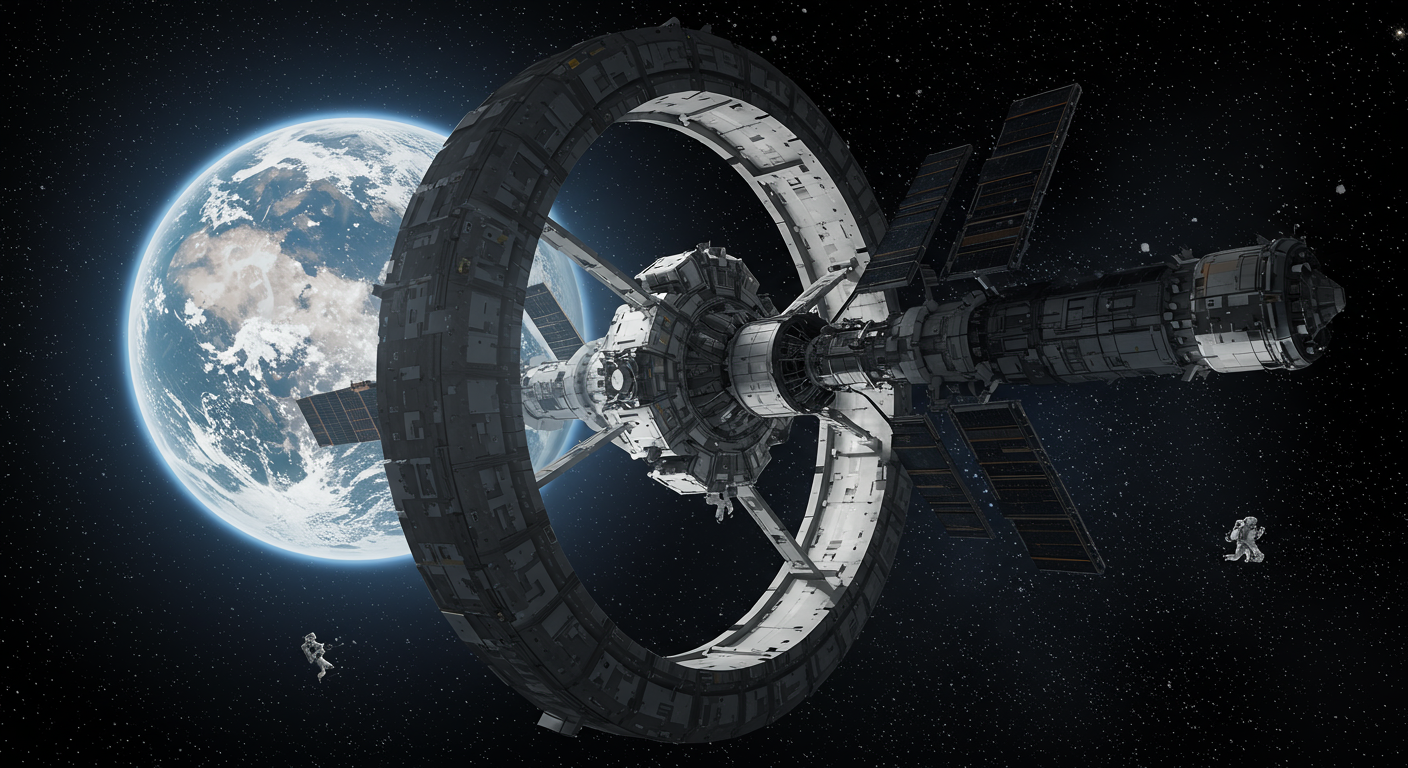
Artificial gravity in space stations does not require a sci-fi force field. In engineering terms, it means creating a gravity-like sensation through acceleration. The most credible method is rotation: if a habitat spins, people inside feel pressed toward the outer floor in a way that resembles weight. That idea is grounded in established physics, not speculative science.
What artificial gravity in a space station actually means
On Earth, gravity pulls us toward the planet. In orbit, astronauts are in continuous free fall, which creates the microgravity conditions seen on stations such as the International Space Station. Artificial gravity is meant to replace some of that missing physical load by accelerating the human body in a controlled way.
The best-known concept is a rotating station shaped like a ring, wheel, or drum. As it spins, the structure continuously changes the direction of motion of everything inside it. Occupants experience that acceleration as a push toward the outer edge, making the floor feel like “down.” In practical terms, that can imitate gravity even though the source is motion rather than a planet’s mass.
Why space agencies care about creating it
Space agencies care because long exposure to microgravity is hard on the human body. NASA and the European Space Agency have both documented risks such as bone loss, muscle atrophy, fluid shifts, and other physiological stresses that crews must manage with exercise and other countermeasures. Those concerns become more important as mission planners consider longer stays in orbit and future missions deeper into space.
That is why artificial gravity remains an appealing idea. If a station or spacecraft could provide continuous or repeated gravity-like loading, it might reduce some of the strain that comes with living in microgravity for months at a time. However, current crewed stations do not provide sustained artificial gravity for their occupants. For now, crews rely on workarounds rather than a spinning habitat.
How rotating stations could simulate gravity
The basic principle is straightforward. In a rotating habitat, the apparent gravity depends mainly on two things: how fast the structure rotates and how large it is. A larger radius can produce the same gravity-like effect with slower rotation, while a smaller station has to spin faster to create a similar force at the floor.
That gives designers options. A station could aim for roughly Earth-like gravity, or it could target lower levels closer to what humans would experience on the Moon or Mars. In theory, even a tether system with two connected masses spinning around a shared center could create useful artificial gravity without requiring a single giant wheel.
Why it is so hard to build in practice
The challenge is not whether the physics works. The challenge is building something people can live in safely and comfortably. The central tradeoff is that compact habitats need higher spin rates, and faster spin can make motion sickness and disorientation worse. Research discussed by NASA, Scientific American, and others has long noted that head and body movements inside a rotating environment can produce unusual sensory effects that are far less intuitive than walking around on Earth.
Then there are the engineering problems. A rotating structure must handle continuous loads, remain balanced, and operate reliably over long periods. Designers also have to think about launch mass, assembly in orbit, maintenance, docking visiting spacecraft, and how to connect rotating sections to non-rotating ones. Each of those adds complexity, cost, and risk.
What designs have been proposed
Engineers and space advocates have proposed several recurring concepts. One is the classic rotating ring or wheel, with crew quarters along the outer rim. Another is a drum-shaped habitat that spins around its axis. A third is a tethered configuration, with two masses separated by a long cable and rotating around a common center of mass.
All of these have theoretical appeal. Larger rotating systems can reduce the spin rate needed for comfortable living, and tether concepts can potentially lower structural demands compared with a rigid ring. But every design introduces operational complications, especially when construction, station-keeping, docking, and long-term maintenance are considered. That helps explain why rotating stations appear so often in studies and concept art but have not yet become standard human habitats in space.
Could partial gravity be the more realistic near-term goal?
A full Earth-like 1 g environment may not be the only useful target. One of the most practical questions in space medicine is whether partial gravity could deliver meaningful health benefits while being easier to engineer. If Moon-like or Mars-like gravity levels turn out to reduce major harms from microgravity, future stations or transit vehicles might not need to reproduce Earth conditions exactly.
That possibility matters because a lower target gravity can ease some design demands. A station may be able to spin more slowly or use a smaller radius while still providing some physiological benefit. But the key medical threshold is not fully settled, so partial gravity remains an important open question rather than a solved requirement.
So, can artificial gravity be created in space stations?
Yes, in principle. Artificial gravity is scientifically credible, and rotational designs are the leading way to achieve it. Nothing about the concept violates known physics.
What has prevented it so far is the practical side: engineering difficulty, cost, system complexity, and uncertainty about what level of gravity is necessary for long-term human health. So the short answer is yes, artificial gravity can be created in space stations, but no operational station currently provides it as a sustained living environment for crews.