Building Self-Sustaining Habitats on the Moon and Mars: Where the Technology and the Ambition Stand
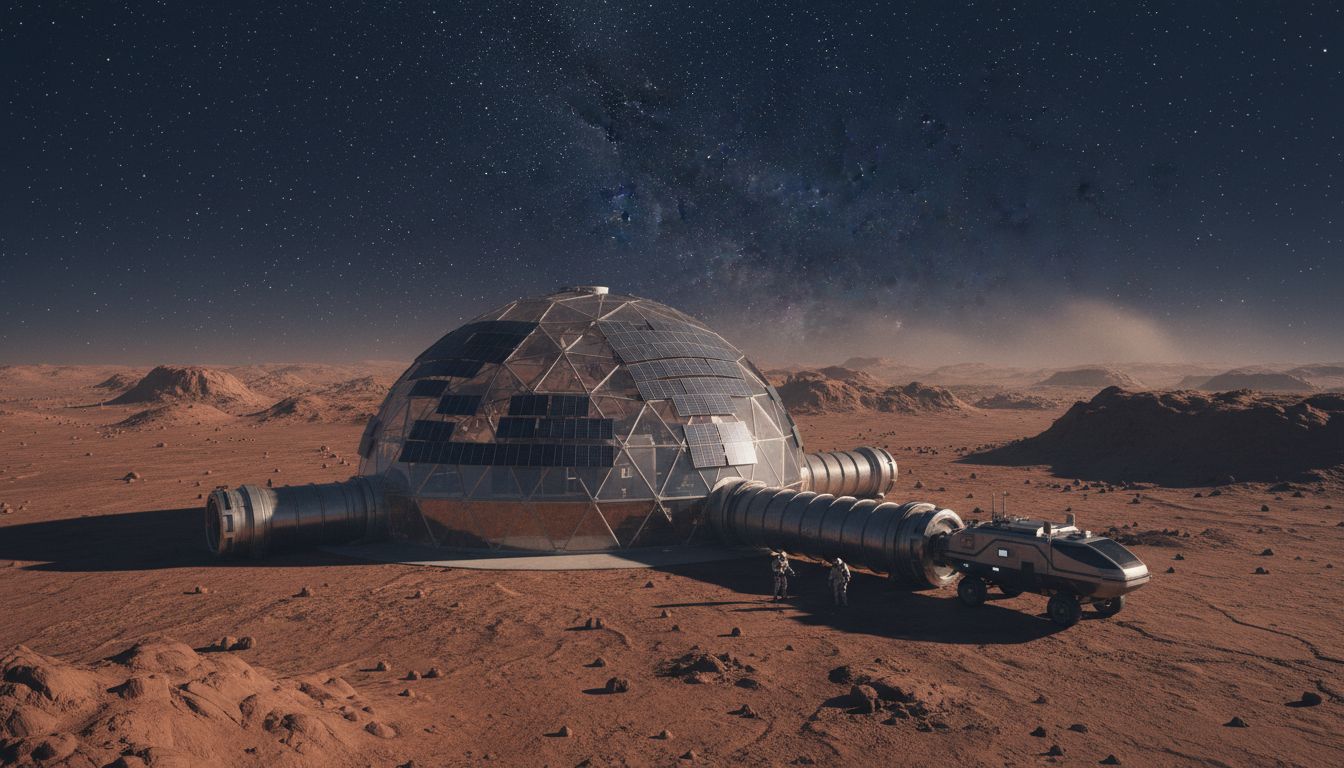
For decades, human presence beyond Earth has meant brief, carefully provisioned visits: a handful of days on the lunar surface, weeks aboard orbiting stations. The next phase under discussion across major space programs is different in kind, not just duration. Agencies and private companies are now oriented around the idea of permanent, self-sustaining habitats—outposts that don't just keep people alive but allow them to live and work with minimal resupply from Earth.
The Moon is widely framed as the proving ground for this shift, while Mars remains the ultimate destination. The distinction matters: survival systems designed for short missions look very different from the closed-loop infrastructure needed for genuine self-sufficiency. Water recycling, food production, radiation shielding, and local construction materials all become central engineering problems rather than afterthoughts.
NASA's Artemis and Moon to Mars Vision
NASA's Artemis program anchors much of the near-term planning in this space. Its stated goals extend beyond flags-and-footprints missions toward a sustained lunar presence, including surface habitats and infrastructure intended to operate over extended periods. This lunar work is explicitly tied to NASA's broader Moon to Mars initiative, which treats the Moon less as an end point and more as a testbed.
The logic behind this approach is one of incremental risk reduction. Technologies and operational procedures—life support, power generation, surface mobility, habitat construction—can be validated in the Moon's relatively accessible environment before being adapted for Mars, where communication delays and distance make real-time troubleshooting far harder.
ESA's Moon Village and the Case for International Collaboration
The European Space Agency, or ESA, has advanced a different but complementary vision: the Moon Village concept. Rather than a single national base, this model envisions shared lunar infrastructure built and used collaboratively by multiple countries and organizations, open to a range of scientific, commercial, and exploratory purposes.
In-situ resource utilization, or ISRU, plays a central role in this concept. The idea of extracting water, oxygen, or construction materials directly from lunar regolith rather than shipping everything from Earth is one of the more consequential technical bets underlying any sustained lunar presence. A shared-infrastructure model like the Moon Village could, in principle, distribute the cost and risk of developing these capabilities across multiple partners. At the same time, multinational cooperation of this scale brings its own friction: differing national priorities, funding cycles, and technical standards can complicate coordination even when the broader goal is shared.
SpaceX and the Private-Sector Push Toward Mars
SpaceX has pursued a notably different path, centered on its Starship vehicle as a reusable transportation architecture. The underlying premise is that affordable, high-frequency launch capability is the prerequisite for large-scale off-world settlement—if enough cargo and people can be moved cheaply enough, self-sufficient colonization becomes a logistics and engineering problem rather than a purely financial one.
This approach differs from government programs in both incentive structure and risk tolerance. Public agencies typically operate under layered oversight, multi-year budget cycles, and international political considerations. A private company can iterate faster and accept higher failure rates in testing, but it also faces different pressures around funding sustainability and timeline credibility. Commercial Mars timelines have historically been more aggressive than those outlined by government programs, a gap that reflects these differing institutional realities as much as differing technical assessments.
The Core Engineering Challenges of Off-World Living
Across all these efforts, several technical challenges recur. Radiation protection is one of the most significant: neither the Moon nor Mars has an atmosphere or magnetic field comparable to Earth's, meaning long-term habitats need substantial shielding, whether through regolith coverings, subsurface construction, or other approaches still being refined.
Closed-loop life support is equally critical. Producing breathable air, recycling water, and growing food with minimal Earth resupply are prerequisites for any habitat meant to be self-sustaining rather than merely survivable. ISRU ties into this directly, since locally sourced water and materials reduce the mass that must be launched from Earth, which in turn affects mission cost and feasibility.
Finally, autonomous and robotic construction techniques are increasingly seen as necessary groundwork. Given the hazards and costs of human labor in these environments, pre-positioning robotic systems to build or prepare habitat structures ahead of crewed arrival is a recurring theme in both agency and private-sector planning.
Government vs. Private Approaches: Complementary or Competing?
NASA, ESA, and SpaceX efforts overlap in their shared interest in ISRU, habitat technology, and sustained off-world presence, and NASA has in fact relied on SpaceX's Starship as part of its own lunar landing plans—an example of how public and private efforts are already intertwined rather than fully separate.
Where they diverge is largely structural: funding models, acceptable risk levels, and underlying motivations differ substantially between a government agency answerable to public oversight and a private company pursuing its own long-term vision. Looking ahead, many observers in the space community anticipate growing interdependence—government programs providing funding stability, regulatory frameworks, and scientific direction, while private companies supply transportation capacity and manufacturing scale.
What's Still Unknown
Despite the ambition on display across these programs, significant gaps remain in publicly available technical detail. Specifics on ISRU methods, radiation shielding performance over long durations, and the real-world viability of closed-loop life support systems at habitat scale are not fully addressed in public agency communications or company statements.
These gaps make it difficult to independently verify how close any of these programs truly are to achieving genuine self-sufficiency, as opposed to extended but still Earth-dependent operations. More detailed technical reporting from agencies and companies alike would help clarify how realistic current timelines actually are.
Looking Ahead
In the near term, milestones worth watching include further Artemis lunar landing missions, continued development and testing of Starship, and any formal expansion of participation in the Moon Village concept. None of these programs suggest that self-sustaining off-world habitats are imminent; rather, the consistent message across agency and industry sources is that this remains a multi-decade undertaking involving numerous government and private actors, each contributing different pieces of a very complex puzzle.