Building Self-Sustaining Habitats on the Moon and Mars: The Next Frontier of Human Settlement
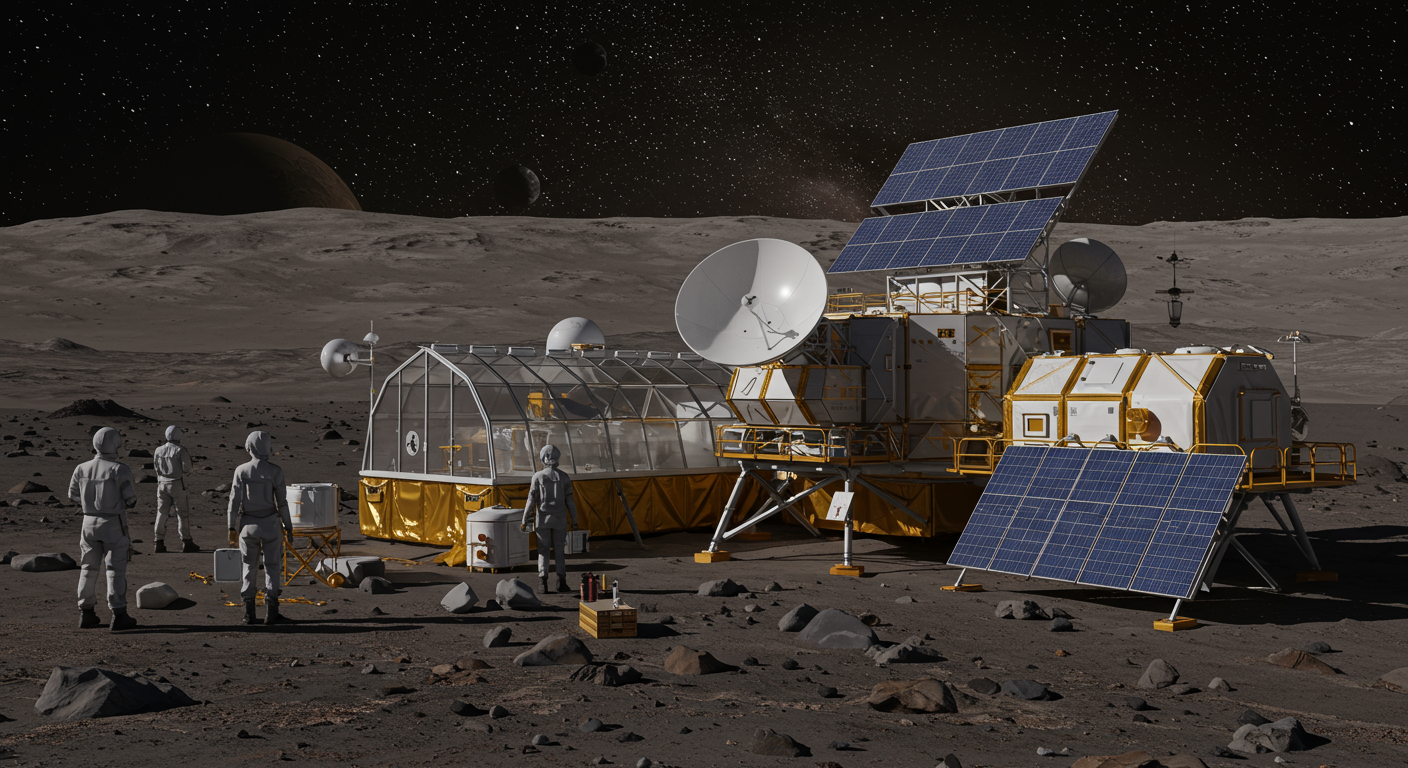
As humanity prepares to become a multi-planetary species, building self-sustaining habitats on the Moon and Mars has evolved from science fiction to active engineering reality. These ambitious projects represent perhaps the greatest technological challenge in human history, demanding revolutionary advances in closed-loop life support, resource extraction, and autonomous manufacturing.
The Race to Build Permanent Space Settlements
Multiple space agencies and private companies are pursuing complementary strategies for establishing permanent human presence beyond Earth. The NASA Artemis program aims to return humans to the Moon by 2026 and establish a sustainable lunar base, while SpaceX's Mars colonization plans target the Red Planet for human settlement within the next two decades. The European Space Agency's Moon Village concept envisions an international lunar outpost serving as a stepping stone to Mars.
Self-sustaining habitats represent the critical milestone determining whether these missions evolve from short-term expeditions to permanent settlements. Unlike the Apollo missions or current International Space Station operations, which rely heavily on Earth-based supply chains, future lunar and Martian colonies must achieve near-complete autonomy to survive communication delays, launch windows, and supply constraints inherent to deep space exploration.
Current funding and technological timelines suggest the first permanent lunar outposts could be operational by the 2030s, with Martian settlements following in the 2040s or 2050s—assuming successful resolution of key technical challenges.
Life Support Systems: Creating Earth-Like Conditions
The foundation of any self-sustaining space habitat lies in reliable life support systems that maintain breathable atmosphere, clean water, and stable temperatures without external resupply. These systems must operate as closed-loop cycles, recycling and regenerating essential resources with minimal waste.
Atmospheric processing systems will continuously scrub carbon dioxide from habitat air while maintaining optimal oxygen levels and humidity. Current International Space Station technology provides a starting point, but lunar and Martian habitats require more robust and efficient systems capable of operating for years without maintenance.
Water recycling and purification represent another critical component, as transporting water from Earth remains prohibitively expensive. Advanced filtration systems must recover water from all possible sources, including humidity, waste, and potentially contaminated local ice deposits.
Temperature regulation poses unique challenges in environments where surface temperatures swing from hundreds of degrees above freezing to hundreds below. Habitat systems must maintain stable internal conditions while managing heat loss through radiation and conduction to the surrounding environment.
Most importantly, all life support systems must incorporate multiple levels of redundancy and backup capabilities, as equipment failure in these isolated environments could prove catastrophic for the entire settlement.
In-Situ Resource Utilization: Living Off the Land
The key to truly self-sustaining space habitats lies in In-Situ Resource Utilization (ISRU)—the ability to extract and process local materials rather than importing everything from Earth. Both the Moon and Mars offer valuable resources that can support human life with the right extraction and processing technologies.
Water extraction represents the highest priority for ISRU development. Lunar polar regions contain substantial ice deposits that can be harvested and purified, while Mars offers both polar ice caps and subsurface permafrost. Successful water extraction provides not only drinking water but also hydrogen and oxygen through electrolysis.
Oxygen production can be achieved through multiple pathways depending on location. On Mars, the carbon dioxide-rich atmosphere can be processed to extract oxygen, while both locations can use water electrolysis as a backup oxygen source.
Construction materials present another opportunity for local resource utilization. Both lunar and Martian regolith can potentially be processed into concrete-like building materials, metals for structural components, and even glass for windows and optical elements.
Advanced manufacturing capabilities will be essential for producing tools, equipment components, and replacement parts using local materials. This requires developing space-qualified 3D printing, metal processing, and electronics manufacturing systems that can operate reliably in extreme environments.
Habitat Construction and Protection
Building structures capable of protecting human life in the harsh environments of the Moon and Mars requires innovative approaches to construction, materials science, and structural engineering. Traditional Earth-based construction methods are largely inapplicable in environments with extreme temperatures, vacuum or thin atmosphere, and constant radiation exposure.
3D printing technology using processed lunar and Martian regolith offers the most promising approach for large-scale habitat construction. Several research programs are developing robotic construction systems that can print habitat shells, foundations, and infrastructure components using locally sourced materials.
Radiation shielding represents one of the most critical design challenges, as both locations lack the magnetic field and thick atmosphere that protect Earth's surface. Underground construction offers natural shielding through rock and soil coverage, while surface habitats must incorporate heavy shielding materials or utilize local terrain features for protection.
Structural engineering in low-gravity environments presents unique challenges and opportunities. While reduced gravitational loads allow for lighter construction, extreme temperature variations create thermal stress that Earth-based structures are not designed to handle.
Modular design approaches will be essential for creating expandable settlements that can grow over time. Initial habitat modules must be designed for easy connection to additional living spaces, laboratories, manufacturing facilities, and life support systems as the colony population grows.
Food Production in Space
Achieving food security in space settlements requires developing agricultural systems that can produce nutritionally complete diets using minimal resources and space. Traditional farming methods are not viable in space environments, necessitating advanced controlled-environment agriculture techniques.
Hydroponic and aeroponic growing systems offer the most efficient approaches for space agriculture, allowing precise control over nutrients, water, and growing conditions while maximizing yield per unit of space and resources. These systems can operate continuously regardless of external environmental conditions.
Crop selection for space agriculture must balance nutritional requirements, growing efficiency, and resource constraints. Leafy greens, small fruits, and grains that provide essential vitamins, minerals, and calories while growing quickly and efficiently are prioritized for space farming systems.
Soil creation in closed environments requires developing composting and nutrient recycling systems that convert organic waste into growing media. This closed-loop approach minimizes waste while providing essential nutrients for plant growth.
Protein production remains one of the most challenging aspects of space agriculture. Potential solutions include insect farming for high-protein content, laboratory-grown meat technologies adapted for space environments, and aquaculture systems for fish production.
Power and Manufacturing Infrastructure
Reliable power generation and advanced manufacturing capabilities form the backbone of any self-sustaining space settlement. These systems must operate autonomously for extended periods while providing sufficient capacity for life support, habitat maintenance, and industrial production.
Power generation options vary significantly between lunar and Martian environments. Nuclear power systems offer consistent output regardless of environmental conditions but require complex fuel handling and safety systems. Solar power provides a cleaner alternative but faces challenges from lunar night cycles and Martian dust storms.
Energy storage solutions must maintain power during extended periods without generation capability. Lunar settlements must survive 14-day night cycles, while Martian habitats must cope with dust storms that can last for months and significantly reduce solar panel efficiency.
Manufacturing infrastructure must be capable of producing everything from basic tools and spare parts to complex electronic components. This requires space-qualified versions of Earth-based manufacturing technologies, including metal processing, electronics assembly, and precision machining capabilities.
Maintenance and repair protocols become critically important in isolated environments where replacement parts cannot be shipped from Earth. Settlements must maintain comprehensive spare parts inventories and develop repair capabilities for all critical systems.
Human Factors and Social Systems
The success of space settlements depends not only on technological systems but also on addressing the psychological and social challenges of isolated, confined communities. These human factors often prove more challenging than the technical obstacles.
Psychological challenges of isolation and confinement can severely impact individual and group performance. Settlement design must incorporate recreational spaces, privacy areas, and communication systems that help maintain mental health and social connections with Earth.
Social structures and governance models for small, isolated communities require careful consideration. Traditional democratic processes may need adaptation for communities where every member's expertise is critical for survival, and where group consensus is essential for major decisions.
Medical care capabilities must address both routine healthcare needs and emergency procedures without the possibility of evacuation to Earth. This requires comprehensive medical facilities, surgical capabilities, and extensive medical training for settlement members.
Communication delays between Earth and Mars can extend up to 24 minutes each way, making real-time consultation impossible during certain orbital periods. Settlements must develop autonomous decision-making capabilities and emergency response protocols that function independently of Earth support.
Current Progress and Future Milestones
Significant progress is being made across all aspects of space settlement technology, with numerous proof-of-concept missions and technology demonstrations planned for the coming decade. These efforts are building the foundation for eventual permanent human presence beyond Earth.
Technology demonstration missions are testing critical systems including ISRU equipment, advanced life support systems, and construction techniques. The National Aeronautics and Space Administration MOXIE experiment on the Perseverance rover successfully demonstrated oxygen production on Mars, while lunar ice extraction missions are planned for the mid-2020s.
Private sector innovation is accelerating development timelines through commercial partnerships and competitive approaches. Companies like SpaceX, Blue Origin, and specialized space technology firms are developing complementary technologies that support settlement objectives.
International cooperation frameworks are emerging to address resource sharing, technical standards, and governance issues for future settlements. These agreements will be essential for managing the complex logistics and political challenges of multi-national space settlements.
Realistic timelines for first permanent settlements suggest lunar outposts by the 2030s and Martian colonies by the 2040s or 2050s, assuming continued technological progress and sustained funding for development programs.