Building Self-Sustaining Habitats on the Moon and Mars
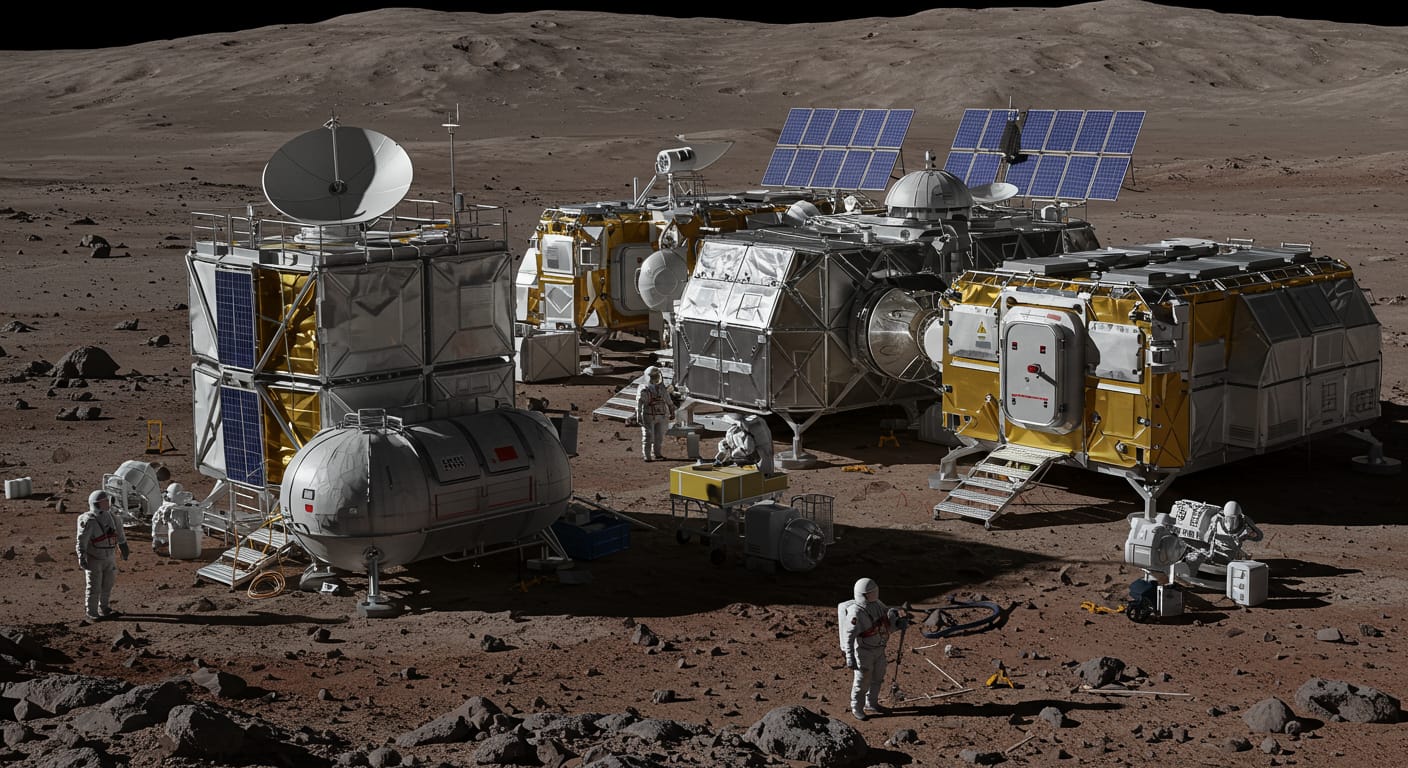
The idea of a fully self-sustaining habitat on the Moon or Mars is compelling, but it can also create the wrong impression. In the near term, off-world habitats are much more likely to be partially closed-loop systems that reduce dependence on Earth rather than eliminate it. That distinction matters. Early space settlements will still need replacement parts, specialized equipment, and periodic logistics support, even as they become more capable and resilient.
A more useful way to measure progress is by looking at reduced resupply needs, stronger redundancy, and smarter use of local resources. The goal is not immediate independence. It is to build habitats that can keep crews alive, productive, and safe for longer stretches in places where failure is far harder to recover from.
The core systems every off-world habitat must integrate
A livable habitat beyond Earth is not a single technology. It is a tightly connected system of systems. Life support sits at the center, handling air revitalization, water recovery, waste management, and environmental monitoring. These functions have to operate continuously and reliably because there is little margin for extended outages.
Power is just as critical. Lunar bases must survive long nights, while Martian habitats have to cope with dust, cold, and changing solar conditions. That means generation, storage, distribution, and thermal control all need to work together. A habitat also has to provide shelter, sanitation, communications, medical capability, work areas, and maintenance access.
In practice, redundancy is essential. Off-world systems need fault tolerance because repair opportunities are limited, crew time is constrained, and even a minor failure can cascade into a life-threatening one.
Closed-loop life support is the foundation of long-duration living
The more a habitat can recycle its own water and air, the less mass has to be launched from Earth. That makes closed-loop life support one of the most important enablers of long-duration habitation. Recovering water from humidity, hygiene, and waste streams, while continuously managing breathable air, can sharply reduce the resupply burden.
But high recycling rates are not the same as full autonomy. These systems are complex, maintenance-heavy, and difficult to perfect over very long periods. Reliability, repairability, and operational safety matter as much as efficiency. A system that recycles more but breaks often is less useful than one that performs slightly worse on paper but is easier for crews to maintain under real mission conditions.
Local resources could turn hostile terrain into usable infrastructure
In-situ resource utilization, often shortened to ISRU, is central to any serious vision of expanding beyond short stays. If crews can extract useful materials from local soil, ice, or atmosphere, they can reduce how much must be shipped from Earth. Over time, that shift could move mission design from expeditionary outposts toward more durable surface operations.
Local materials may serve several purposes. Regolith could support construction methods or shielding. Water ice, where available, could be processed for life support and potentially fuel production. According to NASA, oxygen extraction from lunar materials has long been studied as a way to support surface activities. On Mars, the atmosphere and subsurface resources may offer different pathways for producing consumables.
The value of local resource use rises with mission duration. For short missions, imported supplies may be acceptable. For longer missions and larger crews, resupply becomes too limiting and too expensive to remain the main strategy.
Building materials, shielding, and dust protection may matter as much as oxygen and water
Habitats on the Moon and Mars must do more than provide pressure and temperature control. They also need to protect crews from radiation, micrometeoroids, dust, and long-term wear. Radiation is one of the biggest design drivers, especially for extended stays. That is why many habitat concepts include regolith berms, partial burial, or subsurface placement to add shielding mass without launching it from Earth.
Dust is another major challenge. NASA and the European Space Agency both emphasize how abrasive lunar dust and persistent Martian dust can complicate operations and damage equipment. Seals, joints, suit interfaces, filters, and moving hardware all have to endure repeated exposure. Over time, this may matter as much to mission success as headline technologies like oxygen extraction or crop growth.
In other words, habitat engineering is not just about survival chemistry. It is also about structural durability, maintainability, and designing for an environment that constantly wears systems down.
Food production is possible, but not a complete near-term solution
Growing food in controlled environments is often presented as a hallmark of self-sufficiency, and it does offer real advantages. Plants can support crew morale, provide some fresh nutrition, and potentially contribute to parts of a broader recycling loop. For long missions, those benefits are meaningful.
Still, early lunar and Martian crews are unlikely to grow all of their own food. Agriculture requires volume, water, power, lighting, crew labor, and reliable environmental controls. Those resources compete directly with other mission priorities. In the near term, food production is better understood as a supplement rather than a replacement for shipped supplies.
That makes agriculture one component of habitat ecology, not the single measure of whether a settlement is self-sustaining.
Why the Moon is the proving ground and Mars is the harder destination
The Moon is the logical place to test the technologies and operations needed for long-term surface living. According to NASA's Artemis program and the agency's broader human spaceflight planning, it is closer to Earth, easier to reach, and better suited for iterating on power systems, surface mobility, life support, maintenance procedures, and habitat construction concepts. Lunar missions can help validate how crews actually live and work in reduced gravity while dealing with dust, radiation, and limited local infrastructure.
Mars raises the stakes considerably. Missions are much longer, communication delays are routine, and abort options are far more limited. Resupply is harder, schedules are tighter, and every system has to remain dependable for longer periods. Although some lunar lessons will transfer, Mars presents distinct challenges in atmosphere, dust behavior, entry and landing complexity, and logistics.
That is why the Moon is best viewed as a proving ground rather than a complete stand-in. It can help mature the architecture for long-duration habitation, but Mars will still require its own solutions.
The human factor may be the hardest system to engineer
A successful habitat has to support people, not just biology and machinery. Isolation, confinement, disrupted sleep, heavy workloads, and interpersonal strain can all shape mission performance. Small crews living far from Earth need layouts, routines, privacy options, exercise capacity, and medical planning that support long-term health and behavioral resilience.
Reduced gravity adds another layer of complexity. Exercise systems, movement through the habitat, workstation design, and emergency procedures all have to be adapted to conditions that differ sharply from Earth. Over long durations, the difference between a survivable habitat and a sustainable one may come down to whether crews can remain healthy, mentally effective, and productive.
In that sense, the human element is not separate from engineering. It is one of the primary engineering requirements.
What progress would actually count as a breakthrough
Real breakthroughs in off-world habitation will probably look incremental rather than cinematic. Higher recycling rates in life support, dependable extraction of local resources, better passive and local-material shielding, and modular systems that crews can repair with limited tools would all mark meaningful progress. So would habitat designs that simplify maintenance and tolerate component failures without threatening the entire mission.
The path toward self-sustaining living off Earth is therefore evolutionary. The first major wins will come from habitats that are less dependent on Earth, not fully detached from it. Over time, the Moon and Mars may play different roles in that progression: the Moon as a nearby testbed for resilient surface systems, and Mars as the place where those systems must eventually prove they can support crews with far less outside help.
For now, the most realistic vision is not total independence. It is the steady development of habitats that recycle more, waste less, use local materials intelligently, and keep humans alive and capable in places that were never meant for us.