AI Hardware in Space Exploration: The Machines Operating Far From Earth
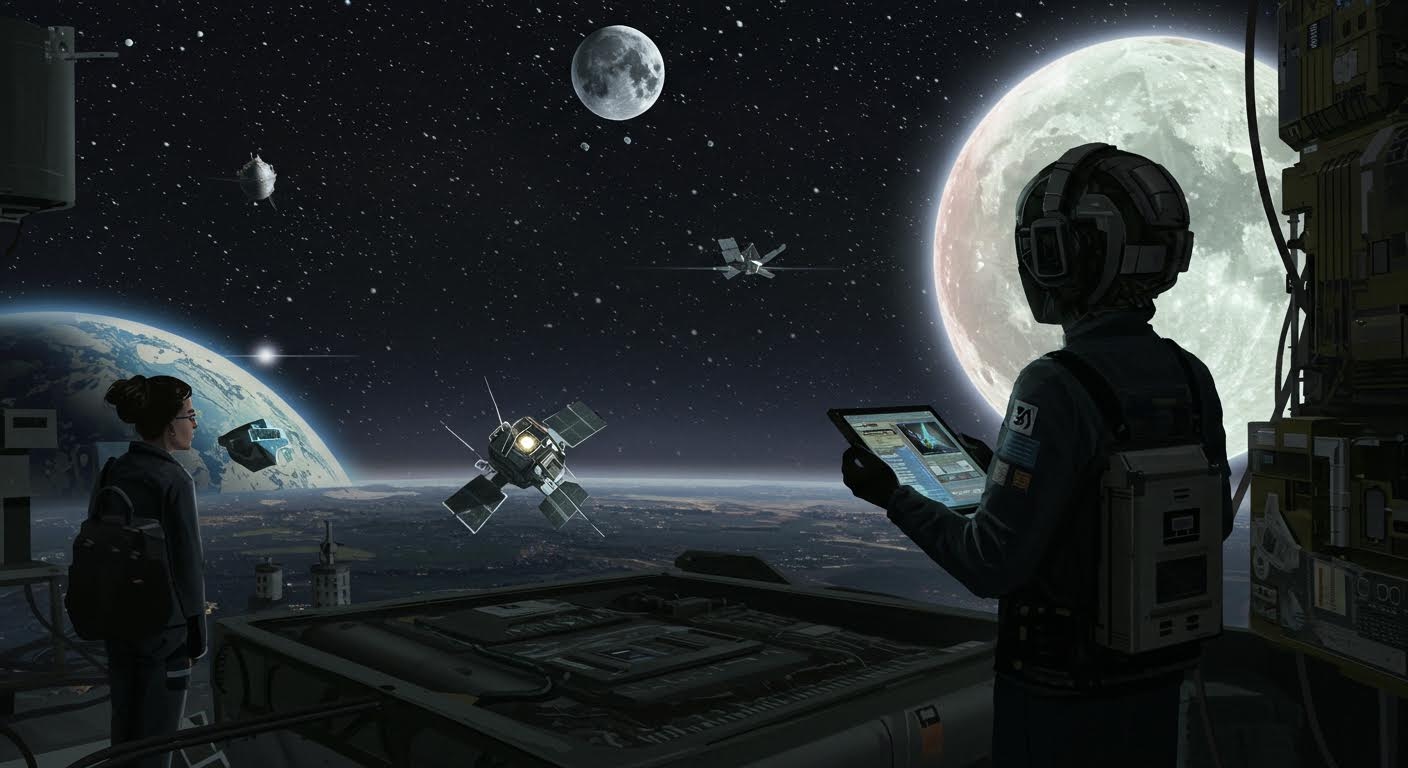
Millions of miles from Earth, sophisticated AI processors make split-second decisions that determine the success or failure of humanity's most ambitious space missions. These specialized computing systems represent a new frontier in space exploration, where traditional hardware must be reimagined to survive the harsh realities of deep space while operating with complete autonomy.
Computing in the Cosmic Frontier
Space exploration presents unique computational challenges that push AI hardware to its absolute limits. When NASA's Perseverance rover encounters unexpected terrain on Mars, it can't wait the 4-24 minutes required for radio signals to travel between Earth and Mars. Instead, onboard AI systems must analyze the situation, make navigation decisions, and execute maneuvers in real-time.
Traditional computing systems designed for Earth's protected environment quickly fail when exposed to cosmic radiation, extreme temperature swings, and the vacuum of space. This reality has driven development of an entirely new category of AI hardware specifically engineered for the space environment.
Engineering for Extremes: Hardware Design Challenges
Creating AI processors for space requires solving engineering challenges that simply don't exist on Earth. Cosmic rays and solar particle events can flip bits in computer memory or permanently damage semiconductor junctions, making radiation hardening a critical design consideration.
Modern space-qualified AI chips employ multiple layers of protection, including radiation-hardened manufacturing processes, error-correcting memory systems, and redundant processing units. These systems must function reliably across temperature ranges from -270°F in deep space shadows to over 250°F when exposed to direct solar radiation.
Power efficiency becomes paramount when every watt must come from solar panels or radioisotope generators. AI processors for space missions typically consume a fraction of the power used by their terrestrial counterparts, achieving remarkable computational efficiency through specialized architectures and careful software optimization.
Size and weight constraints add another layer of complexity. Every gram launched into space costs thousands of dollars, driving engineers to create increasingly compact AI systems that deliver maximum processing power within strict mass and volume budgets.
AI Processors Currently Operating in Space
Several groundbreaking AI systems are currently operating across the solar system, demonstrating the maturity of space-qualified artificial intelligence hardware.
NASA's Perseverance rover represents perhaps the most sophisticated deployment of AI hardware beyond Earth. Its autonomous navigation system, powered by specialized processors, can analyze terrain, plan routes, and execute complex maneuvers without human intervention. The rover's AI systems also manage scientific instruments, deciding which rock samples warrant detailed analysis and how to optimize data collection.
The European Space Agency has deployed AI-powered collision avoidance systems on multiple spacecraft, enabling automatic debris detection and evasive maneuvers. These systems process radar and optical data in real-time, making critical decisions about spacecraft safety when communication with ground control is impossible.
Commercial satellite operators increasingly rely on AI processors for Earth observation missions, processing vast amounts of imaging data in orbit before transmitting only the most relevant information back to Earth. This approach dramatically reduces bandwidth requirements while enabling near-real-time analysis of global phenomena.
Deep space probes operating beyond the outer planets represent the ultimate test of autonomous AI systems. These spacecraft must manage all aspects of their operation—from scientific data collection to spacecraft health monitoring—with no possibility of real-time communication with Earth.
Real-Time Intelligence Without Ground Control
The communication delays inherent in space exploration make real-time ground control impossible for many critical operations. AI hardware fills this gap by bringing edge computing capabilities directly to spacecraft and rovers.
Machine learning algorithms running on space-qualified processors enable spacecraft to adapt to changing conditions without human intervention. These systems can optimize solar panel positioning, manage power consumption based on mission priorities, and even modify scientific observation schedules based on detected phenomena.
Landing systems for Mars missions rely heavily on AI hardware to execute the complex sequence of maneuvers required for safe surface arrival. The famous "seven minutes of terror" during Mars landings occurs entirely under AI control, with onboard processors analyzing altitude, velocity, and terrain data to guide the spacecraft to a safe landing site.
Scientific instrument management represents another critical application. AI systems can prioritize data collection based on preset criteria, manage limited storage resources, and determine which observations are worth transmitting back to Earth given bandwidth constraints.
Integration with Space-Qualified Systems
Modern spacecraft employ hybrid architectures that combine specialized AI processors with traditional space-qualified computers. This approach allows missions to benefit from AI capabilities while maintaining the proven reliability of conventional space systems.
Redundancy remains crucial for mission success. Critical AI systems typically operate with multiple backup processors and fail-safe mechanisms that can transfer control to traditional systems if anomalies are detected. This layered approach ensures mission continuity even if individual AI components fail.
Software-hardware co-design has become essential for optimizing AI performance in space environments. Engineers must carefully balance processing capabilities, power consumption, and radiation tolerance while ensuring seamless integration with existing spacecraft systems.
Extensive testing and validation processes verify AI system performance across all expected operating conditions. These systems undergo rigorous qualification procedures, including radiation testing, thermal cycling, and vibration testing to simulate launch and space environments.
The Next Generation: Future AI Hardware for Space
The future of AI hardware in space exploration promises even more sophisticated capabilities. Quantum computing applications could revolutionize complex orbital calculations and optimization problems, potentially enabling more efficient mission planning and resource allocation.
Neuromorphic chips that mimic brain architecture offer the potential for ultra-low power AI processing, crucial for extended missions where power generation capabilities degrade over time. These systems could enable continuous learning and adaptation over mission lifespans measured in decades.
Advanced machine learning capabilities may soon enable autonomous space construction and repair activities. AI systems could manage robotic assembly of large structures in space or coordinate self-repair activities for long-duration missions.
Human Mars missions will require unprecedented AI hardware capabilities to support long-term space habitation. These systems must manage life support, resource utilization, and mission operations with minimal Earth-based support, representing the next major leap in autonomous space systems.
As humanity's presence in space expands, AI hardware will become increasingly critical for managing the complexity of multi-planetary operations, autonomous manufacturing, and the eventual establishment of permanent space-based civilizations.