Wounded in the Leg: The Legend of Tomás Ordóñez and Cuenca's Plaza Ambush of November 3, 1820
Wounded in the Leg: The Legend of Tomás Ordóñez and Cuenca's Plaza Ambush of November 3, 1820
A Single Day That Changed Cuenca
On the morning of November 3, 1820, the city of Cuenca, nestled in the Andean highlands of what is now Ecuador, is said to have stirred with the kind of tension that precedes upheaval. Colonial South America was a continent in motion at that moment. From Caracas to Buenos Aires, independence movements had been chipping away at Spanish authority for a decade, and the Audiencia de Quito, of which Cuenca was a part, was no exception.
It's worth being upfront about the nature of this account. Much of what circulates about this day in Cuenca comes not from formal archives or contemporary documents but from local tradition passed down through generations. This piece draws on that oral history, and readers should understand that specific details, including names, injuries, and tactical maneuvers, are often impossible to verify against written records. Where a claim rests on legend rather than documentation, we say so plainly.
Who Was Tomás Ordóñez?
According to local tradition, Tomás Ordóñez was among those who took an active role in the independence action that unfolded in Cuenca's central plaza on November 3rd. Some versions of the story describe him as a leader of the ambush that contributed to the city's break from colonial rule. Beyond this, confirmed biographical detail is scarce. No settled public record establishes his occupation, age, family background, or the full arc of his life before or after the events commonly attributed to him.
This gap is not unusual. Many local figures from the independence era, particularly those who were not high-ranking colonial officials or prominent landowners, survive in collective memory primarily through oral storytelling rather than official documentation. Record-keeping in early 19th-century Andean towns was inconsistent at best, and the names of ordinary participants in uprisings were often preserved by families, neighborhoods, and civic commemorations long before, or instead of, formal historical scholarship.
The Plaza Ambush
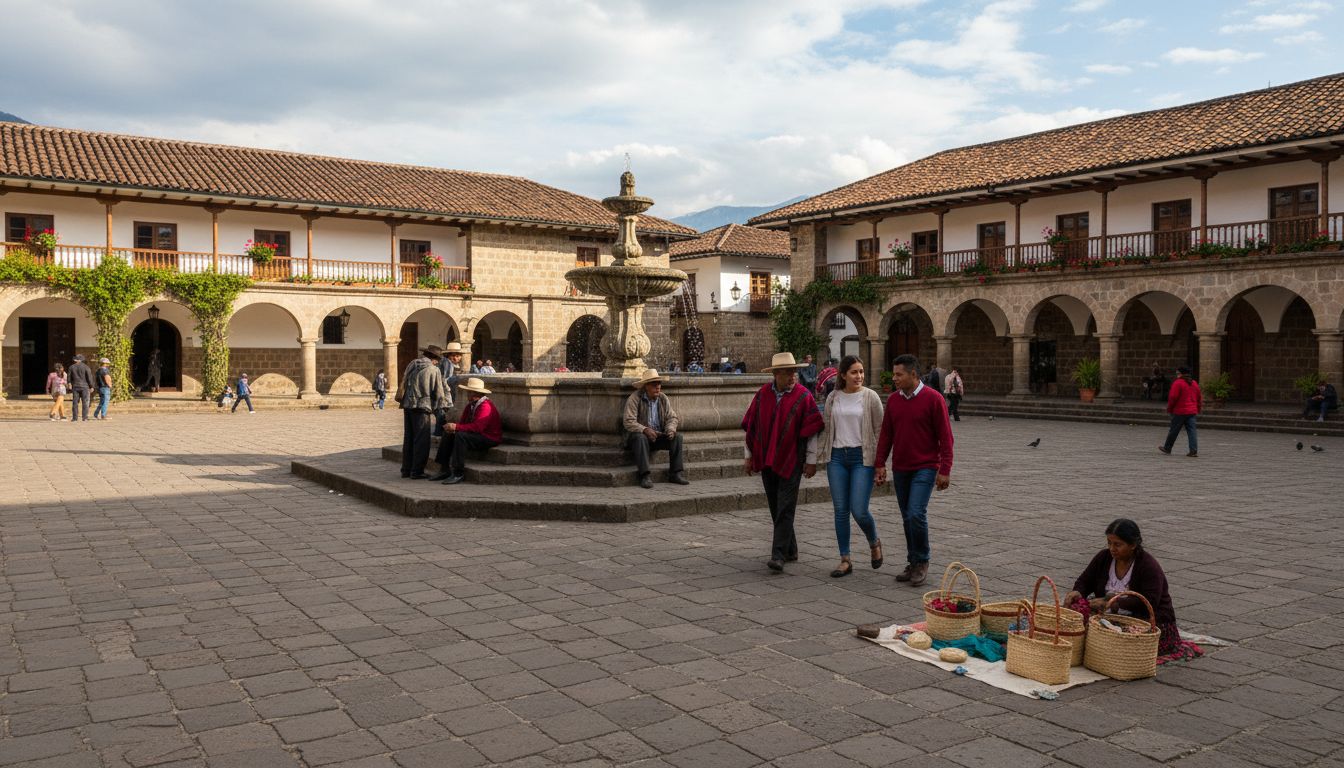
The traditional account describes an ambush staged in Cuenca's main plaza, a central, symbolically loaded space that served as the literal and figurative heart of the colonial city. Supporters of independence are said to have used the plaza as a staging ground to confront royalist forces, a pattern seen in other Spanish American cities where central squares doubled as sites of governance, commerce, worship, and, when the moment called for it, rebellion.
A recurring detail in local retellings is that Ordóñez was wounded in the leg during this engagement. This detail should be treated as unverified tradition rather than established historical fact. No archival or regulatory source confirms the specific wound, the sequence of the ambush, or the precise tactics used. The persistence of such a vivid, specific detail across generations is itself notable. It suggests the story carries emotional and symbolic weight in Cuenca, even if its documentary foundation cannot currently be confirmed.
The choice of a plaza as a staging ground was hardly incidental in colonial Spanish American cities. These spaces were deliberately designed as the center of civic and religious life, meaning that any action taken there carried outsized symbolic resonance. An ambush in the plaza was not just a tactical decision; it was a statement about who controlled the heart of the city.
From Skirmish to Independence
Local narratives connect the plaza ambush directly to Cuenca's declaration of independence on November 3, 1820, framing the skirmish as a catalyzing moment rather than an isolated incident. Cuenca's break from Spanish colonial authority fit within a broader regional pattern, as cities and provinces across the Audiencia de Quito moved, sometimes independently and sometimes in coordination, toward severing ties with the Spanish crown.
Ecuador's full path to independence extended well beyond this single day. The broader struggle continued for several more years, culminating in the decisive Battle of Pichincha in 1822, which secured the independence of Quito and, by extension, the wider territory that would become Ecuador. Cuenca's November 3rd declaration is often remembered as an early and important marker along that longer trajectory.
It is a familiar pattern in independence-era historiography across the region: a local skirmish, a single act of individual bravery, or a specific named figure becomes the anchor point for a city's own independence story, even when the broader military and political campaign involved many more actors and a longer timeline. Ordóñez's place in Cuenca's narrative appears to follow this pattern closely.
Why This Story Still Resonates in Cuenca
Today, November 3rd is marked in Cuenca as a significant civic date, observed through public commemorations, local festivities, and references woven into the city's cultural fabric. Visitors and expats living in Cuenca often encounter the story of Ordóñez and the plaza ambush not through textbooks but through festival programming, informal conversations with longtime residents, or the naming of streets and public spaces that nod to the independence era.
The gap between documented history and local legend does not diminish the story's importance to Cuenca's identity. If anything, many who live in or visit the city would say these local legends do something formal archives cannot: they give the city's independence story a human face and a sense of lived continuity. Whether or not every detail about Tomás Ordóñez can be verified, the persistence of his story says something real about how Cuencanos relate to their own history.
For expats settling into life in Cuenca, stories like this one offer a useful entry point into understanding the city beyond its colonial architecture and cobblestone streets. They are an invitation to hold two things at once: respect for the uncertainty inherent in oral tradition, and appreciation for the role such stories play in shaping a community's sense of place and pride.