When Travel Turns Strangers Into Family
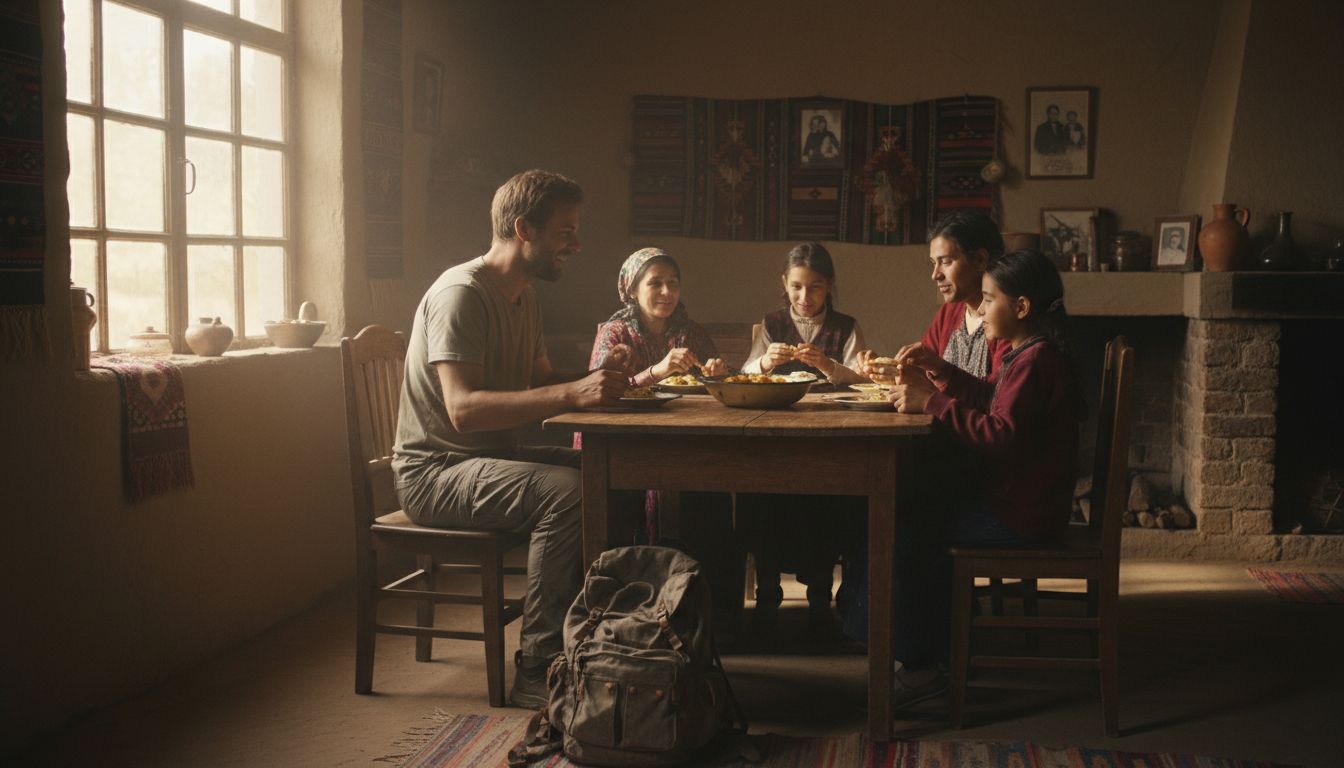
It often begins in a place designed for passing through: a bus station before sunrise, a hostel kitchen with damp backpacks lined against the wall, an airport gate where no one is quite comfortable enough to sleep. At first, everyone is a stranger guarding a small island of space. Headphones stay in. Bags stay close. Smiles are polite but brief. Far from home, caution can feel like common sense.
And yet travel has a way of compressing time. A conversation that might take months to earn in ordinary life can unfold over a single delayed train. A person you met that morning may know by evening that you are newly heartbroken, directionless, exhilarated, and trying not to admit you are lonely. On the road, connection can feel both risky and immediate. The unfamiliar setting strips away the usual sequence of getting to know one another. What remains is often simpler, and more revealing.
The Distance Between Us at the Beginning
In everyday life, people meet one another already labeled by work, routine, and expectation. Travel interrupts that. Nobody at the ferry terminal knows what you do, who your family is, or how competent you usually feel. They only know what is in front of them: you studying a ticket, misreading a sign, trying to pronounce a place name, pretending not to panic when the platform changes at the last minute.
That vulnerability creates distance at first, but it also makes honesty easier. There is less performance to maintain when everyone is slightly tired, slightly uncertain, and living out of a bag. You are not meeting one another at your most polished. You are meeting in real time, under minor pressure, before the masks have had a chance to settle back into place.
Why the Road Makes People More Available to One Another
Travel reduces life to essentials. Where do we sleep? What do we eat? Which bus is ours? Is this neighborhood safe? Does anyone speak enough of the language to help us get through this? Under those conditions, people often become more present with each other. Conversation is less theoretical. It has stakes, however small. A recommendation matters. A warning matters. A seat saved on a crowded ride matters.
This does not mean people become entirely different while traveling. It may be truer to say that the road reveals character quickly. Patience, generosity, selfishness, humor, flexibility, fear—these emerge fast when plans fall apart. In ordinary life, it can take a long time to discover who comforts others, who disappears when things get difficult, who notices, who shares, and who waits. Travel speeds up that discovery.
Freed from their usual schedules, many people also become more emotionally reachable. Without commutes, meetings, and household routines, there is room for long walks, accidental confessions, and the kind of listening that feels rare at home. Shared uncertainty opens a door. Sometimes all it takes is one person asking, “Are you headed that way too?”
The Moment a Stranger Steps In
Often the turning point is not dramatic from the outside. It may be a missed connection in a city you do not understand, the sick feeling of realizing your phone battery is dead, the embarrassment of failing to explain what you need, or the helplessness of standing before a government window with the wrong document in hand. Travel can make capable adults feel suddenly small.
Then someone steps in. A fellow traveler slows down and helps you read the schedule. A host writes directions by hand. A woman at the next table explains what to order. A man you barely know waits with you after dark because your ride has not arrived. Someone brings tea when you are ill. Someone knocks on your door later just to ask if you made it back.
Practical help has a way of becoming emotional reassurance. What begins as information becomes care. In that moment, the world feels less indifferent. Trust does not arrive as a grand declaration. It arrives in gestures: an extra charger, a shared umbrella, a translated sentence, half a sandwich, a seat kept empty until you return from the restroom. The shift happens when a person could choose convenience but chooses you instead.
How Temporary Places Become Emotional Homes
Some of the deepest travel bonds form in places nobody is meant to stay. Hostels, overnight buses, family-run guesthouses, train compartments, border queues, ferry decks, sidewalk cafes near stations—these are temporary spaces, but they can become surprisingly intimate. People who would never meet at home begin building tiny rituals together.
One person wakes early and saves the quiet table. Another remembers who takes coffee without sugar. Someone shares fruit bought at a market. Someone else translates the sign everyone was pretending to understand. There is a rhythm to these small acts. They are not spectacular, but repeated often enough, they create belonging.
That may be one of travel’s quiet miracles: a place does not need permanence to feel like home. Sometimes home is simply where your arrival is noticed. It is where somebody asks if you have eaten, where your absence is remarked upon, where laughter resumes when you sit back down. Temporary settings can sharpen these feelings rather than weaken them. Because time is short, attention becomes more deliberate. People mean what they offer.
What “Family” Means Far From Home
When people speak of finding family on the road, they are rarely talking about replacement. They are describing a feeling: trust without excessive explanation, protection without obligation, ease that arrives faster than expected. Family, in this sense, can look like inside jokes formed over one impossible bus ride, someone checking that you locked the door, or being expected at dinner even though you arrived as a stranger two days ago.
Biological family and chosen travel family do not cancel each other out. They answer different hungers. One is rooted in history; the other in presence. One knows who you were; the other meets who you are in a suspended moment outside your usual life. There can be something startling about feeling understood by people who learned your name only this week. Yet that recognition can be real. Sometimes being seen clearly has less to do with duration than with attention.
On the road, family can mean the people who keep watch while you sleep on a long ride, who tell the story of your worst navigation mistake until everyone is crying with laughter, who know when you need company and when you need silence. It can mean being folded into a routine that did not exist before you arrived and will disappear soon after you leave. Brief does not always mean shallow.
Why These Bonds Can Last After the Trip Ends
Not every connection made in transit survives the return to ordinary life. Many are meant for a season, a city, a stretch of road. But even when they do not continue in practical ways, they can remain deeply formative. A person you knew for four days can alter your sense of what kindness looks like. A shared week can reset your assumptions about who is capable of care.
Some bonds do continue. A message sent months later turns into a lasting friendship. A spare room offered during another trip becomes a reunion. Holidays are shared across continents. Someone attends your wedding years after you met in a hostel kitchen. Someone you once guided through a border crossing later helps you settle in their city. The route of connection keeps unfolding.
Even when the relationship becomes mostly memory, it can still matter. Travel friendships often endure because they are tied to moments when we were especially open, disoriented, and alive. We remember who stood beside us then. We remember who made a strange place feel manageable. Those memories do not just preserve a person; they preserve a version of ourselves that learned the world could hold welcome in unexpected places.
Holding the Idea Gently
Of course, not every journey creates intimacy, and not every stranger is safe. Warmth and caution must coexist. Loneliness does not vanish simply because a map is open in your hands. Some trips are defined by isolation, by misreading others, by discovering that proximity is not the same as trust. It would be too easy to romanticize movement and ignore the need for discernment.
But sometimes, in the middle of unfamiliar ground, someone helps carry what has suddenly become too heavy for one person alone. They guide, wait, translate, feed, reassure, or simply remain. In doing so, they cross the invisible distance between stranger and known. The road does not guarantee family. It only creates the conditions in which family, in its most human sense, can appear unexpectedly.
Maybe that is why these encounters stay with us. They remind us that belonging is not always inherited, and not always permanent. Sometimes it is improvised. Sometimes it lasts a night, a week, a border crossing, a rainy season, or a year. Sometimes it lasts the rest of your life. And sometimes family is not who you started with, but who helped you keep going when everything around you was unfamiliar.