When Travel Turns Strangers Into Family
There is a particular kind of loneliness that arrives with travel. It appears after the tickets are booked and the bags are packed, after the movement itself has begun. You can be surrounded by people in airports, bus stations, plazas, and cafés, yet still feel strangely unanchored. Everything is in motion, including your sense of self. The routines that usually tell you who you are fall away, and without the familiar cast of friends, coworkers, neighbors, and family, you meet the world in a more exposed state.
That exposure is part of what makes travel unsettling, but it is also what makes it intimate. When you arrive somewhere alone, you are no longer protected by habit. You ask more questions. You hold people’s gaze a little longer. You accept help you might refuse at home. Travel strips identity down to simpler truths: hungry, tired, curious, lost, hopeful. In that condition, even brief encounters can carry unusual weight.
Arriving Alone
In everyday life, relationships usually build around structure. We get to know people through work, school, neighborhood routines, long introductions, and repeated context. Travel rearranges that process. You may land in a city where no one knows your history, your profession, or the version of you that exists in ordinary life. There is freedom in that, but also vulnerability. Without your usual reference points, you become newly aware of how much belonging depends on recognition.
That is why simple interactions can feel so charged on the road. A person who explains the bus system, walks you to the right platform, or helps translate a menu is doing more than solving a problem. In a moment when you feel unsteady, they are helping restore your place in the world. Travel turns practical gestures into emotional ones because uncertainty raises the stakes of everything.
Why Strangers Feel Closer on the Road
Trust often forms slowly at home and quickly in transit. Shared uncertainty speeds things up. Two people missing the same train, looking for the same hostel, or trying to navigate a language barrier together can move past small talk with surprising ease. There is less performance in those moments. People are not presenting the polished version of themselves they use in settled life. They are improvising.
That improvisation creates honesty. A traveler asking for help is already admitting confusion. A stranger who offers guidance is already stepping beyond indifference. Both people are participating in a small act of mutual risk. One chooses to depend; the other chooses to care. Even when the exchange is brief, it can feel more genuine than relationships built through longer, more guarded contact.
Being away from home also makes people more readable to one another. Fatigue, delight, fear, embarrassment, relief: these emotions surface quickly when plans fall apart or unexpected generosity appears. You see people reacting in real time, without much insulation. That can make travel companionship feel unusually sincere. You are not just exchanging facts about your lives. You are watching how each person moves through uncertainty.
The Moment Hospitality Becomes Belonging
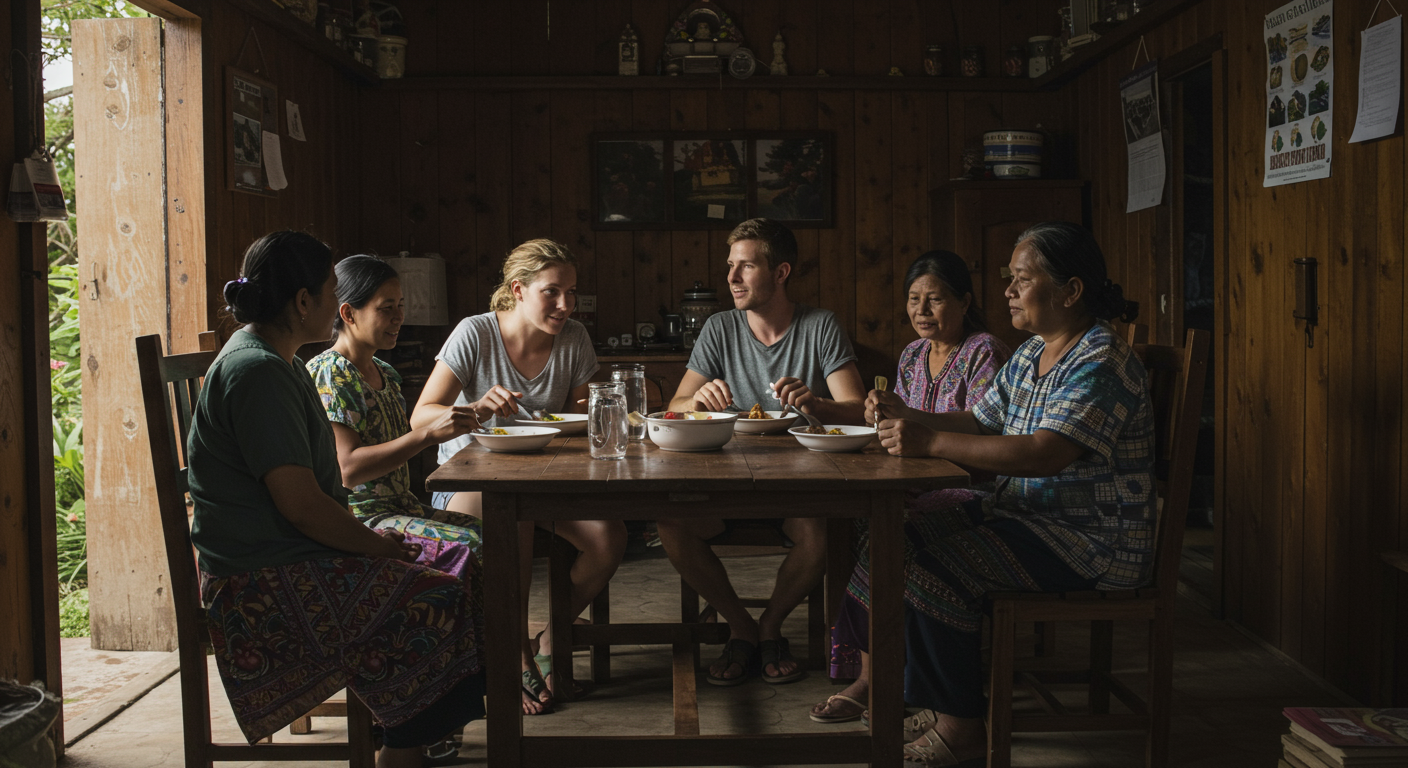
There is a difference between being accommodated and being welcomed. Travel teaches that difference with startling clarity. A room key, a reservation, or a seat at a table may meet a practical need. But belonging begins when someone notices you beyond the transaction. It starts when a host lingers to ask whether you have eaten, when a local insists on walking you part of the way, when someone saves you a place, checks that you arrived safely, or folds you into a meal that was not originally meant for you.
These gestures can feel disproportionately moving because they answer a need deeper than logistics. In an unfamiliar place, many people expect to remain anonymous. To be cared for instead can feel almost disorienting. A bowl of soup, an extra blanket, a warning about a neighborhood shortcut, an invitation to sit longer after everyone else has finished eating—small things on paper. Yet they often carry the emotional force of being gathered in.
That is the moment hospitality becomes belonging. The interaction is no longer about service or convenience. It becomes relational. You stop feeling like a passing body moving through space and begin to feel, however briefly, like someone with a place in the room.
How Temporary Communities Start Feeling Like Family
Some of the strongest travel bonds form in places built around impermanence. Hostels, homestays, volunteer houses, language schools, expat circles, overnight buses, repeated ferry routes—these are environments where people arrive by chance but stay just long enough for familiarity to take hold. At first, everyone is temporary. Then, almost without noticing, routines appear.
Coffee gets made for whoever wakes first. Someone always knows where to buy fruit cheaply. A group chat starts. Nicknames emerge. One person becomes the planner, another the translator, another the one who notices when someone is unusually quiet. These are small social roles, but they resemble the roles people occupy in families. Care begins to organize itself naturally.
Repeated encounters deepen this effect. Seeing the same faces at breakfast, on the walk home, during market runs, or after long day trips creates a rhythm that feels steadier than the calendar would suggest. You may know very little about one another’s pasts, yet still know who gets homesick in the evenings, who needs time alone after crowded days, who will share medicine, charge a phone, lend money, or wait up. Loyalty can grow quickly when life is stripped to essentials.
That is one of travel’s quiet revelations: history is not the only foundation for closeness. Sometimes tenderness grows not from how long people have known each other, but from how fully they showed up during a time of uncertainty.
Leaving With More Than Memories
Travel relationships are often described as fleeting, and many are. But not all of them disappear when the trip ends. Some continue in modest ways at first: a message after arrival, photos exchanged months later, a recommendation sent across time zones, a holiday greeting that turns into a longer conversation. Then life opens again. Someone offers a couch in another country. Someone plans a reunion. Someone becomes the reason you return.
What began as a temporary alliance can grow into something more durable because it was formed around presence rather than convenience. These relationships may not fit neatly into traditional categories. They are not childhood friends, not coworkers, not relatives, and not always romantic partners. Yet they can become central. They enter the map of your life as people you trust, people who understand a specific version of you, people who remind you that home can expand.
Chosen family often begins this way: not through obligation, but through recognition. You meet someone in a setting where nothing requires them to care, and they do anyway. That choice can echo for years.
Not Every Bond Lasts, But Some Change You Anyway
Of course, not every connection made on the road is meant to endure. Some friendships belong exactly where they happened: on a mountain trail, in a shared dorm, around a train station table at midnight. They are real because they were true in that moment, not because they lasted forever. Travel can produce intense closeness that fades once ordinary life returns, and that does not make it false.
Impermanence does not cancel meaning. A stranger who helped you through a difficult arrival, a host who treated you like kin for a week, a group that made a foreign city feel livable—these people may remain in your life or drift out of it. Either way, they can leave behind a changed understanding of trust. They can soften your assumptions about who is capable of caring for you. They can widen your idea of what family is.
Perhaps that is why travel stays with people so deeply. Not only because of landscapes seen or distances crossed, but because of what becomes possible between human beings when the usual boundaries are interrupted. On the road, strangers sometimes meet one another in a more vulnerable, generous, and unguarded state. And in that brief opening, something extraordinary can happen: a person you had never known can begin to feel like someone you have always needed.