When the Journey Never Starts: A Reflection on Sea Turtles That Stayed
Some stories begin with movement. This one begins with its absence.
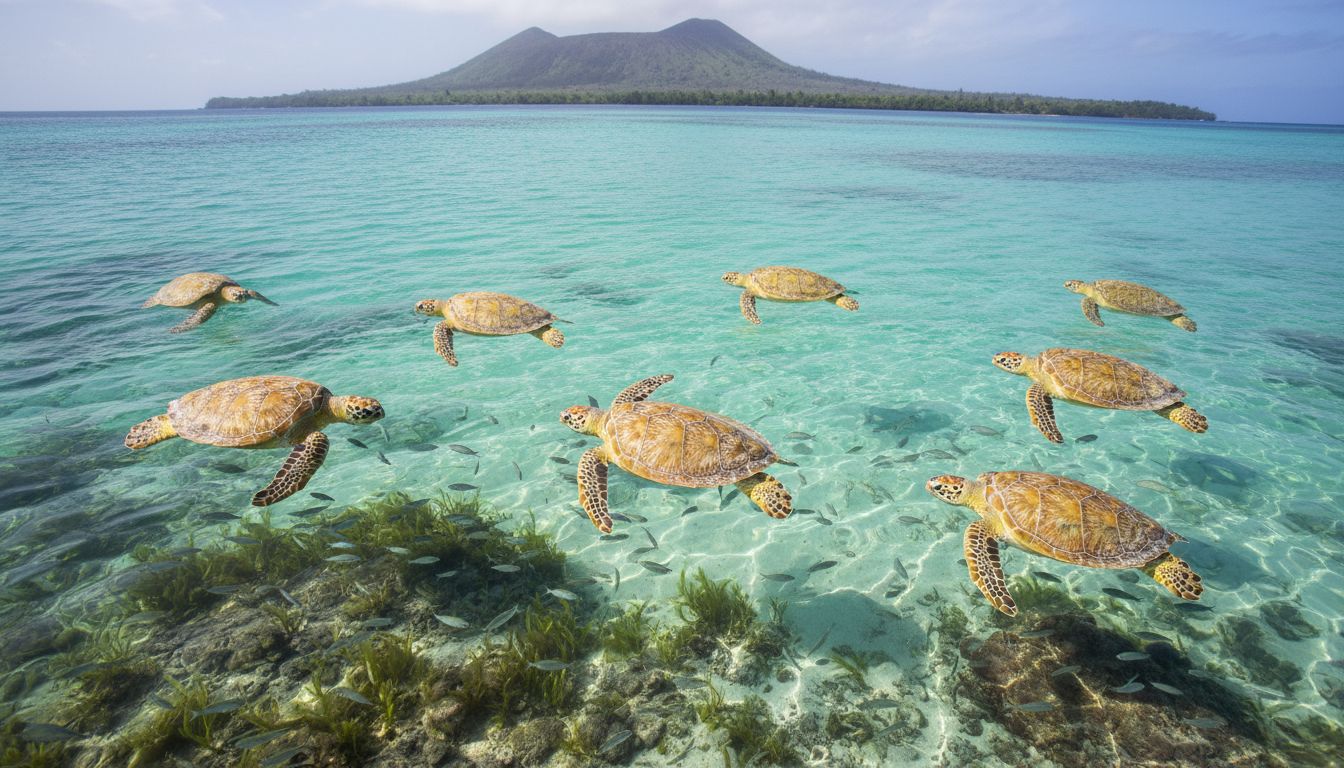
The premise, as it has been described, is striking: nine satellite-tagged yellow Galápagos sea turtles were expected to cross the Pacific, and none of them left. In a world shaped by migration maps, tracking data, and human confidence in patterns, that kind of stillness feels almost dramatic. But without confirmed reporting-grade sourcing, the story is best approached not as settled fact, but as a reflective and carefully framed nature narrative.
Even within that cautious frame, the emotional tension is easy to understand. Researchers, observers, and animal lovers are often drawn to the idea of a great departure. A tagged marine animal seems to promise a visible arc: a route, a destination, a revelation. When that expected line across the ocean never appears, the silence becomes the story.
An Unexpected Journey That Never Began
Many people are fascinated by migration because it seems to offer both mystery and proof. A creature leaves one place, crosses a vast distance, and confirms something about instinct, memory, survival, or season. In the public imagination, satellite tagging turns that mystery into a readable path.
That is what makes an account like this so compelling. The expectation was motion. The reported result was staying put. Instead of a sweeping Pacific crossing, there was apparent stillness, delay, or refusal. Whether that non-departure reflects behavior, timing, environmental conditions, or a misunderstanding of the original premise cannot be determined from the material currently available. Still, the contrast between human expectation and animal reality is powerful.
Why Researchers Expected a Pacific Crossing
In broad terms, marine animal tagging helps researchers understand where animals go, how they use habitat, and how movement connects distant ecosystems. Sea turtles, in particular, are often associated with long and sometimes astonishing travel routes. So the idea that a tagged group might head into the open ocean seems plausible in the context of a migration study.
But plausibility is not proof. A recurring problem in wildlife storytelling is that audiences can mistake an expected route for a confirmed one. Scientists may have a hypothesis. Observers may have a model. Journalists may have a narrative. The animal, of course, has no obligation to cooperate with any of them.
When Wild Animals Refuse the Script
Nature resists clean timelines. Wild animals do not move for the sake of human suspense, and they do not follow a schedule simply because people are watching. They respond to cues that may be subtle, shifting, or poorly understood from the outside.
That is part of what gives this reported turtle story its resonance. If the expectation was a dramatic departure and none came, what remains is uncertainty. Waiting. Recalibration. The possibility that the most revealing thing an animal can do is not begin a grand journey, but decline to perform one on command.
People often read migration through the lens of departure: leave, cross, arrive. But staying put can be just as meaningful, even if its meaning is harder to decode. Stillness may signal comfort, caution, changing conditions, or simply a timeline humans misread.
Reading Meaning Into Staying Put
It is tempting to assign symbolism to a story like this. Maybe staying reflects attachment to place. Maybe it suggests that local habitat offers something essential. Maybe hidden environmental or biological factors shaped the animals' behavior. All of those interpretations are possible in a storytelling sense, but without verified sourcing, they remain speculative.
That matters. Animal stories are especially vulnerable to projection. People often turn movement into destiny and pause into mystery. Yet the truth may be more ordinary and more profound: the animals were following cues unavailable to us, or operating on rhythms we had not fully grasped.
When wildlife fails to match a predicted pattern, the moment can reveal as much about human expectation as it does about the animal itself. We are eager for the grand route, the dramatic crossing, the elegant conclusion. But ecosystems are full of detours, delays, and behaviors that resist tidy explanation.
The Galápagos as More Than a Launch Point
There is another way to read the premise. Instead of seeing the Galápagos merely as the place the turtles were supposed to leave, we might see it as the place that held them. Not a starting line, but a center of gravity.
The islands are often imagined as a theater of motion, adaptation, and evolutionary wonder. Yet they are also habitat: a place of anchoring, feeding, resting, and ecological relationship. If the turtles remained there longer than expected, that apparent choice invites a subtle shift in perspective. Perhaps the deeper story is not about a missed departure, but about the significance of place itself.
Belonging is a human word, and it should be used carefully for animals. Even so, many people are moved by the idea that a landscape can be more than a waypoint. In that sense, the Galápagos becomes more than a launch point into the Pacific. It becomes the setting where expectation met reality, and reality stayed local.
What This Story Can and Cannot Claim
This article cannot confirm the precise factual setup of the story as presented. The specific number of turtles, the tagging details, their coloration, and the reported outcome that none left would all require reliable sourcing before being treated as nonfiction reporting.
So what can be said with confidence here? Only this: as a narrative premise, the image is vivid and thought-provoking. It captures a familiar tension between human prediction and wild behavior. It invites reflection on migration, patience, and the danger of assuming that nature's most meaningful act will always be movement.
Until stronger sourcing emerges, the story works best as an evocative meditation rather than a verified account. And perhaps that is fitting. Not every compelling story about the natural world ends with a line drawn across a map. Sometimes it ends where it began, with animals in place, humans waiting, and meaning still just out of reach.