Whale Season in Puerto López: An Expat's Front-Row Seat to Ecuador's Humpback Migration
Puerto López does not announce itself so much as it drifts into view: a modest string of low buildings along Ecuador's Manabí coast, fishing boats pulled up on the sand, and a rhythm that feels unhurried until you notice the crowds gathering near the docks each morning. I arrived during what locals were calling the peak of whale season, though as with many things in a small coastal town, the exact timing felt more like local folklore than a fixed date on a calendar. Somewhere between June and September, the humpbacks arrive, and Puerto López transforms.
For a long-term visitor or expat still getting acquainted with Ecuador's Pacific side, the shift is hard to miss. Restaurants post handwritten signs advertising tour packages. Fishermen-turned-guides stand along the malecón comparing notes on where the whales were spotted the day before. There is a communal anticipation in the air, the sense that something worth witnessing is happening just offshore, and that everyone in town is, in some way, part of it.
Why Puerto López Draws the Humpbacks
The broad strokes of the story are well known even to casual visitors: humpback whales undertake one of the longest migrations of any mammal, traveling from cold Antarctic feeding grounds to warmer equatorial waters to breed and give birth. Ecuador's coast, and Puerto López in particular, sits near Machalilla National Park, a protected marine and coastal reserve that offers calmer, sheltered waters well suited to nursing calves and courting adults.
Local guides speak of the numbers with confidence, some citing figures as high as ten thousand whales passing through the region during the height of the season. These are the kinds of claims that circulate readily in a town built around whale tourism, repeated by boat operators and hotel owners alike. Whether they reflect a rigorously counted population or a more informal, oft-repeated estimate is hard to say without more formal data. What is certain is that enough whales pass close enough to shore to sustain an entire seasonal economy, and that alone speaks to a migration of real scale.
The Whale-Watching Experience
Boarding one of the tour boats out of Puerto López is an experience in itself. Small operators, often family-run, load a dozen or so passengers into open motorboats each morning, life vests handed out with the casual efficiency of a crew that has done this thousands of times. The ride out to open water takes perhaps twenty minutes, the town shrinking behind you as the boat cuts through the swells.
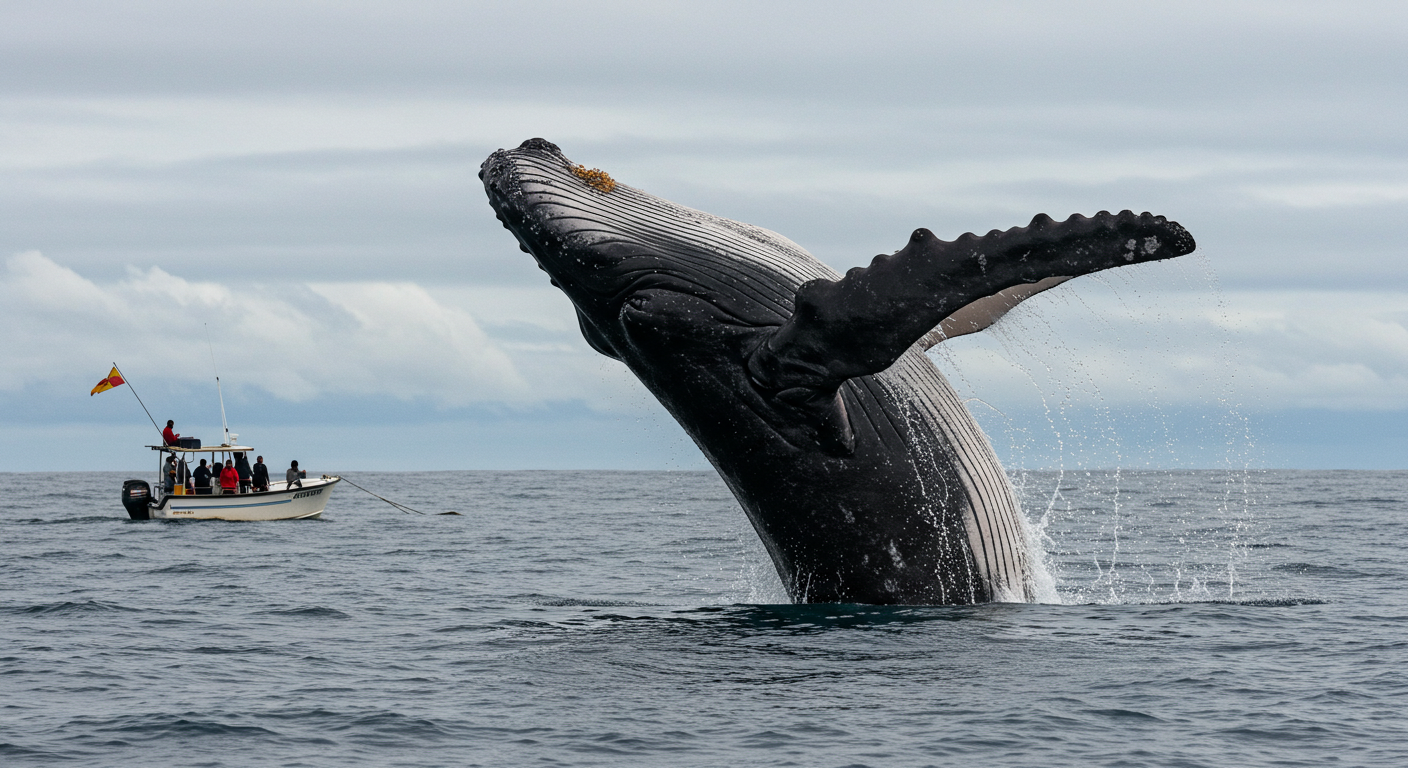
Then, almost without warning, someone points, and there it is: a dark shape breaking the surface, a spray of mist, and if you are fortunate, a full breach, thousands of pounds of whale launching skyward before crashing back into the sea with a sound that carries even at a distance. The guides, often lifelong locals, seem to read the water with an intuition that comes from years spent watching these same patterns unfold season after season. They point out tail slaps, pectoral fin waves, and the telltale signs of a mother traveling with her calf, their informal expertise filling in gaps that no guidebook quite captures.
Life in Puerto López Beyond the Whales
Whale season may be the town's calling card, but daily life in Puerto López carries on with its own steady rhythm. For those living abroad in Ecuador, or simply spending an extended stretch here, the town offers a slower pace than Guayaquil or Quito, with an economy visibly tied to the ebb and flow of the migration calendar. Restaurants along the beach serve fresh ceviche and grilled fish, the catch of the day dictating the menu more than any fixed schedule.
Outside the whale-watching months, the town quiets considerably, and many residents describe a noticeable dependence on this seasonal tourism wave to sustain businesses through the rest of the year. There is a shared understanding among expats and long-term visitors that the town's fortunes rise and fall with the whales, and that the arrival of migration season is as much an economic event as a natural one.
Reflections on Witnessing the Migration
There is something humbling about sitting in a small boat, engine cut, waiting in silence for a creature the size of a bus to surface beside you. Numbers and precise dates matter less in that moment than the simple fact of proximity to something vast and wild, moving through its ancient migratory path largely indifferent to the boats and cameras following along.
Whether the true count is ten thousand whales or some smaller figure, and whether the season's true peak falls in July or August, feels almost beside the point when you are watching a breach unfold in real time. For those of us building a life in Ecuador, Puerto López offers a reminder that some of the most memorable expat experiences come not from settling into routine, but from moments when the natural world asserts itself, unscripted and immense, just beyond the shoreline.