Waking to Ash: An Expat's Reflections on Sangay Volcano's Restless Return
Waking to Ash: An Expat's Reflections on Sangay Volcano's Restless Return
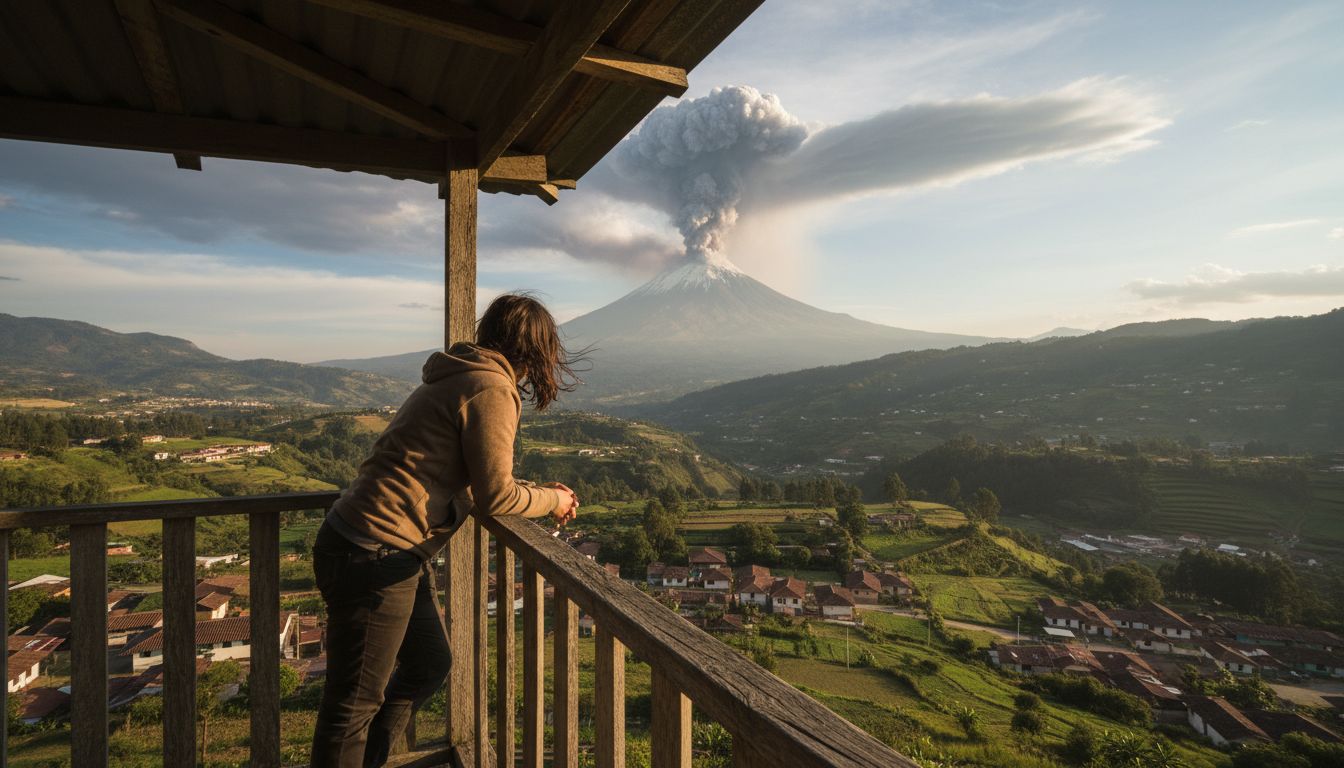
The first sign was the light. It came through the shutters thin and gray, the way it does when clouds sit low over the valley, except the air smelled faintly of sulfur and the windowsill wore a fine dusting of pale grit. For expats who have made a home in the highlands within view of Sangay's distant cone, this is a familiar kind of morning. Many in the region are now describing a reported eruptive episode lasting roughly 40 hours, an event still circulating mostly through word of mouth, local chatter, and unverified social posts rather than confirmed official reporting.
It's worth saying plainly: the specific details of this episode, its exact start time, its duration, and the striking claim that it falls precisely six years to the day after Sangay's well-known 2020 eruption, have not been independently confirmed through the sourcing available for this piece. What follows is less a factual accounting of a single eruption and more a reflection on what it feels like to live, day to day, in the company of an active volcano.
Sangay: Ecuador's Restless Giant
Sangay is widely recognized as one of Ecuador's most consistently active stratovolcanoes, its summit rising within the remote, roadless terrain of Sangay National Park. Its history is one of near-continuous, low-level activity punctuated by more notable ash-emitting episodes, a pattern that has held for decades. Because of its isolation, direct observation is difficult, and much of what reaches nearby towns and expat communities comes secondhand: a haze on the horizon, an advisory notice, a friend's photo of ash on a car windshield.
The specific framing of this most recent episode as landing "six years to the day" after a prior eruption is a compelling narrative detail, but it is one this article cannot verify. It may be a coincidence noted by observers, a rounding of dates in retelling, or simply an evocative frame that has taken on a life of its own in local conversation. Readers should treat it as color, not confirmed chronology. What can be said more confidently is that ash-emitting activity itself is not unusual for Sangay; it is, in a sense, part of the mountain's normal rhythm.
Life Under the Ash Cloud: An Expat's Daily Reality
For those living within range of ash fall, even a non-catastrophic episode reshapes the day. Visibility can drop. The air takes on a gritty, mineral taste. Laundry gets pulled in off the line. Water tanks and cisterns get covered, a habit many expats adopt quickly after their first exposure to volcanic ash, having learned from neighbors rather than official orientation.
Masks come back out, not the pandemic kind but simple dust masks kept in a kitchen drawer for exactly this purpose. Some expats check government advisory channels; others rely more on a WhatsApp thread with neighbors, someone always seems to know before the official notice arrives. There's a kind of dark humor that develops too, jokes about ash on the windshield or the permanent grit in doorframes, a coping mechanism as much as commentary.
Choosing to settle in a country shaped by tectonic and volcanic forces is, for many, a conscious tradeoff. The same geology that produces dramatic peaks and fertile valleys also produces mornings like this one. Most expats who stay long-term describe arriving at a kind of practical acceptance: the risk is real but manageable, and it becomes simply one more feature of the landscape to plan around.
Echoes of 2020: Memory, Coincidence, and Meaning-Making
There's something almost narratively satisfying about an eruption arriving on the anniversary of a previous one, a sense that the mountain is marking time in its own way. It's a story that gets told at dinner tables and in expat forums, often with more confidence than the underlying facts warrant. This piece treats that anniversary claim explicitly as an unverified detail, one that may or may not hold up to closer scrutiny, rather than as an established fact.
What the pattern-seeking says more, perhaps, is about human nature than volcanic behavior. Long-term residents, both expat and Ecuadorian, often find themselves reading significance into natural timing, a way of making an unpredictable landscape feel a little more legible. Whether or not the dates truly align, the impulse to notice and remark on it reflects something real about how communities process living alongside geologic uncertainty.
Navigating Uncertainty: Safety, Community, and Staying Informed
Regardless of the specifics of any single episode, expats living near Sangay or Ecuador's other active volcanoes generally benefit from a few consistent habits: following updates from Ecuador's geophysical monitoring institute, keeping basic supplies like masks and covered water on hand, and staying loosely networked with neighbors who often share real-time, ground-level observations faster than official channels can.
Community, more than any single piece of infrastructure, tends to be what carries people through these episodes. Shared experience, someone who has lived through a longer eruptive period before, someone willing to check in by phone, becomes its own informal early-warning and support system.
In the end, this is a story less about confirming an exact 40-hour timeline or a precise anniversary date, both of which remain unverified here, and more about what it means to build a life in a place defined by its own restlessness. Sangay will likely continue its intermittent activity long after this particular episode fades from conversation. For those who call this landscape home, that ongoing uncertainty is simply part of the bargain, met with practical adaptation, community reliance, and a kind of grounded resilience that doesn't require every detail to be verified in order to be lived.