Two Brothers, a Great Flood and Macaw Brides: The Cañari Origin Myth Still Told Across Azuay and Cañar
Two Brothers, a Great Flood and Macaw Brides: The Cañari Origin Myth Still Told Across Azuay and Cañar
In the highland provinces of Azuay and Cañar, in southern Ecuador, a story circulates that predates written history in the region. It tells of a great flood, two brothers who survived it, and two macaws who became human and gave rise to the Cañari people. This is not a tale confined to dusty archives. It is still told, referenced, and celebrated across the region today, passed down through generations as a living piece of oral tradition.
This account draws on general background and oral tradition rather than a specific set of documentary sources. No external references were supplied for this piece, and readers should approach it as a cultural narrative reflecting how the story is commonly told and understood, rather than as a verified historical or academic record.
Who Are the Cañari?
The Cañari are an Indigenous people whose presence in what is now Azuay and Cañar provinces is generally understood to predate both Inca and Spanish arrival in the region. Their historical and cultural roots run deep in this part of the Ecuadorian highlands, and their identity continues to shape local customs, language influences, and community life.
Understanding this identity is essential to appreciating why the origin myth carries such weight. It is not simply a folktale. For many, it functions as a foundational narrative of peoplehood, tying a community to a specific landscape and a specific story of survival and renewal.
The Great Flood and the Sacred Mountain
At the heart of the myth is a catastrophic flood, an event that, according to the story, threatened to erase all life. Two brothers are said to have escaped this deluge by climbing to a sacred peak, often associated with Huacayñán or another mountain near present-day Cañar.
The mountain in this telling is more than a physical refuge. It functions symbolically as a place of survival and rebirth, a threshold between destruction and renewal. Sacred peaks recur throughout Andean cosmologies as sites of spiritual significance, and this myth is often discussed as part of that broader pattern.
The Macaw Brides: Transformation and Union
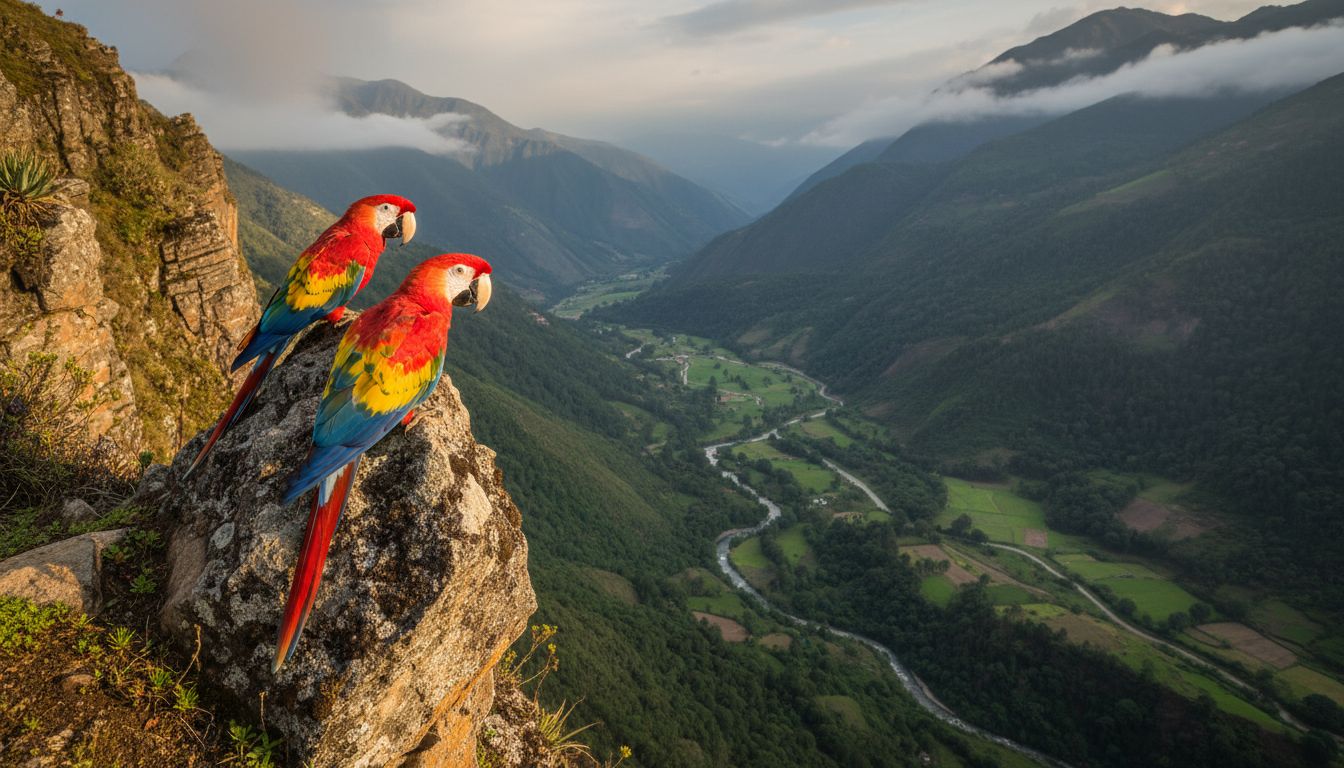
Once the floodwaters receded, the story tells of two macaws arriving at the brothers' refuge, birds described as having human-like faces. According to the myth, these macaws removed their feathers and transformed into women.
The brothers and these transformed women are said to have united, and from this union the Cañari people are believed, in the mythic telling, to have originated. The macaw itself carries symbolic resonance well beyond this single story. Scholars of Andean and Amazonian traditions often point to birds, and macaws especially, as recurring symbols of transformation and as intermediaries between the human world and other realms.
Oral Tradition, Variation, and Colonial Records
As is common with stories passed down orally across generations and communities, versions of the Cañari origin myth vary. Details shift, including the identity of the mountain, the exact sequence of events, and the number of brothers, depending on who is telling the story and where.
Some of the earliest written versions of this myth were recorded by Spanish chroniclers during the colonial period. These records should be read with care: they passed through layers of translation and were filtered through the cultural assumptions and biases of the chroniclers themselves. This means colonial-era texts, while historically interesting, may not fully or accurately reflect how the Cañari themselves understood or told the story.
This tension, between fixed colonial-era written accounts and the more fluid, living oral tradition, is itself part of what makes the myth compelling. The spoken version continues to evolve and adapt even as older written fragments remain frozen in time.
A Living Legacy: The Myth Today
Far from being a relic, the Cañari origin story continues to surface in local festivals, educational programs, and broader initiatives centered on cultural pride and Indigenous identity in Azuay and Cañar. Many in the region see the myth as an active thread connecting present-day Cañari communities to their ancestral past.
For visitors and expats living in or passing through Azuay and Cañar, encountering this story is often part of engaging with the region's living heritage, whether through a local festival, a conversation with a community member, or a visit to a site associated with the legend. The myth, in this sense, serves as a bridge, linking ancestral memory to present-day identity and offering newcomers a window into how a community understands its own origins.