The Night Radio Quito Burned: Remembering Ecuador’s 1949 War of the Worlds Panic
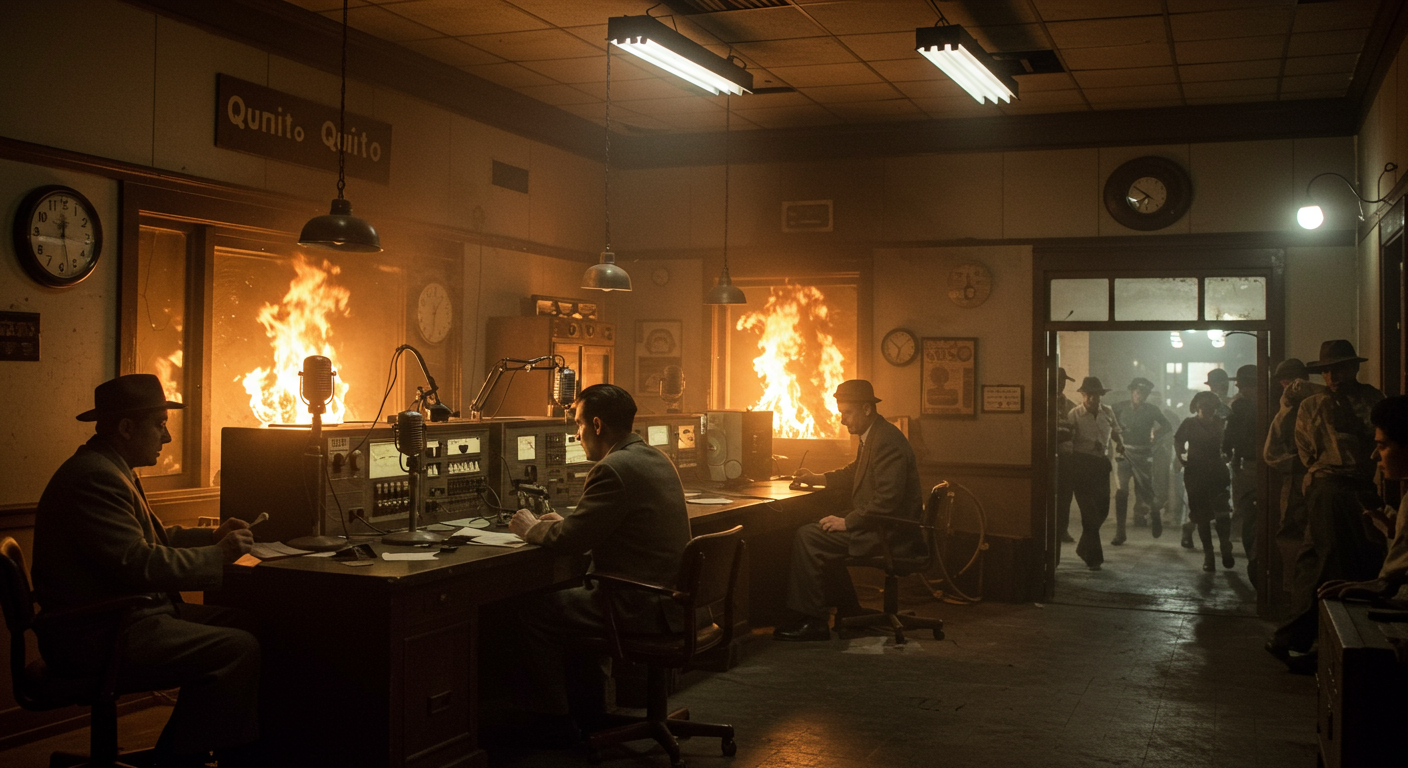
Few media stories from Ecuador are retold as often as the 1949 Quito broadcast said to have turned a science-fiction drama into real-world panic. In its most familiar form, the story sounds almost unbelievable: a local adaptation of War of the Worlds was presented with such realism that listeners believed the city was under attack. When they learned it was fiction, fear reportedly gave way to rage.
It is a gripping story, but also a slippery one. The basic outline of a radio panic in Quito is widely repeated. The details, however, often shift. Different retellings vary on the station involved, the exact sequence of events, and the number of people who died in the backlash that followed. That uncertainty matters, especially when a dramatic legend hardens into accepted fact.
Why the 1949 Quito radio panic still fascinates people
The enduring power of the Quito story comes from how modern it still feels. At heart, it is not just about a radio drama. It is about what happens when a trusted medium speaks with the voice of authority and ordinary people have little reason, in the moment, to doubt it.
Radio in the late 1940s carried a special kind of credibility. For many households, it was the closest thing to a live public square: immediate, intimate, and authoritative. News bulletins interrupted ordinary life. Voices on the radio sounded official even when they were theatrical. In that setting, a fictional emergency delivered in the rhythm and tone of breaking news could become something more than entertainment.
That is one reason the Quito episode remains so memorable. It sits at the intersection of technology, trust, fear, and crowd behavior. Even today, when misinformation is often framed as a social media problem, this older story reminds us that confusion spreads fastest when it arrives through channels people already trust.
What listeners in Quito believed they were hearing
The classic War of the Worlds formula depends on realism. Rather than sounding like a conventional play, the story unfolds as if regular programming has been interrupted by alarming reports. That structure can be disorienting, especially for listeners who tune in late or miss any disclaimer that what follows is fictional.
In Quito, the effect was reportedly intensified by the atmosphere of the time. Radio had authority, but it also had emotional force. A well-delivered voice could create urgency instantly. A staged bulletin about explosions, invasions, or chaos could sound less like fantasy than like disaster unfolding in real time.
According to the commonly repeated account, listeners did not process the program as a literary adaptation. They heard it as emergency information. That distinction is crucial. Panic rarely begins with a love of fiction. It begins when fiction successfully imitates the signals of trusted fact.
How the War of the Worlds format was adapted in Ecuador
The Ecuadorian version is generally described as a local adaptation of H. G. Wells’s famous alien-invasion story, reshaped for radio and delivered in a style meant to resemble genuine reporting. As in other War of the Worlds broadcasts, the production seems to have drawn its power less from the plot itself than from the way it was presented.
Local references may have made the drama more convincing. When a fictional crisis is placed in recognizable geography and voiced in familiar news language, it becomes easier for audiences to imagine that the danger is real and near. That helps explain why adaptations of the same basic story have produced very different reactions in different places.
At the same time, this is one of the areas where caution matters most. Specific claims about who produced the Ecuadorian broadcast, how the script was structured, and exactly which station aired it are often repeated confidently but not always consistently. Any responsible retelling should avoid stating uncertain details more firmly than the record allows.
From panic to backlash
The most dramatic version of the story says that once listeners realized they had been deceived, public fear quickly turned to anger. Instead of remaining a strange radio incident, the episode reportedly spilled into the streets. Crowds are said to have gathered, outrage mounted, and retaliation followed.
Many retellings link that retaliation to a fire involving the broadcaster or related offices. The often-cited claim that six people died is one of the story’s most repeated elements, but it is also one of the details that should be handled carefully rather than stated as settled fact. In popular memory, the death toll has become part of the legend. In historical writing, it remains the kind of claim that deserves verification.
Even with those uncertainties, the broader pattern remains striking. A fictional emergency reportedly caused real fear, and the anger that followed was directed not at imagined invaders but at the people who had staged the illusion. That reversal is part of what makes the Quito story so haunting. The panic itself was dramatic; the backlash was tragic.
What is well known, and what remains disputed
The safest conclusion is that Quito experienced a notorious radio panic connected to a War of the Worlds-style dramatization in 1949. Beyond that, the story becomes harder to pin down. Dates are sometimes rendered differently. Station identities are not always presented consistently. Accounts of who was most responsible, how events escalated, and how many casualties resulted do not always match.
This does not mean the entire episode is myth. It means the line between documented event and embellished retelling has blurred over time. That happens often with dramatic historical episodes, especially those carried forward through journalism, anecdote, and cultural memory rather than through widely consulted archives.
For readers today, the best approach is to separate the strong consensus from the unstable details. The consensus is that a dramatized broadcast in Quito caused enough confusion and alarm to become one of Latin America’s most famous media panics. The unstable details are the exact mechanics of how that night unfolded and the full human cost.
Why this story matters beyond Ecuador
For expatriates and newcomers to Ecuador, the episode offers more than a sensational historical anecdote. It opens a window into the country’s media history and into a moment when mass communication was becoming powerful enough to shape public behavior at scale. It also shows how quickly trust can turn into vulnerability when institutions speak with confidence.
The Quito panic belongs to a much larger story about audience belief. People do not simply absorb information because it is available. They respond to tone, urgency, familiarity, and context. A message that feels official, local, and immediate can override skepticism in seconds.
That lesson has not aged out. If anything, it feels newly relevant. The platforms have changed, but the underlying human mechanisms remain recognizable: authority, repetition, emotional contagion, and the speed with which uncertain information can become collective conviction.
How to tell the story responsibly today
The temptation with a story like this is to lean into its most dramatic elements: the panic, the flames, the death toll, the astonishing idea that fiction could produce such consequences. But when the historical record is uneven, restraint is part of good storytelling.
That means attributing contested claims, especially casualty figures and exact chains of responsibility. It means acknowledging that some details are widely repeated without being uniformly documented. And it means recognizing that the most compelling part of the story may not be the sensational legend alone, but what the legend reveals about public trust.
Whether every repeated detail can be confirmed or not, the Quito broadcast remains a powerful cautionary tale. It reminds us that media do not need to be malicious to be dangerous; they only need to be convincing enough, at the wrong moment, to become more believable than reality itself.