The Floreana Murders That Inspired Hollywood’s “Eden”
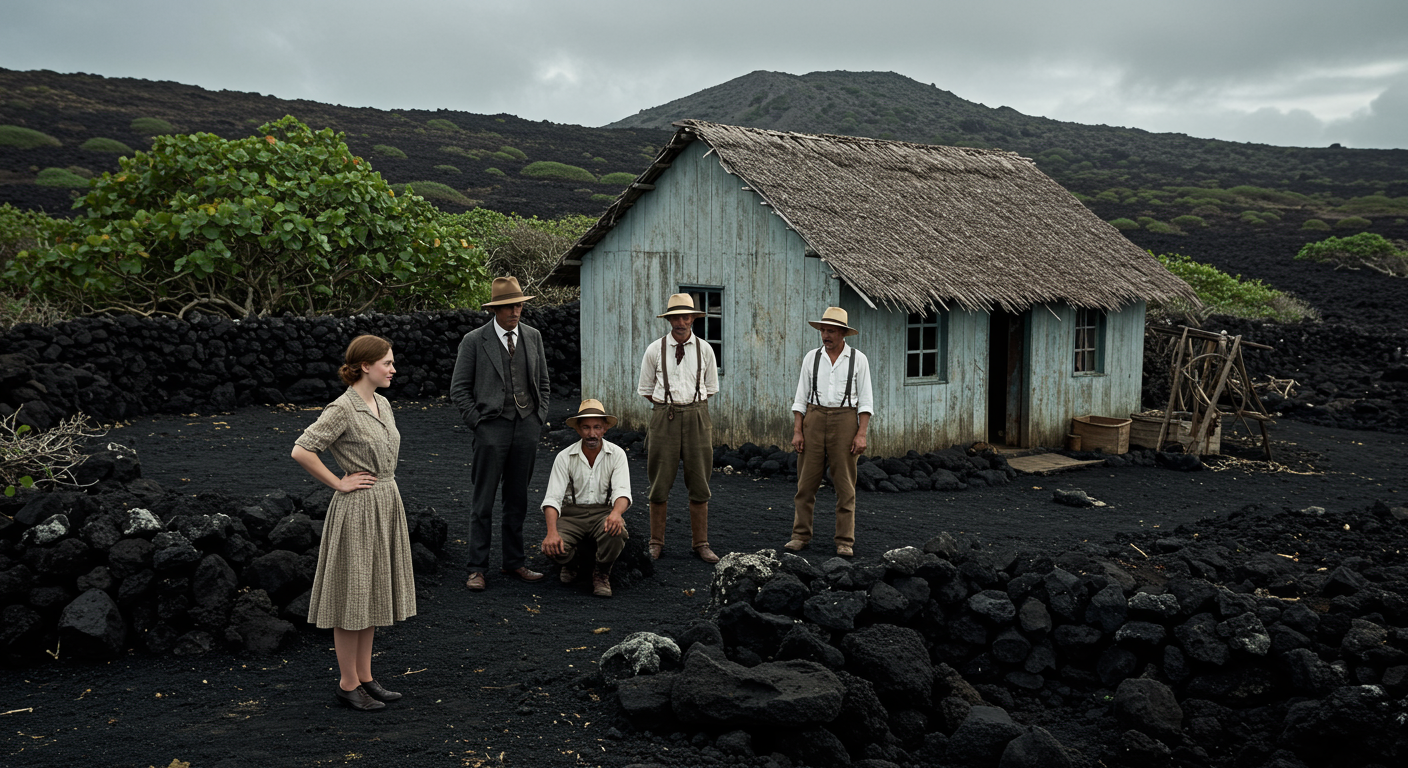
Few stories puncture the fantasy of starting over quite like the Floreana affair. On an isolated island in the Galápagos in the early 1930s, a small group of European settlers tried to build new lives far from the pressures and conventions of the mainland. Instead, their experiment became entangled with jealousy, theatrical self-invention, rumor, disappearances, and deaths so murky that the case has never settled into a single accepted explanation.
That tension is exactly what keeps the story alive. At first glance, it looks like a paradise tale: volcanic landscapes, open horizons, and the promise of beginning again at the edge of the world. But the deeper history is less about escape than about what people carry with them into exile: ego, longing, hierarchy, resentment, and the need to control the story of who they are. That is also why the events on Floreana continue to echo through books, documentaries, true-crime retellings, and the Hollywood film Eden.
Why the Floreana affair still fascinates
The enduring pull of the Floreana mystery lies in its contradictions. It is part survival story, part island melodrama, part unsolved crime, and part cautionary tale about reinvention abroad. The setting feels almost too cinematic to be real, yet the people at its center were not fictional archetypes. They were settlers, drifters, idealists, performers, and opportunists trying to make life work in conditions that magnified every personal fault line.
For readers drawn to expat histories, the story has a special resonance. It is an extreme version of a familiar fantasy: leave the old world behind, reject its rules, and build something freer somewhere remote. But Floreana suggests that distance alone does not simplify human nature. If anything, isolation can make every rivalry sharper and every dependency harder to escape.
The dream of starting over on Floreana
In the early 1930s, remote places still held a powerful imaginative charge for Europeans disillusioned with modern life. A harsh island in the Galápagos could be imagined not simply as a refuge, but as a blank page. For those drawn to radical self-reinvention, Floreana offered exactly that illusion: little infrastructure, few neighbors, and enough distance from Europe to make old identities seem optional.
Yet the same conditions that made the island attractive also made it dangerous. Life there depended on improvisation, endurance, and a willingness to live with scarcity. Supplies were limited. Comfort was minimal. Reputation mattered, because in a tiny community every alliance and grievance could affect survival. What looked like liberation from society could quickly become dependence on a very small social world.
The first settlers were often described as people searching for a different order of life, whether philosophical, personal, or practical. Some wanted freedom from convention. Others wanted anonymity or renewal. But reinvention in isolation is rarely clean. The island did not erase the settlers’ pasts; it stripped away distractions and forced personalities into close contact.
Enter the Baroness and her entourage
If the early settlement years already contained tension, the arrival of the self-styled Baroness turned strain into spectacle. She entered the island story as a larger-than-life figure: charismatic to some, manipulative to others, and impossible for anyone to ignore. Her presence changed the social balance because she did not merely join the settlement. She performed herself within it.
Accounts of the Baroness tend to emphasize her theatricality. She cultivated status, drew attention, and seemed to understand that on a remote island, narrative could be a form of power. Around her was an entourage of male companions whose presence added romantic intrigue, practical competition, and instability. In such a small community, personal attachments were never merely personal. They shaped alliances, resentments, and the daily distribution of trust.
That is one reason the story remains so difficult to pin down. Nearly every major figure inspired sharply divided reactions. To one observer, the Baroness might appear bold and magnetic; to another, disruptive and dangerous. Those conflicting impressions became part of the mystery itself, because later testimony was filtered through rivalry, fascination, and self-interest.
How a utopian experiment became a pressure cooker
Floreana was not simply remote. It was psychologically compressive. In places where resources are scarce and social circles are tiny, rumors travel fast and minor slights can grow into major fractures. Every household becomes visible. Every personality becomes consequential. People who might have drifted apart elsewhere instead remain locked in one another’s orbit.
Daily life under those conditions intensified much of what the settlers had hoped to escape. Scarcity sharpened competition. Harsh living conditions wore down patience. Dependence on occasional contact with the outside world made status and storytelling newly important. In a place where few independent witnesses existed, whoever controlled the narrative could influence how events were understood beyond the island.
That is the deeper expat dimension of the Floreana affair. Reinvention abroad can sound like a clean break, but geography does not cure insecurity, vanity, or conflict. In some cases, remoteness acts less like an escape hatch than like a pressure chamber. It concentrates unresolved tensions until they become impossible to ignore.
The disappearances and deaths at the center of the mystery
The central events that made Floreana infamous unfolded through a sequence of disappearance, death, and suspicion rather than a single clear-cut crime. Broadly speaking, the Baroness and one of her companions vanished under contested circumstances, leaving behind a story that was never conclusively verified. Competing explanations emerged quickly, and none fully resolved the obvious questions.
In the aftermath, the island’s remaining settlers and associates became both witnesses and interested parties. That overlap matters. The people best positioned to explain events were also those whose reputations, safety, or futures might be shaped by whichever version was accepted. As a result, even the chronology of what happened next has often been retold with different emphases and implied motives.
Additional deaths deepened the sense that Floreana had crossed from hardship into nightmare. Some incidents have been framed as the possible outcome of interpersonal violence, others as accident, illness, exposure, or the consequences of desperate circumstances. What makes the case endure is not just that people died, but that almost every explanation seems to leave something out.
It is important not to force certainty onto a historical record that has long remained disputed. The affair became notorious precisely because no single account cleanly explains the disappearances, the later deaths, and the motives attributed to the people who survived long enough to tell the tale.
The competing theories that refuse to die
Over time, the Floreana mystery has generated a familiar set of competing theories. One line of interpretation treats the affair as the predictable result of interpersonal conflict in an environment too small to contain it: jealousy, rivalry, resentment, and the collapse of fragile alliances. Another sees opportunism at work, with testimony shaped by who stood to gain materially or reputationally from a rival’s absence.
There is also the possibility that survival itself distorted the story. People under extreme stress can make choices that later become impossible to narrate honestly, even to themselves. A remote island offers many opportunities for ambiguity and relatively few for independent verification. In that sense, the mystery may have been protected as much by circumstance as by deception.
More elaborate theories often center on cover-up, conspiracy, or carefully staged departures. These explanations remain attractive because the known facts feel incomplete. Yet each theory tends to depend on at least one narrator whose account may have been selective, self-serving, or shaped by retrospective mythmaking. The story survives not because one theory is irresistible, but because all of them reveal how unstable the evidence has always been.
From island scandal to modern legend
What began as a local historical drama eventually became modern legend. The Floreana affair moved outward through memoir, historical reconstruction, documentary treatment, and true-crime fascination. With every retelling, the same basic ingredients proved hard to resist: a beautiful but unforgiving setting, a self-created aristocrat, sexual intrigue, missing people, dead witnesses, and no final consensus about what happened.
That afterlife matters because retellings do not simply preserve a mystery. They reshape it. One version may cast the Baroness as villain, another as adventurer, and another as the victim of a harsher community than legend admits. Some interpretations foreground psychological collapse; others emphasize manipulation, class performance, or colonial fantasy. The ambiguity is not a flaw in the story’s survival. It is the reason it can keep being retold.
Audiences return to Floreana for the same reason they return to so many enduring island mysteries: paradise makes a powerful contrast with human darkness. The more idyllic the setting appears, the more shocking betrayal or violence seems within it. That contrast gives the story a permanent dramatic engine.
Why Hollywood turned to Eden
From a filmmaking perspective, the appeal is obvious. Floreana offers a closed world, a limited cast of vivid personalities, escalating tension, and motives that can be read in multiple ways. It combines survival drama with psychological conflict and historical intrigue, all in a location that naturally intensifies mood and symbolism. For screen adaptation, that is almost irresistible.
A film like Eden also benefits from the way the original events already feel half-mythic. Adaptations of unsolved stories often compress timelines, sharpen rivalries, and assign clearer emotional arcs than history allows. Ambiguous people become more legible characters. Murky chronology becomes dramatic progression. The audience is given a shape to follow, even if the real story refuses one.
That does not mean the cinematic version and the historical record will align neatly. In stories like this, adaptation usually chooses emphasis over completeness. A film may lean into seduction, menace, class tension, or feminist reinterpretation depending on its aims. The Hollywood retelling is therefore part of the Floreana story’s afterlife, not its final explanation.
What the Floreana story says about expat fantasy
At its core, the Floreana affair is not just a mystery story. It is a brutal commentary on the dream of escape. The settlers went to a place that seemed to promise freedom from old constraints, only to discover that remoteness does not dissolve human complexity. Hierarchy reappeared. Desire reappeared. Competition reappeared. So did the need to be admired, feared, believed, or obeyed.
That is what gives the affair unusual power as an expat story. Most people who move abroad are not stepping into anything remotely as extreme as 1930s Floreana. But the emotional structure is recognizable: the fantasy that a new setting can produce a new self, and the shock of discovering that old patterns survive the journey. In ordinary life, that realization may lead only to disappointment. On Floreana, under harsher conditions, it may have helped produce catastrophe.
The island stands as a cautionary symbol. Utopia is often imagined as a place without friction, yet every attempt to build one must still contend with the people inside it. The more intense the dream, the more painful the collision with reality can become.
Ending with the mystery intact
There is always a temptation to solve Floreana too neatly: pick a villain, assign motives, and turn a tangle of contradictory testimony into a coherent moral fable. But the story has endured precisely because certainty never fully arrived. It remains suspended between history and gossip, between survival narrative and self-invention, between documented event and legend.
That unresolved quality is what makes the affair feel modern as well as historical. We still live among stories shaped by charisma, selective testimony, and the competition to define what really happened. Floreana simply staged those forces in one of the most remote and dramatic settings imaginable.
In the end, the image that lingers is not just of violence or disappearance, but of paradise turned into theater. A remote island promised rebirth, then exposed the people who came seeking it. Utopia vanished. The mystery stayed behind.