The Cat That Refused to Be Forgotten
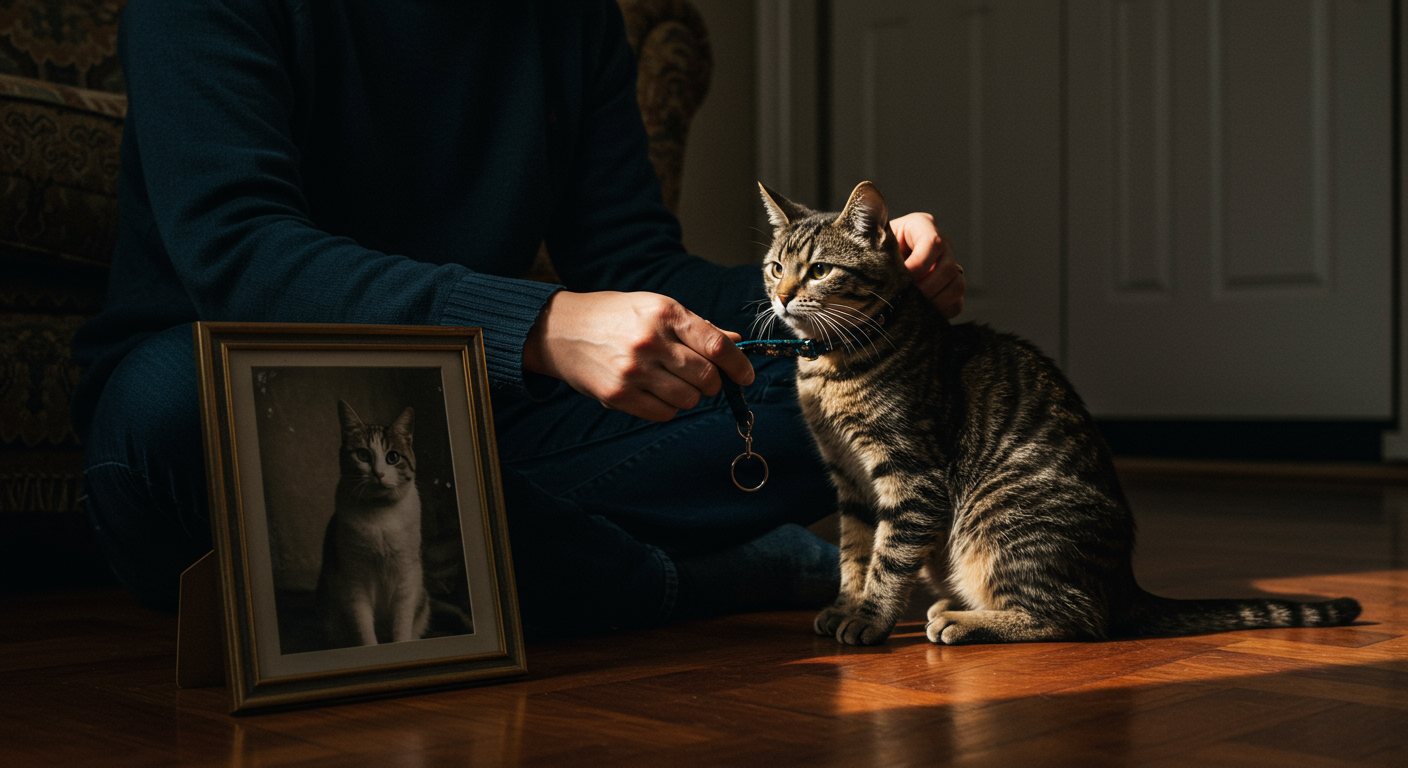
By the time the bakery opened, the cat was usually already there.
He would be stretched along the low wall near the corner, one ear flicking at the morning traffic, as if he owned not the street but the hour. People passed him with grocery bags, in school uniforms, with the resigned speed of those late for work. Some noticed him. Most did not. But for me, in those first months abroad, when every errand still felt slightly self-conscious and every exchange in Spanish required a small gathering of courage, he became part of the map. Not a landmark exactly. Something more intimate than that. A witness.
Some absences arrive all at once. Others enter quietly, through habit. This was the second kind. Long before he was gone, the cat had already taken up residence in my days so completely that forgetting him was no longer possible.
How he entered my life
I never learned where he came from. In cities like this, cats often seem to belong to no one and everyone at once. They appear in courtyards, on roofs, under parked cars, beside market stalls. This one was gray with a white throat and a look of deep practical judgment, as though he had survived by keeping most of his opinions to himself.
At first, he was simply the cat near the bakery. Then he was the cat who began to recognize the sound of my steps. Then he was the cat who would rise, stretch, and follow me halfway down the block before deciding I had gone far enough. It did not happen dramatically. There was no cinematic rescue, no declaration of mutual devotion. It was built out of repetition: mornings, crumbs, greetings, pauses.
I started carrying a little extra in my bag for him. Not every day, and not enough to pretend I was his sole provider, but enough to make our acquaintance feel acknowledged. He was never sentimental about it. He accepted food with the composure of someone collecting rent. If I tried to stroke him too soon, he moved away. If I sat on the curb and waited, he sometimes came close enough to press one flank against my ankle for a brief second, then retreated as if embarrassed by the concession.
That restraint was part of what made him matter. He did not offer uncomplicated affection. He offered recognition. In a season of life when so much around me felt provisional, that distinction was enormous.
Why it felt different abroad
Back home, I had people who knew my history without explanation. I had familiar stores, familiar weather, familiar jokes. Abroad, even ordinary competence had to be rebuilt from scratch. Which bus to take. How to ask for change. What tone to use with neighbors. How long to wait before calling someone a friend.
Expat life can look expansive from a distance, but on the inside it often narrows into rituals that keep loneliness manageable. The same route to the market. The same table at the cafe. The same voice note sent to family on Sunday afternoons. We collect these habits because they help hold the day together.
The cat became one of those habits, but also something more. He asked nothing of me that language could complicate. He did not care where I was from or how long I planned to stay. He did not require fluency, biography, or confidence. He was simply there, with his battered dignity and exacting routines, and in his presence I did not feel quite so temporary.
Animals can become anchors in unfamiliar places for reasons that are hard to explain without sounding sentimental. They offer continuity without interrogation. They return, until they do not. And because they cannot narrate the relationship in words, we fill the silence with our own need, our own tenderness, our own sense that being recognized by another living thing is a form of belonging.
The separation
The morning he was missing, I noticed before I reached the corner.
It was not logic that told me. It was interruption. The wall looked too bare. The light fell on the pavement without being broken by his body. I slowed instinctively, already searching under the parked cars, near the doorway, beside the stack of plastic crates where he sometimes retreated when it rained.
He was not there.
I told myself it meant nothing. Street animals vanish for a day and return the next. They find shade elsewhere. They follow food. They fight, hide, wander, recover. But his absence persisted in that peculiar way that begins to rearrange attention. For several days I looked for him at the usual hour, then at unusual hours. I checked the side street. I asked, awkwardly, at the bakery counter if they had seen the gato gris. The woman wrapping bread nodded as though she knew exactly which one I meant. She shrugged, then softened her face. No lo he visto.
That was all. No explanation. No final scene. No certainty generous enough to close the matter.
Perhaps someone took him in. Perhaps he was injured. Perhaps he simply moved his life beyond the borders of mine. The facts remained small, and because they remained small, memory had room to grow around them.
What stayed after he was gone
I kept slowing at the corner for weeks. Then months.
Even after I stopped expecting him, my body had already learned the pause. I would glance toward the wall before remembering why I was glancing. More than once, I caught myself reaching into my bag for the little packet I no longer carried. Grief, in minor keys, often sounds like this: reflex without destination.
Others remembered him too, though usually in passing. A neighbor mentioned that the street felt emptier without the cats that used to drift through. Someone at the bakery said, with the casual authority of local observation, that these animals come and go. Life continues. The bread still sold out by noon. Children still ran down the hill after school. Rain still gathered in the broken places in the pavement. Nothing changed, except that something had.
That is the strange arithmetic of loss. The world remains itself and becomes newly unrecognizable in one specific spot.
After he disappeared, I found myself noticing other cats more carefully. Not because they replaced him. They did not. But because he had trained my attention. He had made me more available to the unnoticed lives braided through a neighborhood: the dogs sleeping under fruit stands, the sparrows exploding from gutters, the old woman who spoke to every passing animal as if taking attendance. He left behind, among other things, a way of seeing.
Memory, grief, and place
People who move across borders become practiced at underestimating what will matter later. We imagine we will remember the major events: the flights, the apartments, the paperwork, the departures. And we do remember those. But often what survives longest are the smaller attachments that once seemed incidental. A cashier who knew your order. The smell of eucalyptus after rain. A chipped blue gate. A cat on a wall outside a bakery.
Maybe that is because large transitions are too obvious to trust. We expect them to change us. Smaller presences slip in unannounced and alter the shape of daily life before we have words for what is happening.
This cat was not a symbol in the moment I knew him. He was himself: cautious, routine-bound, mildly arrogant, unexpectedly generous with his company. Only later did he begin to stand for other things too: the tenderness that can take root in unstable ground, the odd intimacy of being known in fragments, the fact that some of what sustains us abroad is so modest we hardly think to defend it until it is gone.
To remember him is not to turn him into a metaphor and erase the animal he was. It is the opposite. It is to insist that this one life, however small it looked from the outside, had weight. That his existence changed the emotional weather of one corner and one person. That he mattered not because he represented something universal, but because he was particular.
Refusing oblivion
I still think of him when I pass bakeries early in the morning, especially ones with low walls out front and a patch of sun that arrives before the day has fully decided what it will be. For a second, I expect to see that gray shape curled in confidence against the noise of the street.
I never do. But I look.
That, in the end, may be what remains when no neat ending is available: the ritual of looking, the refusal to let a life dissolve simply because it was ordinary or brief or witnessed by only a few. Memory is not rescue. It does not reverse disappearance. But it grants something stubborn in its place.
The cat is gone, as far as I know. Yet he continues to inhabit a corner of the world because he inhabits a corner of thought. He survives in the half-second pause at a bakery wall, in the instinct to carry a little extra, in the knowledge that even far from home we are shaped by the creatures who keep showing up until one day they do not.
Being remembered is not the same as being saved. Still, for some lives, perhaps it is the closest thing to a second life we can offer. And so he is not forgotten. Not by the street, which has already moved on. Not by the city, which never noticed. But by the one person who learned, because of him, how absence can remain vividly, stubbornly present.