The Abandoned Place Everyone Avoids After Sunset
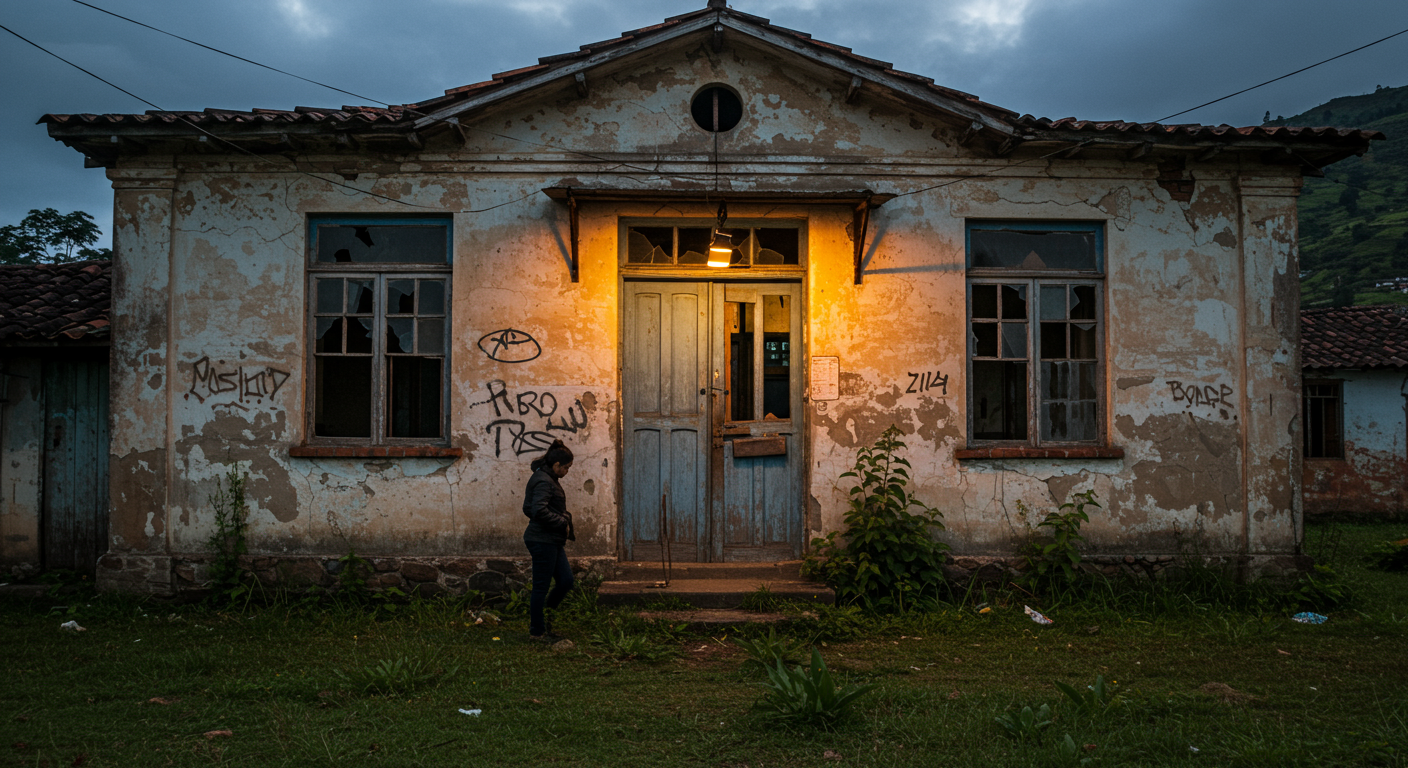
There are places in Cuenca that barely register in daylight. You pass them without slowing down, maybe noticing a broken wall, a chained gate, or a building that looks as if everyone left in the middle of a sentence. But after sunset, the same place can feel entirely different. The air seems heavier. The street grows quieter. Even people who normally walk anywhere without a second thought choose another route.
This is not a story about proving rumors true or false. It is about something many expats recognize: the moment you realize a place has two identities. One belongs to the map and the daylight. The other belongs to whispers, habits, and the unspoken ways locals teach each other what to avoid.
Why This Place Changes After Dark
By day, an abandoned place can look almost disappointing in its ordinariness. Faded paint. Weeds pushing through cracks. Windows clouded by dust or boarded from the inside. Nothing dramatic, nothing cinematic. Just neglect. But once the sun drops behind the hills and the last color drains from the street, details disappear and mood takes over.
That is when the contrast becomes impossible to ignore. What seemed merely empty starts to feel sealed off. What looked forgotten begins to feel watched, even when no one is there. In a city where so much life spills onto sidewalks, plazas, and corner stores, an empty property can stand out more at night than any busy place does during the day.
As an expat, I have learned that these shifts are often noticed first not through what I see, but through what other people do. A taxi slows, then keeps going. A neighbor lowers their voice when the place comes up. Someone gives directions with a quiet warning: not that way at night.
What I Heard Before I Went
Long before I stood near the place myself, I had already heard about it in the way these things usually spread. Not as a clear story with dates and names, but as fragments. People said it felt wrong after dark. They said nobody liked passing there late. They said locals had their reasons, though those reasons were never explained the same way twice.
Some comments sounded practical, others almost theatrical. A raised eyebrow. A quick shake of the head. A laugh that did not quite hide discomfort. The warnings were rarely specific. They lived more in tone than in detail.
That vagueness is part of what makes places like this so powerful. Most of what circulates around them is secondhand. Someone heard something from a cousin, a neighbor, a shopkeeper, a former tenant. The story survives because no one tells it completely, only enough to pass along the feeling. And that feeling, more than any verified fact, is what people remember.
It is worth saying clearly: impressions are not evidence. Rumor is not proof. But social behavior has its own kind of reality. Even when a story is blurry, the avoidance it creates can be very real.
Seeing It in Daylight
In daylight, the place seemed smaller than its reputation. That was my first surprise. It sat there without drama, surrounded by the ordinary rhythms of the city: distant traffic, a dog barking somewhere behind a wall, a few people moving through the neighborhood as if nothing unusual had ever happened there at all.
There was neglect, of course, the kind that accumulates slowly. Rust on metal. Crumbling edges. A tired look that suggested years without care. But there was also stillness. Not menace, exactly. More like the silence of a place that has fallen out of use and then out of conversation, except for the rumors that keep it alive.
Daylight has a way of shrinking mystery. You notice physical things instead of stories. The angle of the gate. The weeds. The dust. The geometry of a wall. In the sun, the abandoned place looked less like a legend and more like a property that time had simply stopped visiting politely.
And yet its reputation clung to it. Even standing there in full light, it was hard not to view every detail through the warnings I had already heard.
What Shifts at Sunset
The change begins subtly. The light thins first. Shadows gather in corners that were empty a few minutes earlier. Sounds become harder to place. The same street that felt open in the afternoon starts to feel farther from help, farther from explanation.
Then people begin to disappear. Not dramatically, just gradually. A door closes. A conversation ends. Footsteps become less frequent. The city does not stop, but it withdraws enough to make absence noticeable.
That is often what creates unease more than the abandoned place itself. A building does not need to do anything to feel off-limits. Atmosphere can do the work on its own. Silence can do it. Distance can do it. So can the simple fact that no one else seems interested in lingering nearby.
At sunset, the place seemed to absorb what little movement remained around it. The familiar became uncertain. The ordinary looked staged. Even if nothing happened, it felt like the kind of place where most people preferred not to test their imagination.
Why People Avoid It
There are many possible reasons people avoid places like this, and not all of them are dramatic. Sometimes it is simple discomfort. Sometimes it is isolation. Sometimes it is the way darkness magnifies every unanswered question. And sometimes a place inherits a reputation so thoroughly that avoiding it becomes automatic, even for people who do not know the original story.
Superstition can play a role. So can neighborhood lore. In other cases, the avoidance may have less to do with any single event and more to do with a general sense of unease repeated over years. Once enough people act as though a place should be avoided, that behavior starts to justify itself.
Reputation can become a form of architecture. It shapes movement. It redirects attention. It tells people when to cross the street, when to keep walking, when not to ask too many questions.
For outsiders, that can be frustrating. We want reasons. We want facts. But communities do not always organize themselves around complete explanations. Sometimes they organize around feeling, habit, and inherited caution.
How Expats Read Places Like This
For many expats, learning a city means learning its unofficial map. Not just where things are, but how people relate to them. Which park is lively in the morning. Which street empties too early. Which block is described with a shrug in the afternoon and a warning at night.
Language gaps make this even more pronounced. You catch part of a story, miss the nuance, fill in the blanks with your own imagination, and before long a place has become larger in your mind than it may be in reality. A half-understood warning can carry more weight than a fully explained one.
That is part of the expat experience: piecing together a city through routines, observations, and incomplete translations. You learn from what people say, but also from what they avoid saying directly. You notice pauses. Changes in tone. The way someone says, better not, and leaves it there.
Places like this become lessons in local reading. They remind newcomers that cities are built not only from streets and buildings, but also from shared signals. To understand a place, you often have to notice what others do before you understand why they do it.
The Power of a Reputation
An abandoned place can be physically empty and still socially full. Full of suggestion. Full of memory, or what passes for memory when stories are told too many times to trace back to their source. In that sense, some places are abandoned twice: once by the people who leave them, and again by everyone who decides not to return.
That second abandonment is often the more powerful one. It changes behavior. It creates detours. It teaches caution without instruction. Over time, the reputation of the place becomes more durable than any known detail about it.
What stays with me is not the idea that there must be a hidden explanation waiting to be uncovered. It is the realization that fear does not always depend on clear facts. Sometimes what people avoid after sunset is not just a building or a lot or a dead-end stretch of street. Sometimes it is the story that has settled over it so completely that no one wants to be the person who ignores it.
And in cities where daily life is shaped as much by shared instinct as by official maps, that may be reason enough.