Quito Just Found Its Second-Ever Petroglyph on Ilaló — Geometric Carvings From a Forgotten Culture
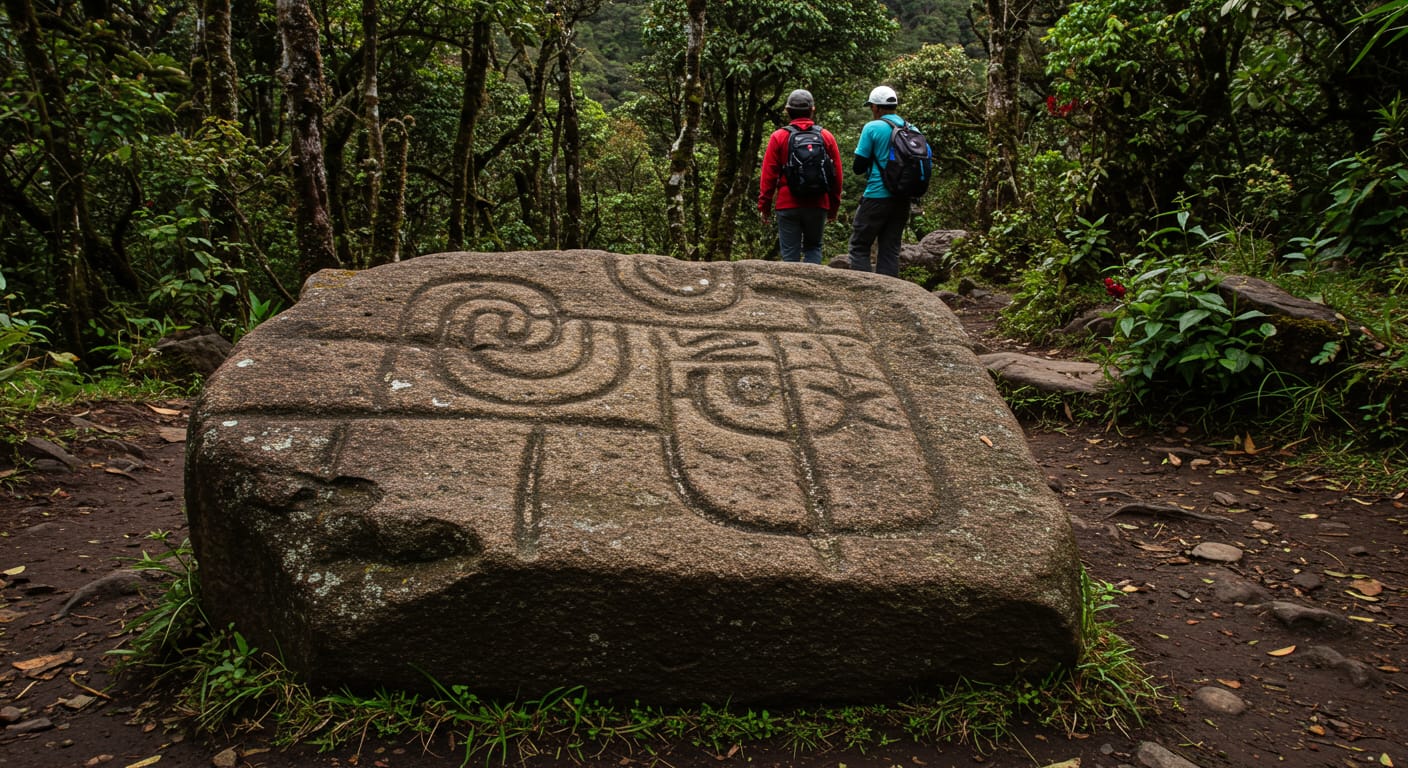
For many expats living in and around Quito, Ilaló is less a landmark than a fixture of daily life — the dormant volcano that rises between the capital and the Valle de los Chillos, its slopes crisscrossed by trails that locals and foreigners alike use for weekend hikes, trail runs, and quiet escapes from city noise. So when word began circulating of a second petroglyph reportedly found on the hill, it caught the attention of the kind of people who know Ilaló's paths well enough to wonder what else might be underfoot.
Details around this reported discovery remain thin. There is no confirmed date for when the carving was found, no named discoverer, and no official statement yet from archaeological authorities. What's circulating appears to be early and largely word-of-mouth. Still, even an unverified report like this resonates with the expat community, many of whom have come to see Ilaló not just as scenery, but as a place layered with history that is still, quite literally, being uncovered.
What Little We Know About the Carvings
According to the limited descriptions available, the newly reported carvings are geometric rather than figurative — abstract lines and shapes, as opposed to the animal or human figures sometimes found in petroglyphs elsewhere in the Andes. Beyond that general characterization, specifics are scarce.
The framing of this as the hill's "second-ever" petroglyph implies that a previously documented carving already exists somewhere on Ilaló, which raises a reasonable question: could there be more markings scattered across the volcano's slopes, still unnoticed by hikers passing within feet of them? That's speculation at this point, but it's the kind of possibility that tends to stick with people who spend time in the area.
It's worth being upfront that no cultural attribution has been confirmed publicly. References to a "forgotten culture" reflect the absence of identification rather than any confirmed link to a specific pre-Columbian group. Readers should treat these details as preliminary, since no verified source material was available to confirm the exact location on Ilaló, the pattern of the carvings, or any expert reading of their origin or age.
Ilaló's Deeper Archaeological Reputation
None of this emerges in a vacuum. Ilaló has long drawn interest from archaeologists and geologists, both for its volcanic history and for its position within a basin that has yielded pre-Columbian artifacts and sites over the years. The wider Quito valley and surrounding highlands are known, in general terms, for having supported human settlement long before the Inca or Spanish arrived, and researchers have periodically turned up evidence of that deeper past in the hills and valleys around the capital.
A recurring theme among people who follow this kind of local history is that the picture remains incomplete — full of gaps, competing hypotheses, and sites that have never been formally excavated. This petroglyph, if confirmed, would fit into that broader, still-unfinished story rather than settle any particular question about who lived on Ilaló's slopes or when.
Why This Resonates With Expats in the Quito Area
For expats who hike Ilaló on weekends, live in its foothill communities, or simply pass by it on the drive between Quito and the Valle de los Chillos, a discovery like this lands differently than it might elsewhere. It's a quiet reminder that living abroad often means brushing up against history that even locals are still piecing together — that the ordinary hillside you walked last Sunday might hold traces of people whose names and stories have been lost to time.
There's something worth sitting with in that: a shared sense of curiosity, and maybe a small sense of stewardship, in being present for a place's history as it's slowly rediscovered. That doesn't mean treasure-hunting instincts are welcome. If anything, moments like this are a good prompt to treat the area with more care and respect — leaving any unusual markings or stones undisturbed, and letting trained researchers determine what, if anything, they represent.
What to Watch For Next
If this reported find holds up, further investigation would likely follow — dating, documentation, and an attempt at cultural identification by archaeologists or heritage specialists. Readers curious about the story's development should watch for official statements from Ecuadorian heritage authorities or academic archaeological teams, since those are the sources most likely to confirm or correct the details currently circulating.
This piece is necessarily an early and incomplete look at a story that is still developing, built on limited public information rather than confirmed reporting. But incomplete as it is, it points to something worth remembering: much of Ecuador's pre-Columbian past likely remains hidden in plain sight, even on hills as familiar and well-trodden as Ilaló.