Otavalo on June 24: Watching the Plaza Fill During Inti Raymi
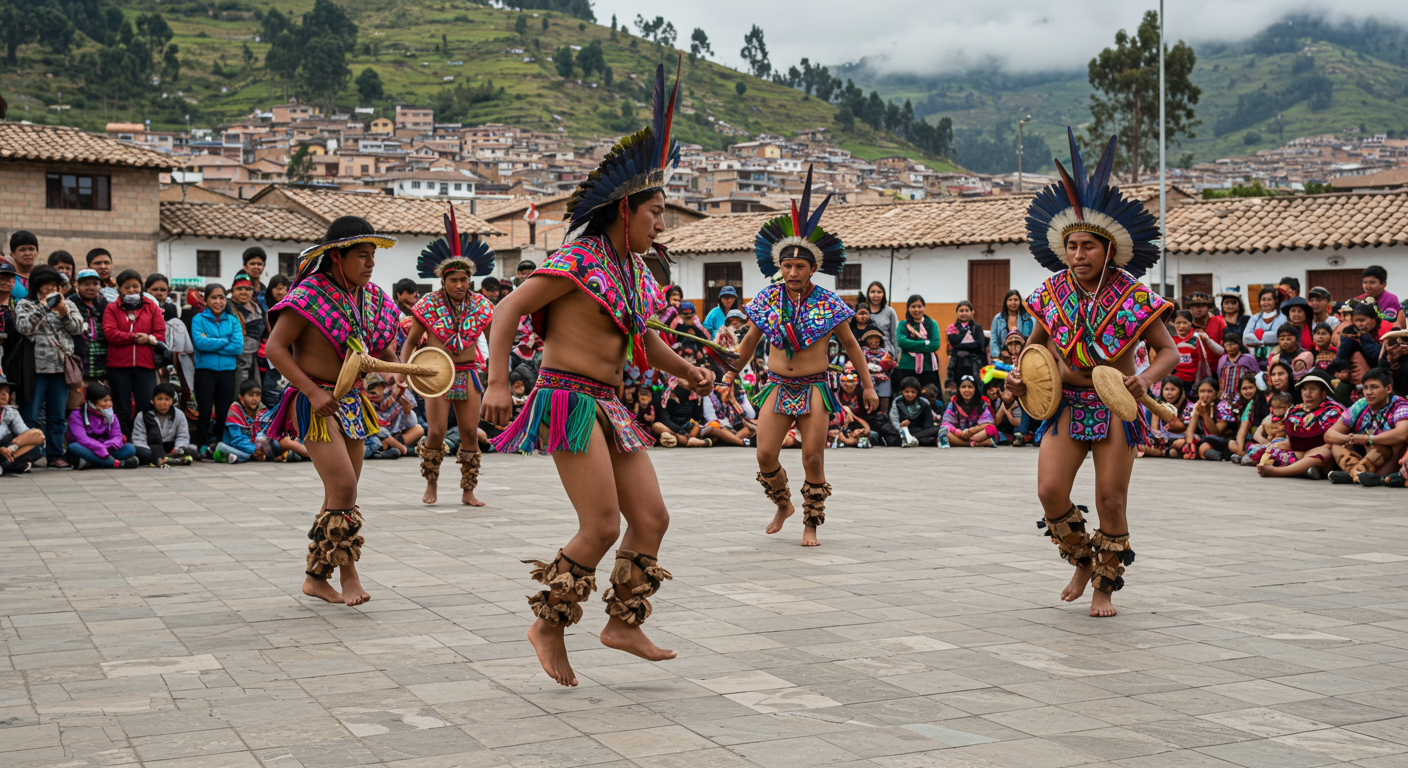
You feel it before you fully understand it. Otavalo on June 24 carries a different kind of pressure in the air: more movement in the streets, more people gathering with purpose, more sound rising from corners that on an ordinary day might simply feel busy. There is music, conversation, and the percussion of many feet. Even for a newcomer, it is clear this is not just another festival date on the calendar.
What follows is not a definitive explanation of Inti Raymi in Otavalo. It is an on-the-ground encounter with a day many people experience deeply, and one that outsiders should approach with care. The finer meanings, names, and timing are best understood through local voices, not imposed by a visitor passing through with a notebook and camera.
What the Day Feels Like in the Streets and Square
As the town fills, the plaza becomes more than a landmark. It turns into an emotional center of gravity. People move toward it in waves, and the energy changes block by block. What first reads as celebration begins to feel more concentrated than that, more collective, more ceremonial.
The most memorable sensation is rhythmic. You hear the ground as much as the music. There is dust, motion, and the repeated impact of feet meeting stone and earth with force and cadence. The sound travels through your body. It is not delicate. It is public, physical, and communal.
Standing at the edge of the square, you get the sense that public space itself is being redefined for the day. The plaza is no longer just a place to pass through or sit beside. It becomes the stage, the gathering point, and, for many, a point of return.
Witnessing the “Toma de la Plaza”
Some locals refer to the climactic moment as the Toma de la Plaza, a phrase that in conversation often carries both familiarity and weight. From the outside, what stands out is the collective movement into and through the square: the foot-stomping cadence, the density of the crowd, and the unmistakable feeling that people are not simply attending an event but actively making the space their own.
To watch it unfold is to feel the atmosphere tighten. The plaza seems to change character in real time. What had been anticipation becomes assertion. What had been a gathering becomes a presence. The repeated beat of feet gives the moment a pulse that is impossible to ignore.
And yet the meaning of that moment does not arrive with a tidy caption. One person may describe it in terms of tradition. Another may speak of memory, identity, or continuity. Someone else may emphasize the joy of reunion, the return to the town center, or the importance of keeping community practices visible and alive. The scene invites interpretation, but it resists simplification.
How Locals Explain the Meaning
When you ask respectful questions, the answers tend to widen the event rather than narrow it. Some people speak about inheritance: what was passed down, what is still practiced, what must not be forgotten. Others describe the day in more immediate terms, as a lived expression of belonging. Depending on whom you speak with, the emphasis may fall on celebration, cultural continuity, community strength, or the simple fact of showing up together in a place that matters.
That variation matters. It is tempting for outsiders to search for one clean summary, one authoritative sentence that explains everything. But culturally rooted events often hold several truths at once. They can be festive and solemn, welcoming and not fully legible to strangers, joyful and shaped by long memory.
The most responsible way to hear those explanations is to let them remain textured. Not every resident will frame the day in the same way, and that difference is part of the reality rather than a problem to be solved.
For an Expat, the Lesson Is Humility
For someone coming from outside, the strongest lesson may be how much you do not know. It is easy to arrive looking for spectacle and leave with photographs. It is harder, and more honest, to recognize the limits of quick understanding.
There is a difference between witnessing a powerful public event and claiming to understand it in full. Humility means listening more than narrating. It means asking before photographing individuals at close range, paying attention to how people around you are behaving, and resisting the urge to package a living tradition into something conveniently exotic for foreign consumption.
In that sense, the day offers a quiet correction to the expat habit of explaining Ecuador back to itself. Some things are visible right away: the sound, the force, the collective movement. Other things have to be learned slowly, through relationships, language, and trust. And some things may never belong fully to an outsider’s vocabulary.
Why This Moment Stays With You
Long after the square empties, what remains is the afterimage of rhythm. The beat of feet. The dust hanging briefly in the air. The sense that a familiar public space had been transformed by collective presence into something denser with memory and meaning.
That is part of what makes Otavalo feel distinct. Not because it can be reduced to a postcard version of culture, but because moments like this reveal how much history can live in the use of a plaza, in a recurring date, and in the act of gathering together with intention.
An outsider may leave with only a partial understanding. But even partial understanding can carry respect. And perhaps that is the most lasting impression of all: not mastery, but the recognition that some places teach you first by showing how much they hold.