Near Death on a Remote South American Road: A Survival Story
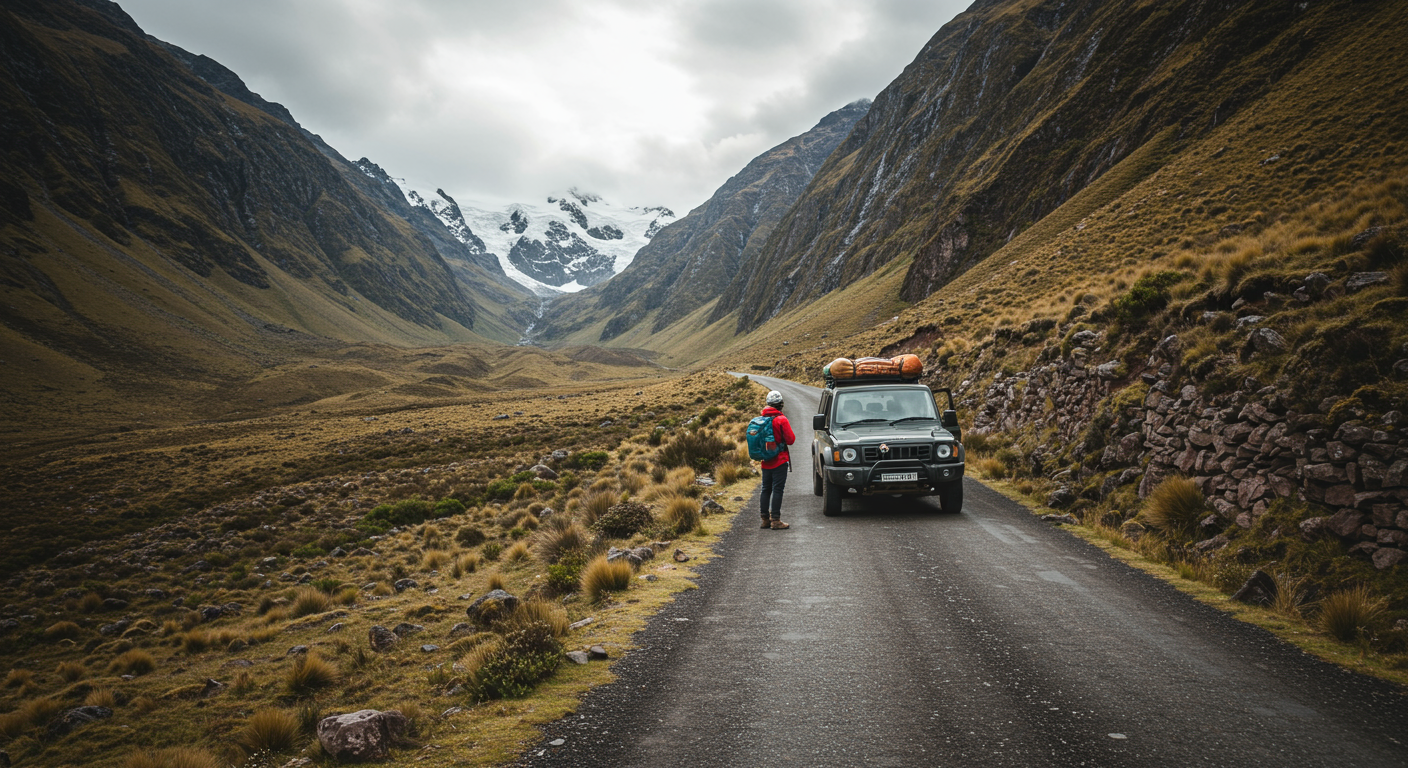
The gravel road stretched endlessly ahead, disappearing into the Andean mist like a question mark carved into the mountainside. I should have turned back when the pavement ended. I should have listened when the last village mechanic shook his head at my aging Land Cruiser. But I was chasing a story, convinced that the remote indigenous community three hours up the mountain held the perfect ending to my freelance article about traditional weaving techniques.
That hubris nearly cost me my life.
The Road to Nowhere
The Cordillera de los Andes has a way of making you feel simultaneously insignificant and invincible. As I climbed higher into the Bolivian highlands, the landscape transformed from scrubby valleys to moonscape terrain dotted with ancient volcanic peaks. The road—if you could call it that—was little more than two tire tracks carved into loose shale and granite.
I had been living in La Paz for eight months, working as a freelance journalist and slowly adapting to life at 12,000 feet above sea level. The assignment seemed straightforward: document the traditional textiles produced by a small Aymara community that had supposedly maintained pre-Columbian weaving techniques. My editor wanted authentic, off-the-beaten-path content, and I was determined to deliver.
The warning signs were everywhere from the beginning. The fuel gauge showed less than a quarter tank when I left the last gas station. My water supply consisted of two plastic bottles. I had no satellite phone, no GPS device—just a hand-drawn map from a contact who spoke broken Spanish and seemed genuinely unsure about distances.
But the landscape was intoxicating. Vicuñas grazed on impossible cliff faces. Ancient terraces carved by long-dead civilizations created geometric patterns across the mountainsides. The silence was so complete that my engine noise felt like sacrilege.
When Everything Went Wrong
The breakdown happened without drama—a grinding sound from the engine, followed by a shuddering stop. Steam rose from under the hood as I coasted to a halt on a narrow shelf of road with a thousand-foot drop on one side and an impassable rock face on the other.
My first emotion was irritation rather than fear. I was a seasoned traveler, someone who prided himself on adaptability. I popped the hood and stared at the engine as if mechanical knowledge would somehow materialize. The radiator had cracked, probably weakened by altitude and rough roads. Coolant pooled beneath the vehicle in a rainbow-colored puddle.
That's when reality began to sink in. I had seen no other vehicles for over two hours. My cell phone showed no signal—hadn't for the past 90 minutes. The temperature was dropping as afternoon clouds gathered around the peaks. I was wearing a light jacket suitable for La Paz's mild climate, not the near-freezing conditions of high altitude.
The silence that had seemed so beautiful now felt oppressive and hostile. Every sound—wind through the rocks, my own breathing, the tick of cooling metal—seemed amplified in the thin air.
Fighting for Survival
Survival came down to brutal mathematics: water, warmth, and rescue. I had perhaps 32 ounces of water, clothing suitable for maybe four hours in dropping temperatures, and no way to signal for help. The rational choice was to wait by the vehicle—the first rule of wilderness survival. But rational choices felt increasingly inadequate as the first flakes of snow began to fall.
I made a decision that probably saved my life, though it violated every survival manual I had ever read. I decided to walk. Not back down the mountain—that would have meant at least six hours to the last village—but forward, toward the indigenous community that might or might not exist.
The altitude made every step a conscious effort. At nearly 14,000 feet, my lungs couldn't process enough oxygen to maintain a normal pace. I found myself stopping every few minutes, gasping in the thin air while snow continued to accumulate on my shoulders.
My mental state deteriorated faster than my physical condition. The landscape that had seemed magical now felt malevolent. Every rock formation looked like a crouching predator. The silence became a roar of white noise that made it impossible to think clearly. I began talking to myself, then arguing with myself, then pleading with the mountains to show mercy.
What kept me moving was a stubborn refusal to become a cautionary tale. I had read too many stories about overconfident foreigners found frozen in the Andes. My pride—the same trait that had gotten me into this situation—now became my lifeline.
The Long Road Back
I smelled the smoke before I saw the village. Wood smoke mixed with the distinctive odor of llama dung fires—a scent I had learned to recognize during my months in Bolivia. The community consisted of perhaps a dozen stone houses clustered around a small church, exactly the kind of place that existed on no official map.
The villagers—an extended Aymara family—found my appearance more amusing than alarming. A middle-aged woman named Esperanza took charge immediately, leading me to a one-room house where a fire burned in a corner hearth. She served me bitter coca tea and soup made from potatoes and some unidentifiable but delicious meat.
Communication was challenging. My Spanish was intermediate at best, and several of the older villagers spoke only Aymara. But the universal language of hospitality needed no translation. They fed me, dried my clothes, and provided thick llama wool blankets for the night.
The next morning, Esperanza's teenage son guided me back to my abandoned vehicle on foot—a journey that took less than an hour. In daylight, without falling snow and panic, the distance I had struggled to cover revealed itself as embarrassingly short. A neighbor with mechanical skills bypassed the radiator with some creative hose work, and I limped back to civilization with profound new respect for the mountains.
Lessons From the Edge
That near-death experience fundamentally changed how I approach both travel and life. The mountains taught me that confidence without preparation is just arrogance in hiking boots. I had confused familiarity with competence—eight months in Bolivia hadn't made me qualified to handle serious wilderness emergencies.
The most important lesson was about redundancy. One broken part, one wrong turn, one bad weather system—any single failure could cascade into catastrophe. Now I travel with backup plans for my backup plans: satellite communication devices, extra food and water, appropriate clothing for worst-case scenarios.
But the experience also revealed something unexpected about human resilience. When comfortable options disappear, the mind and body prove capable of remarkable adaptation. The panic that initially paralyzed me eventually gave way to a kind of focused clarity I had never experienced before.
For fellow expats living in South America, my advice is simple: respect the landscape. These mountains have been humbling overconfident humans for millennia. The same beauty that draws us to remote places can turn deadly with shocking speed. Modern conveniences—GPS, cell phones, well-maintained vehicles—create an illusion of control that disappears quickly when you're truly alone.
Take local advice seriously, especially from people who have spent their entire lives reading these landscapes. Carry emergency supplies appropriate for the worst conditions you might encounter, not just the weather you expect. And perhaps most importantly, tell someone your exact route and expected return time.
I eventually wrote that article about traditional weaving techniques. Esperanza and her family became not just sources but friends, and I learned more about Aymara culture during my unplanned stay than I could have gathered in weeks of formal interviews. But that story, with its neat narrative arc and cultural insights, was really just the postscript to a more fundamental lesson about survival, humility, and the thin line between adventure and disaster.
The mountains are still there, as beautiful and dangerous as ever. I return occasionally, but now with proper preparation and deep respect for their power. Some lessons, I learned, are worth almost dying for.