Near Death on a Remote South American Road: A Journey to the Edge
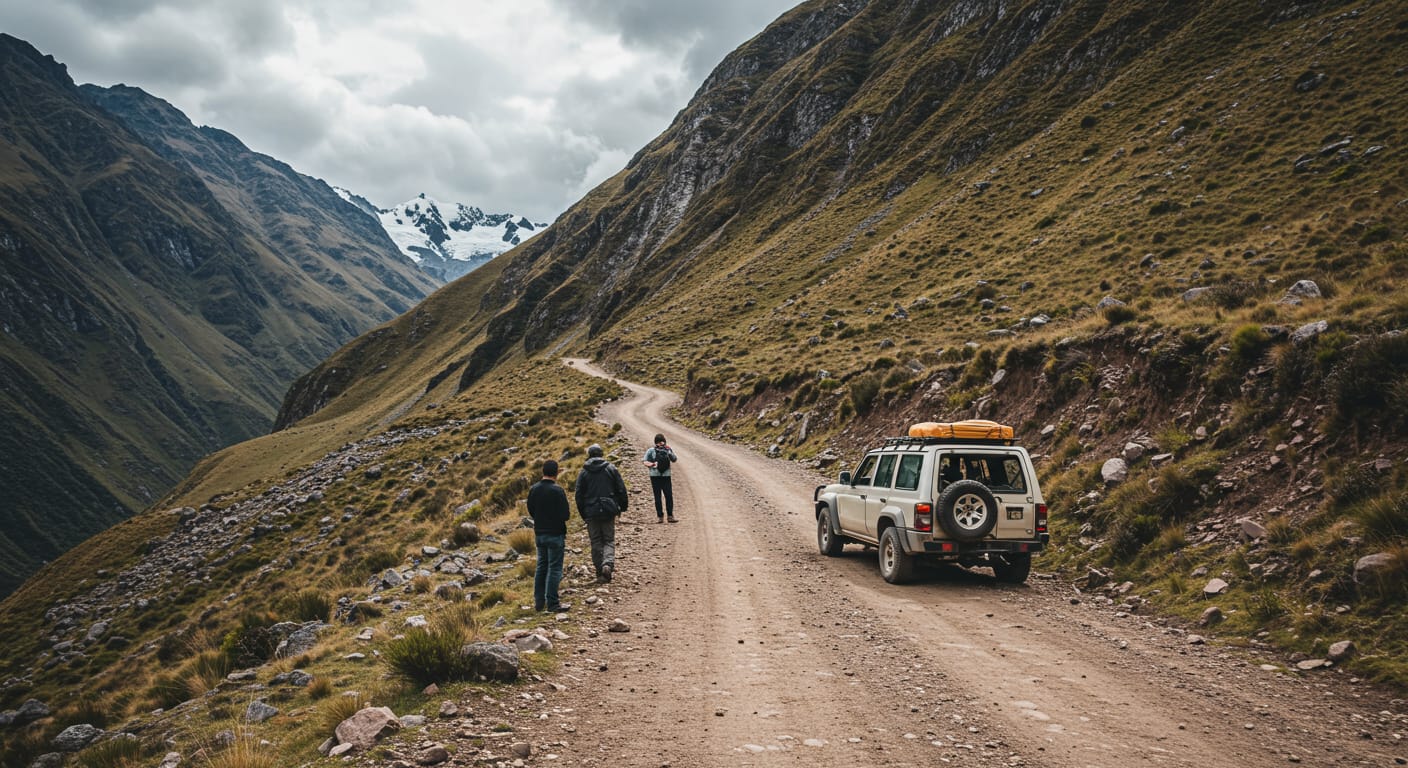
The GPS had been silent for hours, its screen showing nothing but an empty grid where roads should have been. I should have taken that as a warning.
The Road Less Traveled
Three days into what was supposed to be a straightforward drive from La Paz to Cusco, I had made the fateful decision to take the "scenic route" through the Bolivian highlands. The main highway seemed too ordinary, too predictable for someone seeking authentic South American adventure. Local mechanics had mentioned an old mining road that would cut through spectacular mountain terrain, saving nearly a full day of driving.
"It's a bit rough," one had said with a shrug that I now realize conveyed far more than his words. "But the views are incredible."
The morning had started with breathtaking optimism. At 13,000 feet above sea level, the landscape stretched endlessly in shades of rust and gold, punctuated by snow-capped peaks that seemed close enough to touch. My rented Toyota pickup handled the washboard dirt road admirably, and I felt that familiar rush of satisfaction that comes from choosing the path less traveled.
The first warning sign was the absence of other vehicles. In six hours of driving, I had seen exactly one truck heading in the opposite direction, its driver giving me a look that seemed more concerned than friendly. The second warning was my fuel gauge, which was dropping faster than it should have been due to the high altitude and challenging terrain.
When Everything Went Wrong
It happened at exactly 4:23 PM—I remember because I had just checked the time, calculating how much daylight remained. The road had been deteriorating for the past hour, transitioning from washboard dirt to loose rocks and finally to what could generously be called a trail. I was navigating around a particularly large boulder when I heard the sickening crunch of metal against stone.
The impact threw me against the driver's side window hard enough to see stars. When my vision cleared, I realized the pickup was tilted at an alarming angle, its left front wheel suspended over empty air. Below me, the mountainside dropped away into a valley so deep I couldn't see the bottom.
My heart hammered against my ribs as the full gravity of the situation crystallized. I was alone, at least 50 miles from the nearest village, on a road that maybe five people traveled in a week. The truck was precariously balanced, and any movement might send it—and me—over the edge.
The physical fear was immediate and overwhelming. My hands shook as I slowly, carefully reached for my phone. No signal, of course. The emotional realization followed close behind: I might actually die here, alone, and no one would know where to look for me.
Survival Mode
For the first ten minutes, I simply sat motionless, afraid that any shift in weight would complete the truck's journey over the cliff. But as the initial shock subsided, survival instincts kicked in. I needed to get out of the vehicle, but how?
The passenger side door was pressed against the rock face, impossible to open. The driver's side opened onto empty space. That left the rear window or waiting for help that might never come. I chose action over hope.
Moving with deliberate slowness, I crawled into the truck bed and kicked out the rear window. Each movement caused the vehicle to groan and shift slightly, but it held. I managed to squeeze through the opening and onto the relative safety of the rocky trail.
Standing on solid ground, I could fully assess the disaster. The truck's front axle was cracked, and even if I could somehow get it back on the road, it wouldn't be driving anywhere. I had perhaps two hours of daylight, temperatures that would drop below freezing after sunset, and no way to call for help.
I gathered everything useful from the truck: a sleeping bag, some food, water, a flashlight, and my passport. If the vehicle went over the edge during the night, I'd at least have the essentials. Then I started walking back the way I had come, hoping to find higher ground with cell coverage or, miracle of miracles, another human being.
Angels in the Wilderness
I had been walking for nearly an hour when I heard the distant rumble of an engine. The sound seemed impossible, like a mirage for the ears, but it grew steadily louder. Around a bend came an ancient Mitsubishi truck, loaded with what appeared to be mining equipment and driven by a weathered man in his sixties.
He stopped without hesitation, though his eyes widened when he saw me—clearly not expecting to encounter a gringo on this remote stretch. My Spanish, usually adequate for basic travel needs, suddenly felt woefully inadequate for explaining a life-threatening emergency.
"Accidente," I managed, pointing back toward my stranded vehicle. "Muy peligroso."
His name was Carlos, and despite the language barrier, he grasped the situation immediately. He drove me back to assess the truck, shaking his head gravely at its precarious position. Through a combination of gestures, basic Spanish, and remarkable patience, he conveyed that we needed more help.
Carlos had a CB radio, a piece of technology I hadn't seen in years but which proved invaluable in this remote region. He made several calls, speaking rapidly in a local dialect I couldn't follow. Within an hour, two more vehicles had arrived: another pickup truck and a van carrying six men from a nearby mining operation.
What followed was an extraordinary display of communal problem-solving. These men, who had never seen me before and would likely never see me again, spent the next four hours engineering a solution to extract my vehicle from its precarious position. They used chains, ropes, wooden planks, and mechanical knowledge passed down through generations of working in impossible terrain.
The Long Road Back
By 9 PM, my truck was back on solid ground, though clearly undriveable. The front suspension was destroyed, and the engine made ominous grinding noises. But it was no longer threatening to tumble into the abyss, and more importantly, neither was I.
Carlos insisted I spend the night at the mining camp, a collection of prefab buildings and tents that served as base for a small copper extraction operation. The miners shared their dinner—a hearty stew that tasted better than any meal I could remember—and listened patiently as I attempted to tell my story in broken Spanish.
The next morning, arrangements were made for my truck to be towed to the nearest town, a five-hour journey over roads that would challenge most vehicles. I rode in the cab with the tow truck driver, a taciturn man named Miguel who spoke excellent English and had worked for several years in mines in Nevada.
"This happens more than you think," he told me as we bounced along the mountain trails. "People see these roads on maps and think they're like highways. But out here, a small mistake can kill you."
The physical toll of the experience became apparent once I reached safety. My ribs ached from the impact, my hands were cut and bruised from crawling through broken glass, and exhaustion hit me like a wall once the adrenaline subsided. But the emotional impact was more profound.
Lessons from the Edge
That night in a small hotel in the mining town, I lay awake replaying every decision that had led to the crisis. The choice of route, the ignored warning signs, the overconfidence that had nearly cost me everything. I had always considered myself a careful traveler, but I realized how thin the line was between adventure and disaster.
The practical lessons were obvious: better preparation, communication devices for remote areas, more conservative route choices. I would never again venture into truly isolated terrain without satellite communication and detailed local knowledge. The romantic notion of disappearing into unmapped territory had lost much of its appeal.
But deeper reflections emerged over the following days. The experience had stripped away all the non-essential concerns that usually occupy my mind, reducing existence to its most basic elements: survival, safety, human connection. In those hours of genuine mortal fear, career anxieties, relationship troubles, and financial worries had simply evaporated.
Most profoundly, I had witnessed extraordinary kindness from complete strangers. Carlos and the miners had no obligation to help me, yet they had spent their entire evening and considerable resources to extract a foreign stranger from a predicament of his own making. They had asked for nothing in return, though I insisted on paying for fuel and materials.
This generosity challenged many of my assumptions about human nature and cultural differences. Despite language barriers and vastly different life circumstances, these men had immediately recognized a fellow human being in distress and responded with compassion and competence.
The experience also revealed my own resilience in ways I hadn't expected. When faced with genuine life-or-death choices, I had been able to think clearly and take decisive action. The panic had been real, but it hadn't been paralyzing. There was something valuable in learning that about myself, even at such a high cost.
Months later, safely back in more familiar territory, I still think about that remote South American road. Not with trauma or regret, but with a complex mixture of gratitude and hard-earned wisdom. I had traveled to the very edge of my own mortality and somehow found my way back, helped by the kindness of strangers and a stubbornness I didn't know I possessed.
The road less traveled had indeed made all the difference, just not in the way Robert Frost had imagined.