Meet the Aya Uma, the Two-Faced, Twelve-Horned Andean Spirit Linked to Ecuador’s San Juan Dances
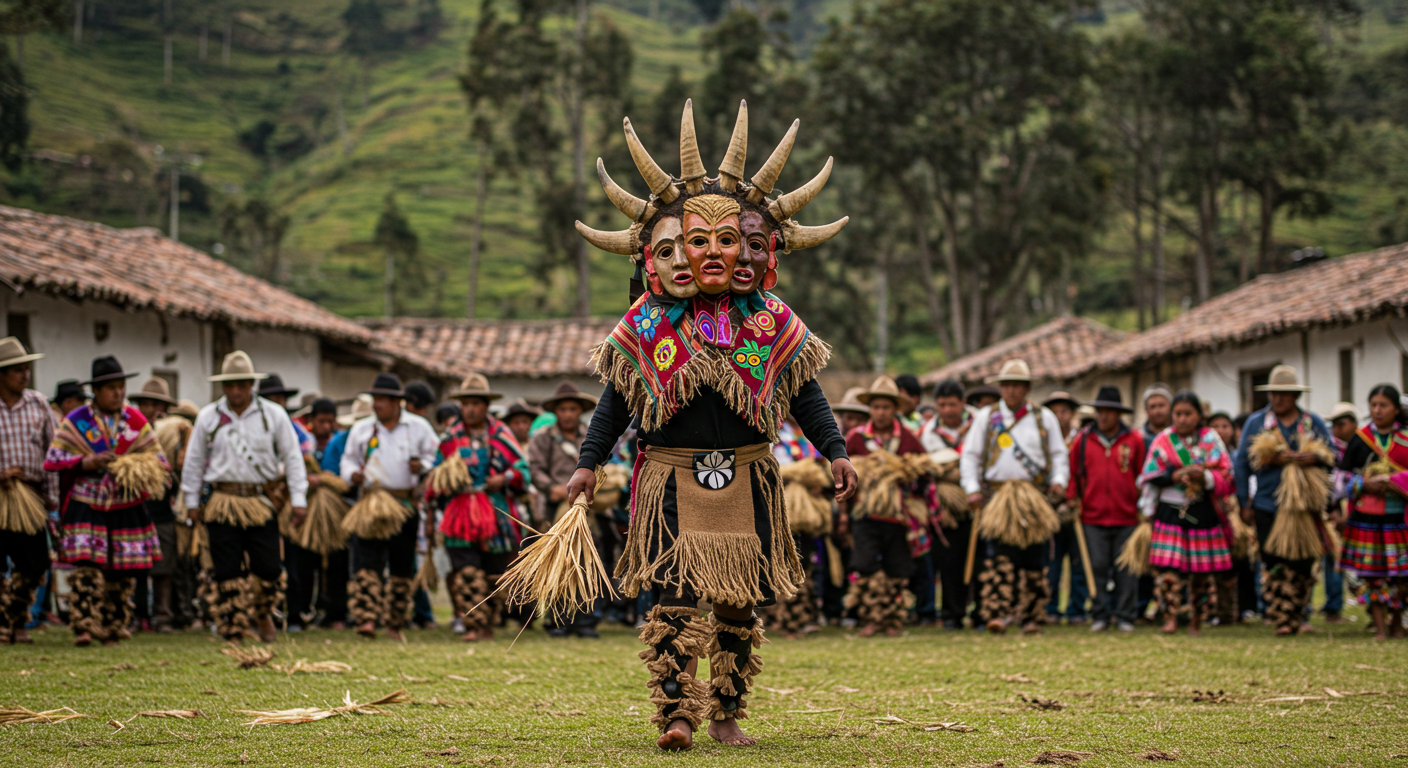
Among the most visually memorable figures in Andean celebrations in Ecuador is the Aya Uma, a character often described in popular retellings as two-faced and crowned with twelve horns. Even so, those details deserve care. In festival culture and folklore, names, costumes, and meanings can shift from one community to another, and no single version tells the whole story.
The Aya Uma is commonly linked to San Juan and related seasonal festivities in the northern Andes. Rather than treating the figure as a fixed historical fact with one official explanation, it makes more sense to see it as part of a living tradition shaped by dance, memory, and local interpretation.
Who Is the Aya Uma?
The Aya Uma is widely recognized as a ceremonial or folkloric figure in Indigenous Andean celebration, especially in places where festival traditions remain closely tied to agricultural cycles and communal identity. Depending on who is describing it, the figure may be understood as a dancer, a ritual presence, a symbolic guardian, or a character that connects celebration to older spiritual ideas.
Descriptions of the Aya Uma often emphasize a dramatic mask or headdress and a presence that stands apart from ordinary festival costume. But as with many traditions passed down through generations, the details are not always standardized. The image of a two-faced, twelve-horned being is part of the story many people tell, yet the symbolism behind those features may differ by region, community, and family tradition.
Why This Figure Stands Out in Festival Culture
What makes the Aya Uma so compelling is not only its appearance, but the role it seems to play in the atmosphere of a festival. In Andean celebrations, costume is rarely just decoration. It can signal status, memory, protection, transformation, or a link between the everyday world and the ceremonial one.
That is part of why the Aya Uma captures visitors’ attention so quickly. The figure seems to gather many layers into one presence: performance, spirituality, local pride, and inherited knowledge. To an outsider, it may first look theatrical. To community members, it may hold meanings that are social, historical, and deeply personal all at once.
The Meaning Behind the Two Faces and Twelve Horns
The best way to approach the reported imagery of two faces and twelve horns is symbolically rather than literally. In many traditional cultures, unusual visual elements express ideas rather than physical description. A double face may suggest duality, watchfulness, or the ability to look in more than one direction at once. Horns may evoke strength, protection, rank, or the passage of time.
Some readers may encounter interpretations that connect the two faces to balance: past and future, day and night, or the visible and invisible worlds. The twelve horns are sometimes linked in popular explanations to cycles, possibly including the months of the year or the rhythm of agricultural time. Still, these are interpretations, not settled facts, and local meanings may vary significantly.
That variation does not weaken the tradition. If anything, it shows how folklore stays alive. A symbol can endure precisely because communities continue renewing its meaning across generations.
How Aya Uma Fits Into Ecuador’s San Juan Harvest Dances
The Aya Uma is often associated with San Juan festivities and related dance traditions in the Ecuadorian Andes, where communal celebration has long been tied to land, weather, harvest, and seasonal transition. In that context, dance is not merely entertainment. It can be a way of marking time, honoring continuity, and bringing the community together in visible, public form.
Figures like the Aya Uma are often said to appear in processions, dances, or festival gatherings where movement, music, and costume all carry meaning. These celebrations may blend Catholic feast-day calendars with much older Andean understandings of cyclical time and communal obligation. That blending is common across the Andes, though the exact form it takes is always local rather than uniform.
It is important not to flatten these practices into one nationwide story. What San Juan means in one town may not be exactly what it means in another, and the role of a festival character can change with geography, language, and history.
More Than a Costume: Ritual, Identity, and Community
One reason figures like the Aya Uma matter is that they carry more than visual symbolism. They can also serve as vessels for Indigenous memory and local identity. A festival character is not just worn; it is inhabited, interpreted, and recognized by the people around it.
That gives the tradition a social life beyond the dance itself. Children grow up seeing it. Elders explain it. Families prepare for it. Musicians, dancers, and artisans all help make it real each year. In that sense, the Aya Uma is best understood not as a relic from the past, but as part of a living cultural system that continues to be performed and redefined.
For communities that have had to defend language, land, or heritage over time, festival expression can also become a powerful form of visibility. The celebration says: we are still here, and this meaning still belongs to us.
What Visitors and Expats Often Miss
Many visitors first notice the spectacle: the mask, the movement, the energy of the procession. What can be harder to see at first is the depth behind the image. Figures like the Aya Uma are often approached too quickly as curiosities, when they make more sense as part of a broader world of ceremony, agriculture, kinship, and place.
For expats living in Ecuador, respectful curiosity goes much further than instant interpretation. Instead of assuming that every striking costume has a single myth attached to it, it helps to ask how local people describe the figure, what they say it means, and why it matters now. Those answers may be layered, and they may not always match what appears in travel summaries or casual online retellings.
Listening locally matters because traditions like this are still lived. They are not frozen exhibits. They belong to communities that continue to shape them.
Why the Story of Aya Uma Deserves Careful Telling
The Aya Uma is fascinating precisely because it sits at the intersection of image, ritual, and memory. But fascination should not become simplification. Without careful sourcing, it is better to present the figure as it is commonly understood in tradition rather than declare one final origin story or one definitive symbolic code.
Folklore does not lose value because versions differ. In many cases, that variation is part of the truth. Different communities preserve different emphases, and those differences show how culture stays alive over time.
For readers drawn to Ecuador’s festival world, the Aya Uma offers an invitation: look beyond the mask, ask better questions, and let local voices lead the explanation. The result is not just a more accurate story, but a more respectful one.