Marcantaitas, Dancing Bears, and Ajas: Saraguro's Month-Long Christmas Season
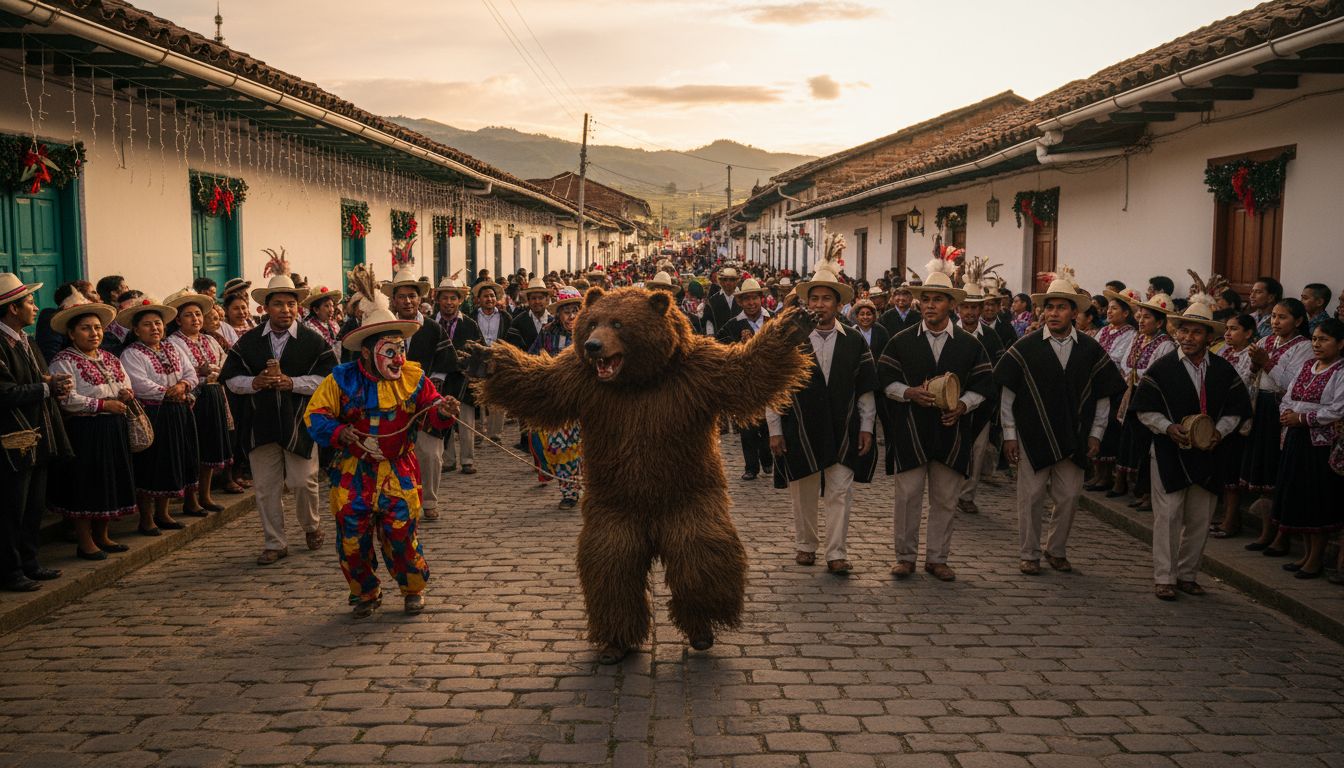
In the highlands of Loja Province, southern Ecuador, the town of Saraguro observes a Christmas season unlike the shorter, more commercialized holidays familiar to many visitors. Here, the celebration unfolds over nearly two weeks, beginning on December 25 and continuing through January 6, the Feast of the Epiphany. Many observers note that this extended season reflects a deep blending of Catholic liturgical tradition with longstanding Andean indigenous customs. Among the figures most associated with the festivities are the Marcantaitas, the costumed Dancing Bears, and the ritual characters known as Ajas — three threads woven into a celebration that locals have maintained across generations.
Setting the Scene: Saraguro's Cultural Identity
The Saraguro people are a Kichwa-speaking indigenous group known throughout Ecuador for their distinctive dress, strong communal identity, and reputation for preserving traditions that have faded elsewhere in the country. Settled largely in the canton that bears their name within Loja Province, the Saraguro have long been recognized by anthropologists and travelers alike as a community where cultural continuity remains a visible, daily practice rather than a historical footnote.
It is this reputation for preservation that makes Saraguro's Christmas season stand out from the more generic, retail-driven holiday atmosphere found in many Ecuadorian cities. A recurring theme among those who write about the region is that the season functions less as a shopping event and more as a sustained communal ritual. Some specifics of these customs are best understood as general cultural background rather than precisely verified detail, and readers interested in deeper confirmation are encouraged to seek out local, firsthand accounts.
Marcantaitas: Ceremonial Godparents of the Season
Among the central figures of the Saraguro Christmas season are the Marcantaitas, whose name and role suggest a connection to godparenthood traditions found throughout the Andes. In many Andean communities, ceremonial godparents — sometimes called padrinos or madrinas depending on context — take on responsibilities tied to specific festival roles, sponsoring events, overseeing ritual objects, or guiding younger participants through customary practices.
The precise function of the Marcantaitas within Saraguro's festivities appears to draw on this broader compadrazgo tradition, a system of ritual kinship that extends family bonds beyond blood relations into the wider community. The exact scope of their duties during this particular season would benefit from further verification through direct community sources. What can be said with more confidence is that such figures typically reinforce social cohesion, formalizing relationships of mutual obligation and care that persist well beyond the holiday itself.
Dancing Bears: Costumed Performers in Procession
A particularly striking element of the season is the appearance of costumed performers dressed as bears, a tradition found in various forms across Andean festival culture. These "Dancing Bears" are understood to be community members who take on the bear persona for processions and ritual dances, often moving through town in choreographed or semi-improvised routines that draw crowds of onlookers.
Symbolically, bear figures in Andean festivals are frequently linked to themes of nature, wildness, and the turning of the seasons, sometimes tied to harvest cycles or the taming of untamed forces as a metaphor for order within community life. In Saraguro, these performances likely serve both an entertainment function and a deeper communal bonding role, drawing families and neighbors together in shared spectacle. A recurring observation among those familiar with similar Andean traditions is that such costumed processions help transmit cultural memory to younger generations through direct participation rather than passive instruction.
Ajas: Masks, Figures, and Ritual Characters
Alongside the Marcantaitas and Dancing Bears, the Ajas represent another layer of the celebration's ritual texture. Described broadly as masked or costumed figures, the Ajas appear to occupy a ceremonial role whose precise meaning remains somewhat elusive without deeper local documentation. Many observers suggest that such masked characters in Andean festivals often carry symbolic or spiritual weight, representing ancestral spirits, seasonal forces, or moral lessons enacted through performance.
The uncertainty surrounding the exact definition of the Ajas invites curiosity rather than firm conclusion. Comparable masked figures appear in festival traditions throughout the Ecuadorian and broader Andean highlands, often serving as intermediaries between the sacred and the everyday, or as figures of mild mischief that break up the solemnity of formal ritual. Readers interested in the specific iconography and meaning of the Ajas in Saraguro are encouraged to consult community members or regional cultural organizations directly, as this remains an area where firsthand testimony would add valuable clarity.
Syncretism: Where Catholic and Kichwa Traditions Meet
Saraguro's extended Christmas season is perhaps best understood through the lens of religious syncretism — the blending of Spanish Catholic liturgical observance with pre-existing indigenous spiritual practice. The arc from Christmas Day to the Feast of the Epiphany, commemorating the visit of the Three Kings, provides a Catholic calendar framework onto which Andean customs such as the Marcantaitas, Dancing Bears, and Ajas appear to have been layered over generations.
This pattern is not unique to Saraguro; across the Ecuadorian Andes, similar fusions of Catholic feast days with indigenous ritual forms are common, reflecting centuries of negotiation between colonial religious imposition and local cultural resilience. What makes Saraguro notable, according to many who study or visit the region, is the apparent vitality and visibility of these blended practices, which continue to be performed openly rather than relegated to private or diminished observance.
Experiencing the Season: What Visitors and Expats Might Encounter
For an outside observer, a visit to Saraguro during this season likely offers a markedly different holiday atmosphere than that found in larger Ecuadorian cities or in many Western Christmas traditions. Rather than retail displays and commercial events, visitors might encounter a steady rhythm of community gatherings, processions, and ritual performances unfolding over nearly two weeks.
Expats and travelers interested in experiencing these traditions are encouraged to approach the season with respect and humility, recognizing that these are living community practices rather than staged tourist attractions. Those who wish to witness the Marcantaitas, Dancing Bears, or Ajas in person would do well to seek guidance from local residents or cultural organizations about appropriate ways to observe and participate without disrupting the customs themselves. Many who have spent time in similar Andean communities note that the value of such experiences lies precisely in their non-commercialized, community-centered nature — a quality increasingly rare in an era of globalized holiday culture.
Conclusion: Preserving Tradition Through Generations
Saraguro's month-long Christmas season, anchored by figures such as the Marcantaitas, the Dancing Bears, and the Ajas, stands as a vivid example of how faith, community, and indigenous identity can intertwine across generations. Amid the broader pressures of modernization and cultural homogenization, the continued observance of these customs suggests a community actively choosing to maintain its distinct heritage rather than allow it to fade.
For readers and travelers alike, Saraguro's celebrations offer an invitation: to seek out these living traditions with curiosity and respect, and to recognize the enduring strength of a community that continues to write its own cultural story.